

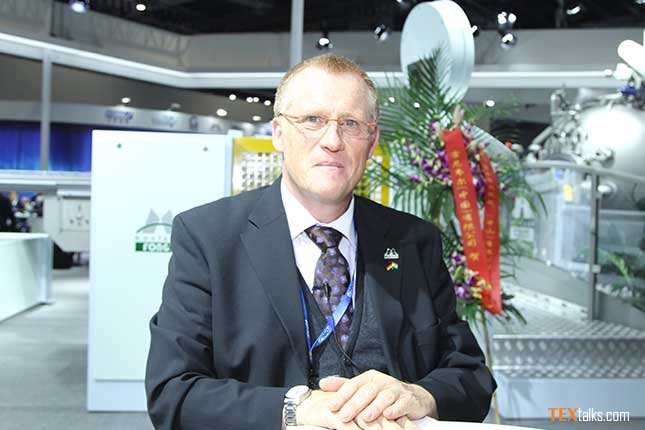
Hans Wroblowloski, Head of Denim Finishing Technology, Monforts Textilmaschinen GbmH&Co KG., talking to TEXtalks told that Monforts is contributing mainly in weaving sector of textile since 1884 in the beginning that have developed Skim preparation, Raising and Sharing Machines. In early 50’s Monforts brought first Motor locks Search for centrist they have developed dying machines and continuous dying machines. For power saving we are using 4.0 as standard of Internet protocol version 4 (IPv4) which is leading the textile weaving skimming and dying process with great optimization and efficient functionality and less time consumption.
Monforts was founded in 1884 by August Monforts, a long story. We started first with mechanical workshop then which shifted to textile with Raising and Sharing Machines. The first order was for a “napping machine for textile fabrics with five rollers”, but in 1891 Monforts then developed the first 24-roller napping machine which led to a significant improvement in the napping process. In 1897 August Monforts established an iron foundry which – equipped with hydraulic casting machines. In 50’s, we started the stenters which we till today doing for difference type of applications. Further we developed dyeing machines, continuous dyeing machines. We also manufacture machines for technical textiles. We are in the wide field of textiles today.
Answering to a question for the new developments at ITMA Asia, Hans Wroblowloski told, “two main developments we have bought in, especially for energy saving. We brought new technology of Eco Applicator, where we really assure the minimize application of humidity including chemistry so that not further more energy is be use to dry or to fix all this kind of chemistry on the fabrics. So at least upto 50% savings can be reach in a shift during the processing and the second one is the developing a dyeing process likes e-control and by fine tuning even for polyester cotton fabrics we have now two steps dyeing process made in one. So that opens a door to save the chemistry, time and opens a door for more productivity for the customer.
About the industry 4.0, Hans Wroblowloski told, “I am working for 12 years on industry 4.0 and the machines are equipped with many possibilities who are fulfilling already these kind of standards. Meeting people standard having different minds, one of mind is of course to optimize efficiency, productivity so that overall cost deduction for producers or consumers later on can be shift but the main point is that all is we have lot of data involved more knowledge is involved so these people can today store this kind on knowledge and they can restore and they can recall it even for quality reasons that give us opportunity to say we have a big data system. I am not saying internet, every where you can data store brought in that is todays ways in industry 4.0.
Let us clear the power savings of course if you talk about electronic power we are using todays new standards got the (3.34) already by the use of this special kind of motors upto 10 and 15% of energy by power but if you talk about general savings then we to look into by application systems as less humidity to use as less steam or dry capacity use and what is the major cost do even factor in production heat sources also drying heat setting all this kind of unit heat and steam and oil is be needed to get fabrics dry that is the mind keep on how to save of course cost that is our focus on we are really focus on that to save sources in the production.
Some kind of ecological function where we also assure that of course never more used as chemistry is be needed. We are not wasting something we put all these items there where it be really use for fabrics. So that is one case the other thing is energy we are using the energy also only on the fabric side and we are not blowing it somewhere sot therefore we have of course in the standard special kind of isolation we have also special kind of circulation systems so that the heat is always in contact with the fabric himself that is normally our code blue competent as well. In dying section this is little bit different. In dying we are looking to the sources as well that we save lt it say dye pigments getting good results, fastness. Then even after the garment wash not too many of (5.29)
into water so therefore we are really looking in this kind of ecological function.
for many time the machines use always (5.45) because as you know in denim everywhere somewhere this kind of (5.51) material must be (5.52) to get direction of the design fact is that we have degrees (5.57) be used in previous machines ten times less now so as a figure four thousand new looms only for four hundred new looms for get the same results so that opens a door of course even for sensitive material which was not to run before so that is one big goal then we combined our demonstrate unit (6.20) corrections, stew corrections even conditioning for heat set material we make three processing in one so that is of course the feature of all because we don’t need (6.33) steps and then the application in the machine we do in one and we do it in that position where that’s be needed and that was really the goal now for opening the flexibility for elastic material for combine material, for printed material even for new functional processing. And that was the in denim right now we can see how fashion can moving denim that was the door opener for denim.
