

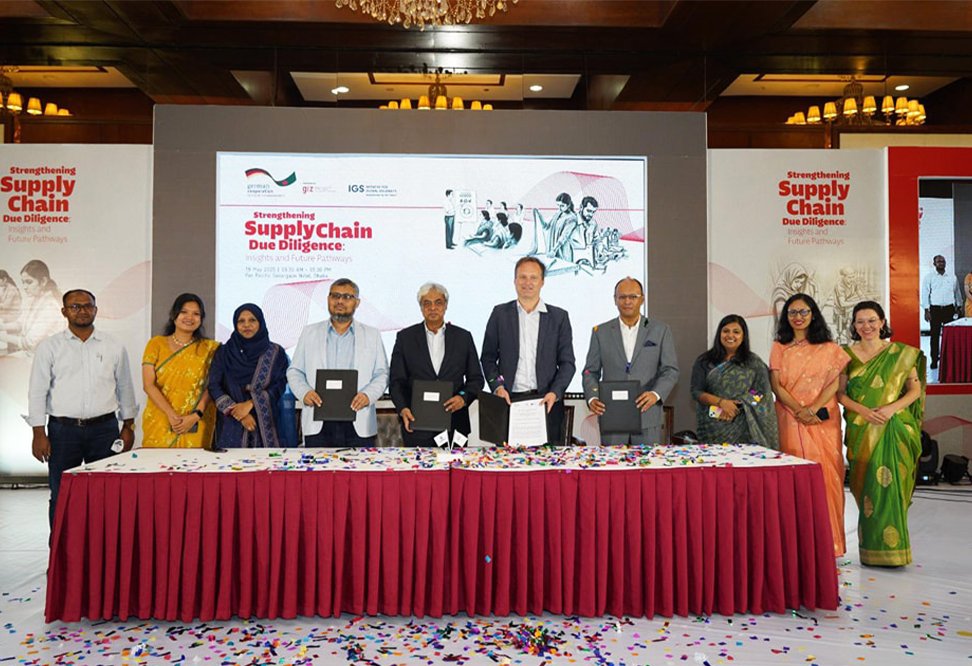
The May 2026–February 2028 partnership targets the issues now shaping sourcing decisions: EU readiness, energy efficiency, circularity, worker protection and waste transparency.
The Bangladesh Garment Manufacturers and Exporters Association and Germany’s international cooperation agency GIZ have signed a strategic Memorandum of Understanding to support the sustainable transformation of Bangladesh’s ready-made garment sector. The agreement, signed at the BGMEA Complex in Uttara, Dhaka, will run from May 2026 to February 2028 and is described as the first formal MoU between the two organisations dedicated specifically to the sector’s comprehensive development.
EU compliance moves to the centre
The partnership is designed to help factories prepare for emerging European market requirements around supply-chain due diligence, traceability, circularity and decarbonisation. The Responsible Business Helpdesk will also receive institutional support, giving manufacturers a more structured route to understand and respond to buyer and regulatory expectations.
Implementation will involve BGMEA and GIZ working with the Ministry of Commerce, Export Promotion Bureau and Department of Environment. This coordination matters because Bangladesh’s compliance agenda now cuts across export policy, factory operations, environmental regulation and buyer assurance.
Energy, chemicals and circularity
Several GIZ-backed programmes will operate under the agreement, including STILE II, SCAIP, SOSI, CIRCLE, Energy Efficiency for Development, TVET for Renewable Energy and Skills for Sustainable Employment. The work will cover chemical management, pollution reduction, energy audits, renewable-energy skills, worker social-protection databases and improved textile-waste management.
One commercially important element is the proposed digital marketplace for garment waste, or jhut. If executed well, it could improve transparency in a waste stream that is increasingly relevant to recycled-fibre production, circularity claims and export-market credibility.
Governance will decide impact
BGMEA Vice President Vidiya Amrit Khan will act as focal point for German technical cooperation, while GIZ will coordinate with BGMEA’s specialised groups on circularity, decarbonisation, energy efficiency, data and responsible business practices.
The next test is factory-level adoption. The MoU will matter most if it produces measurable gains: lower energy use, cleaner chemical practices, credible traceability data, stronger worker protection systems and commercially usable circularity infrastructure.
