

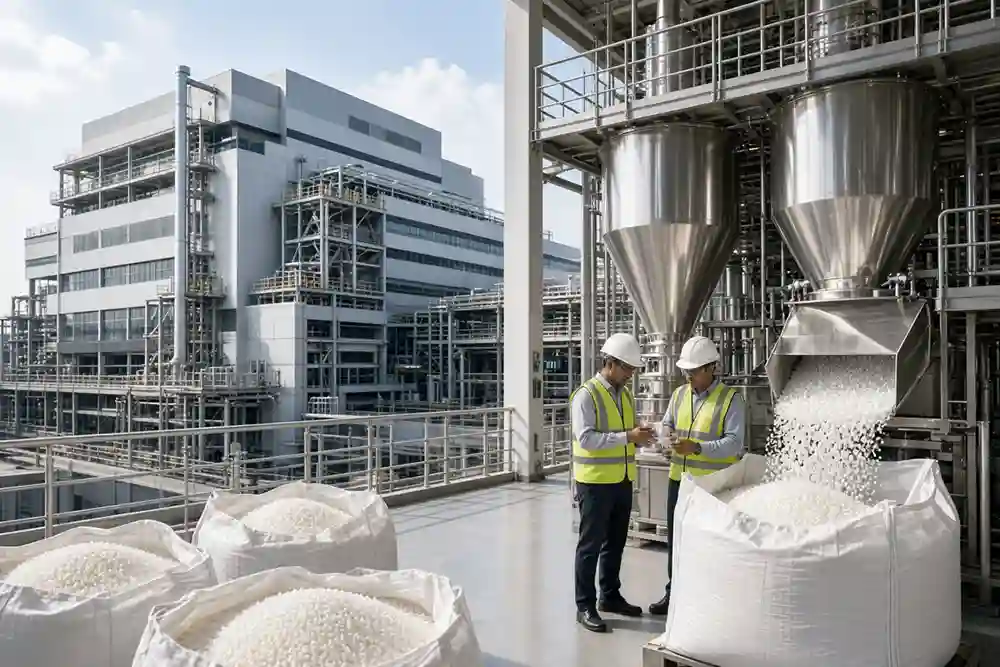
Modern Syntex will almost quadruple polyester-chip capacity, strengthening Bangladesh’s backward integration into man-made fibres as apparel demand shifts beyond cotton.
The Asian Development Bank has signed a $50 million loan with Modern Syntex Limited (MSL) to expand polyester-chip manufacturing in Bangladesh, marking a significant investment in the country’s upstream synthetic-textile supply chain. MSL is part of TK Group and operates in the Mirsarai Economic Zone near Chattogram.
Capacity jumps from 107 to 407 tonnes a day
The project will expand MSL’s polyester-chip capacity from 107 tonnes to 407 tonnes per day, an increase of roughly 280%. The new plant will produce high-intrinsic-viscosity polyester chips for higher-value textile and apparel applications, while part of the financing will refinance short-term local working-capital facilities. Commercial operation of the expanded capacity is targeted for 2027.
ADB says Bangladesh still depends heavily on imported synthetic textile inputs. Increasing domestic polyester production should therefore shorten supply chains, improve input availability and strengthen backward linkages for yarn, fabric and apparel manufacturers.
Energy efficiency built into expansion
The project will introduce energy-efficient machinery expected to save around 4,840 MWh of electricity annually and avoid approximately 2,222 tonnes of CO₂e emissions per year. MSL will also pursue LEED Platinum certification for the expanded building and factory.
ADB’s environmental assessment additionally identifies wastewater, hazardous materials, occupational health and safety, process safety and climate resilience as areas requiring continued management through an agreed action plan.
Pakistan competitiveness takeaway
The investment highlights a strategic gap for Pakistan. Pakistan’s own textile policy has long identified man-made fibres and filaments as an underdeveloped export value chain, while recent government-industry consultations continue to emphasise synthetic-fibre competitiveness, diversification and scale.
As Bangladesh expands upstream polyester capacity, Pakistan risks losing further ground in MMF apparel, sportswear, performance textiles and technical textiles unless domestic polyester investment, competitive feedstock access and downstream product development accelerate.
The important signal is not the $50 million loan alone: Bangladesh is deliberately reducing imported-input dependence while positioning its textile industry for a global fibre mix increasingly driven by synthetics.
