

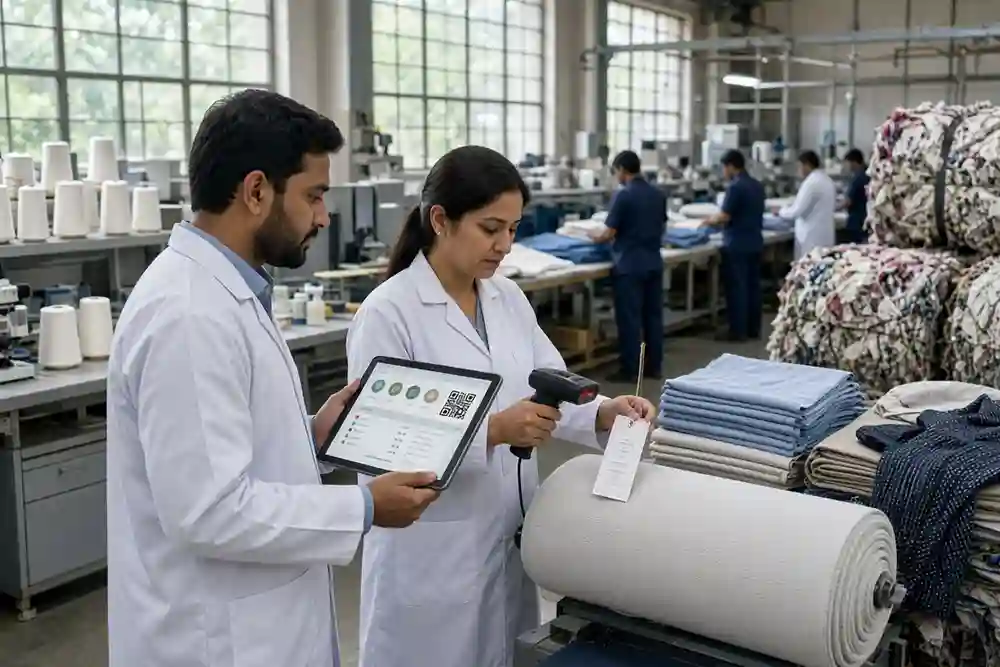
Europe’s shift towards ecodesign, textile EPR and Digital Product Passports is turning traceability, recyclability and product-level data into competitive requirements for Pakistani exporters.
Pakistan’s textile industry faces a new phase of EU market compliance as Europe moves from broad sustainability ambitions toward product-level circularity, traceability and waste-management rules. The transition is commercially significant because the EU is Pakistan’s second-largest trading partner, with bilateral goods trade of €12.2 billion in 2025, while more than 85% of Pakistani exports enter the bloc duty- and quota-free under GSP+.
Around 89% of EU textile and clothing imports from Pakistan currently receive preferential tariff treatment, making continued European competitiveness particularly important.
DPP moves closer to textiles
Textiles are a priority category under the EU’s Ecodesign for Sustainable Products Regulation (ESPR). The European Commission currently plans to adopt textile-specific ecodesign and Digital Product Passport requirements in Q4 2027.
Potential DPP information includes product identity, fibre composition, compliance documentation and other lifecycle information relevant to repair, reuse and recycling. Economic operators will receive a transition period of at least 18 months after the relevant delegated act is adopted, so the requirements are not expected to become mandatory for textiles immediately in 2027.
Waste rules add another layer
The revised EU Waste Framework Directive, effective since October 16, 2025, requires member states to establish harmonised Extended Producer Responsibility schemes for textiles and footwear. Producers will finance collection and management of used and waste textiles.
This will increase pressure on brands to understand material composition, recyclability and downstream treatment—requirements that will inevitably travel upstream to supplying mills and garment factories.
Pakistan competitiveness takeaway
Pakistan already has advantages in cotton recycling, spinning waste recovery and vertically integrated manufacturing, but much of this capability remains fragmented and poorly documented.
The priority is therefore not simply buying recycling machinery. Exporters need digital material traceability, structured product data, verified recycled-content chains, fibre-composition accuracy, chemical records and product-level environmental information.
The competitive risk is clear: GSP+ preserves tariff access, but it will not compensate for weak data capability. As EU buyers integrate circularity into sourcing, suppliers that can prove what a product contains, where inputs originated and how the product can be recovered or recycled will increasingly have the advantage.
