

An insect-blocking spacer fabric developed from military-textile research could open a new high-value market for knitted technical textiles in crop protection—but commercial farm validation is still required.
Researchers at North Carolina State University have developed a three-dimensional knitted crop cover that increased harvestable strawberry production by as much as 3.56 times in tunnel-field trials while maintaining light access and relative humidity. The peer-reviewed study was published in Agriculture in September 2026.
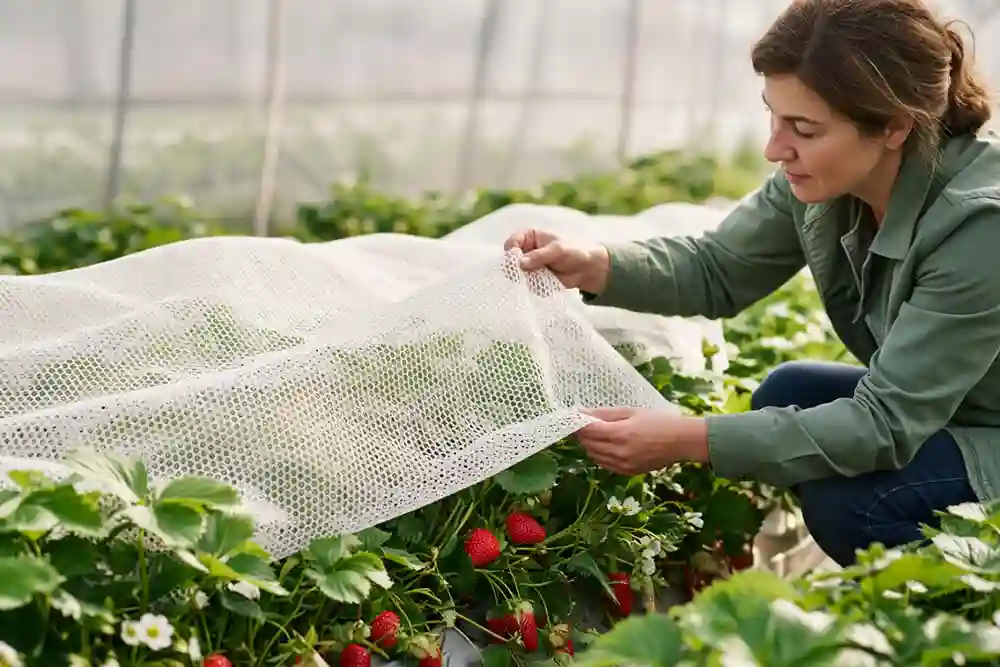
Known as Plant Armor Gen 2, the porous spacer textile is draped directly over plants. Its multilayer architecture creates a tortuous physical pathway that makes insect penetration difficult while allowing air, rainfall and sunlight to pass through.
Textile structure does the work
Earlier NC State material characterisation shows Plant Armor Gen 2 uses 70-denier polyester multifilament containing 0.05% TiO₂ in its outer layers and 9-denier polyester monofilament internally. The fabric was produced on a Jacquard spacer-knitting machine and weighed approximately 14.6 g/m².
The technology emerged unexpectedly from research into military textiles designed to prevent mosquito bites while improving comfort beneath body armour.
Yield gain comes from microclimate
Researchers found no significant reduction in available light and no increase in vegetative biomass at the expense of fruit. Instead, the textile consistently raised temperature around the crop, increasing accumulated growing degree-days and allowing plants to reach fruiting stages sooner. Fruit number and total fruit weight both increased significantly.
Laboratory testing also recorded complete aphid exclusion, supporting the technology’s potential to reduce pesticide dependence. However, the latest study did not quantify actual pesticide or irrigation savings, so those benefits remain prospective rather than demonstrated.
Agrotextiles gain a higher-value role
Plant Armor illustrates an important opportunity for technical-textile manufacturers: crop covers can move beyond simple shade nets and frost protection toward engineered microclimate management, pest exclusion and yield enhancement.
The technology is patented by NC State and licensed for commercial development. The next decisive step is multi-location on-farm testing to determine durability, economics, crop compatibility and whether the 3.56× yield improvement can be reproduced under commercial conditions.
