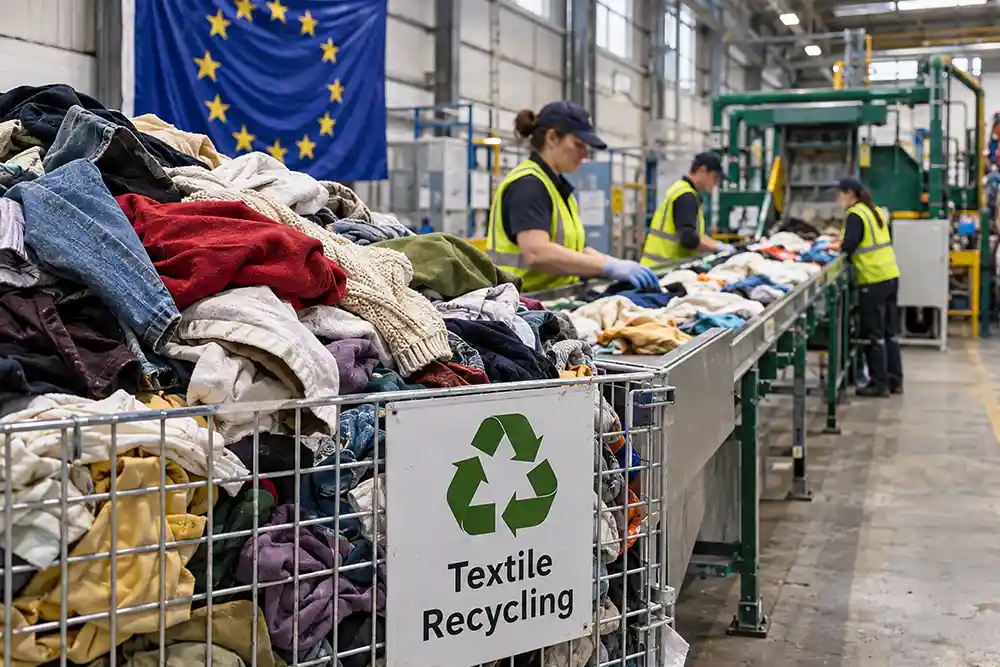
New Eurostat data reveal major differences in textile waste treatment across Europe, reinforcing the need for better collection, recycling infrastructure and producer responsibility systems.
The European Union generated 2.3 million tonnes of textile waste in 2024, with households accounting for more than half, according to Eurostat figures released on November 12, 2026.
Of this amount, approximately 1.4 million tonnes underwent waste treatment, equivalent to 63% of the waste generated that year. The findings expose significant differences in textile waste management across member states as the EU strengthens its circular economy regulations.
Italy Leads Textile Waste Generation
Italy recorded the largest textile waste volume at 441,736 tonnes, followed by France with 339,965 tonnes and Germany with 212,107 tonnes.
Italy also reported the highest treatment and recycling volume, at 280,680 tonnes. France treated 258,129 tonnes, while Germany processed 207,156 tonnes.
Across the EU, recycling represented 78% of treated textile waste. Another 13% underwent incineration with energy recovery, 8% was landfilled and 1% was incinerated without energy recovery.
Recycling Performance Varies Sharply
Italy and France reported recycling rates of 98% of their treated textile waste, followed by Lithuania at 87% and Slovenia at 83%.
However, Latvia recorded no recycling within its reported treatment operations, Estonia achieved 5%, and Romania reported 23%, based on 2022 data.
These percentages apply to waste undergoing treatment, not total discarded textiles. They also do not distinguish fibre-to-fibre recycling from other recycling processes.
EU Producer Responsibility Rules Raise the Stakes
The revised EU Waste Framework Directive, effective October 16, 2025, requires member states to establish extended producer responsibility (EPR) schemes for textiles and footwear.
Producers will finance collection and waste management through fees that can reflect product durability and recyclability.
Member states have 20 months to transpose the directive and 30 months to establish EPR schemes.
For textile manufacturers, recyclers and fashion brands, the emerging priorities include improved fibre identification, material traceability, sorting technologies and recycling-compatible product design.
The next commercial test will be whether new collection obligations and producer-funded systems generate sufficient investment in industrial recycling capacity while creating reliable demand for recycled textile fibres.