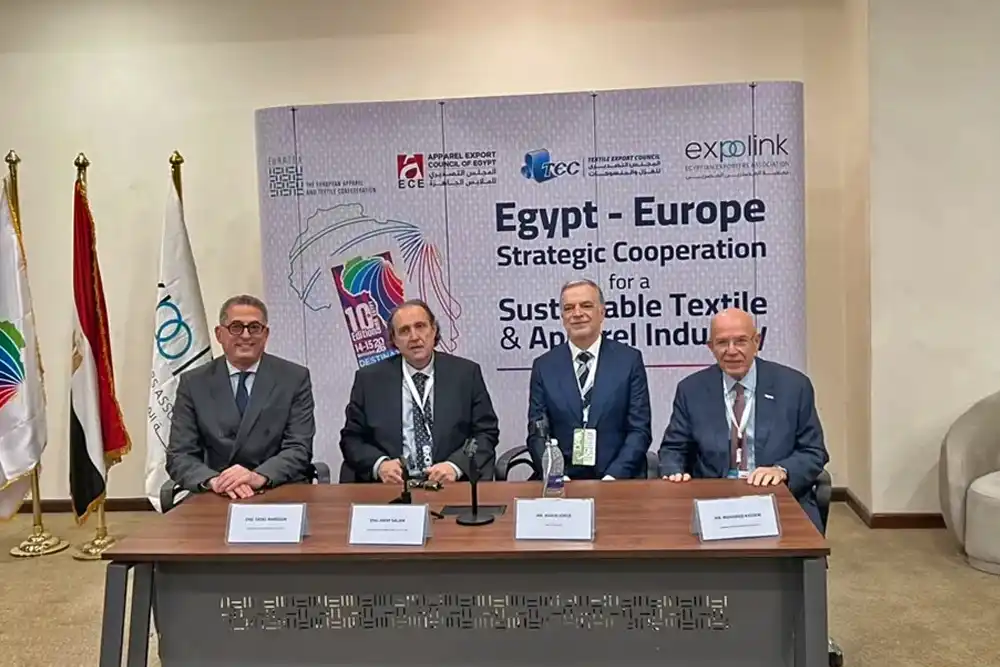
The partnership will help Egyptian textile and apparel manufacturers prepare for EU sustainability regulations while promoting industrial investment, technology transfer and stronger Euro-Mediterranean supply chains.
The European Apparel and Textile Confederation (EURATEX) has signed a cooperation agreement with three Egyptian industry organisations to strengthen textile and apparel trade, facilitate investment and improve manufacturers’ readiness for European sustainability requirements.
Signed on November 14, 2026, during Destination Africa in Cairo, the memorandum of understanding brings together EURATEX, the Apparel Export Council of Egypt (AEC), the Textile Export Council of Egypt (TEC) and the Egyptian Exporters Association (EXPOLINK).
EU compliance becomes a priority
The agreement identifies regulatory cooperation as a central objective, particularly concerning circularity, textile waste management and Digital Product Passports (DPPs).
The organisations will support Egyptian manufacturers in understanding European requirements and adopting more sustainable production practices.
They will also advocate for an Industrial Greening Fund to finance industrial transformation. The fund remains a proposal; no financing commitment or investment amount has been announced.
Investment, technology and skills
The partnership will facilitate business contacts between European and Egyptian manufacturers, encourage joint investments and address customs-related challenges.
Other priorities include technical knowledge exchange, workforce training and potential participation in European research and industrial projects.
A Joint Committee on Textiles and Clothing will meet at least twice annually to establish priorities, develop projects and monitor implementation.
Egypt’s growing European trade opportunity
The agreement builds on established commercial ties. EU–Egypt merchandise trade reached €32.3 billion in 2025, with Egypt exporting €12.3 billion in goods to the European market.
The EU–Egypt Association Agreement, effective since 2004, already provides a framework for preferential industrial trade.
Trade and Economic Security
For Egyptian textile exporters, closer cooperation could support access to European buyers increasingly demanding reliable product information, traceability and environmental performance data.
The immediate test will be whether the partnership delivers funded industrial projects, practical regulatory training and measurable improvements in manufacturing competitiveness.
For other textile-exporting countries, including Pakistan, the agreement also illustrates Europe’s interest in linking sourcing relationships with supplier sustainability capabilities and industrial cooperation.