

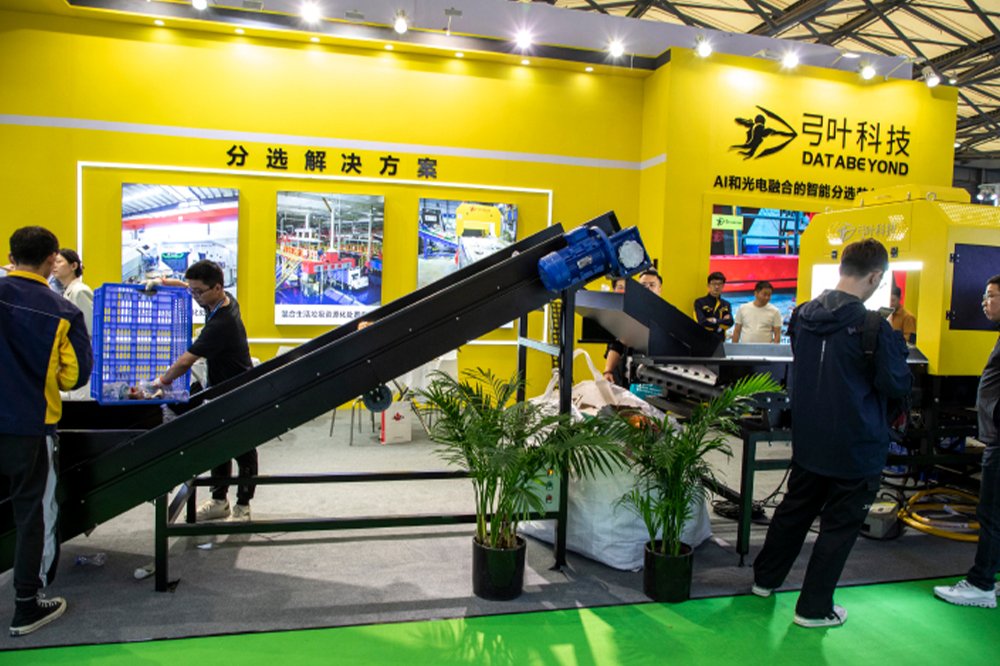
Fastsort-Textile does not solve textile waste on its own, but it tackles one of the industry’s hardest operational problems: separating mixed post-consumer waste fast enough, and accurately enough, to make recycling more viable.
In Zhangjiagang, a coastal industrial city in eastern China, an AI-based sorting line is showing how automation could reshape textile recycling economics. DataBeyond’s Fastsort-Textile machine, installed in 2025 at Shanhesheng Environmental Technology, scans used garments, identifies fibre composition and separates them for recycling far faster than manual sorting. The machine was listed among TIME’s Best Inventions of 2025, underscoring rising interest in AI-enabled waste handling.
Where the efficiency gain lies
According to operator figures cited by the Associated Press, Fastsort-Textile sorts 100 kg of clothing in two to three minutes and can process about two tonnes per hour. By comparison, manual sorting of the same volume would take far longer and deliver lower accuracy, especially when distinguishing between close polyester or nylon blends. The system uses AI plus hyperspectral imaging on a conveyor-based line, with composition readings generated in under a second per item.
Why this matters for recyclers
Sorting accuracy is commercially decisive because post-consumer textiles are only recyclable at scale when streams are sufficiently clean. At the Zhangjiagang plant, management says the share of material deemed unrecyclable has fallen from about 50% to 30% after installation of the machine, reducing volumes sent to incineration or landfill. That matters in a market where synthetic fibres remain dominant and recovery infrastructure still lags waste generation.
The broader China signal
China remains the world’s largest textile exporter, with textile exports of roughly $142.6 billion in 2025, according to China customs data cited by industry reporting. That scale also means China’s recycling constraints matter globally. The next question is whether AI sortation can move beyond single-site pilots into multi-plant industrial deployment—and whether improved sorting can feed enough reliable mono-material streams to justify downstream fibre-to-fibre recycling investment.

