

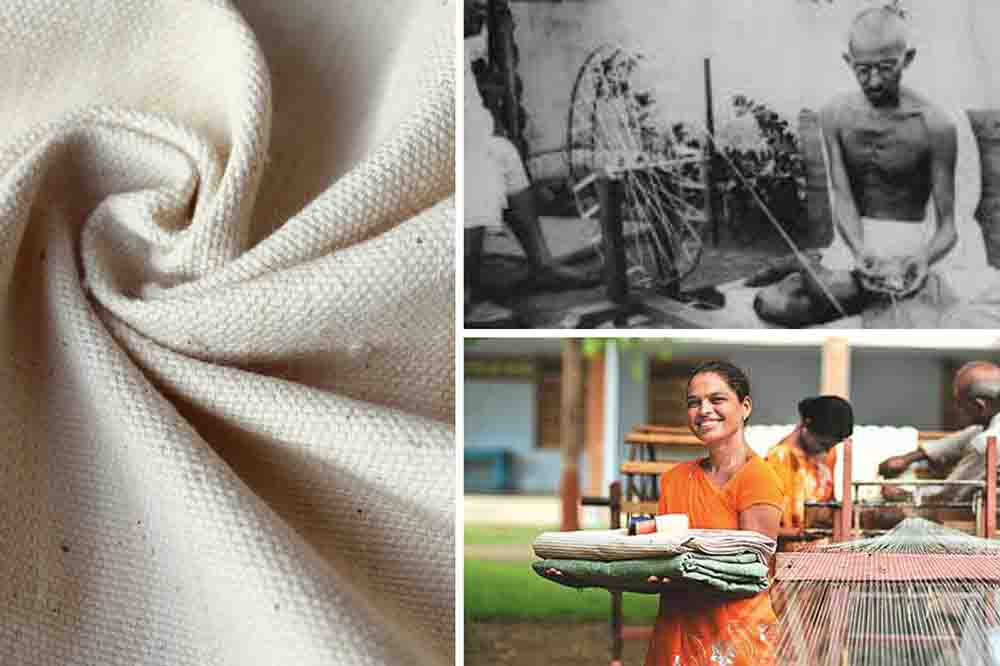
Khadi fabric, also known as Khaddar, is a type of hand-woven cloth that is traditionally made in India, though artisans in Pakistan, Bangladesh and Nepal also weave it. Its production is again on the rise after it declined after the introduction of electronic weaving machines.
In India Khadi sales are constantly rising, increasing from INR1081.04 crore in 2013-14 to INR5942.93 crore in 2022-23. This rise of about 450 percent raises the hope about the preservation of those art among artisans.
Khadi provides an ideal medium for creating conscious and sustainable fashion. The addition of natural dyeing and printing techniques could further enhance the appeal of various khadi fabrics, making them the preferred choice for sustainable fashion enthusiasts.
The term “Khadi” is derived from the Sanskrit word “khaddar” which means “hand-spun” or “handwoven.” It holds great significance in Indian history and played a significant role in the country’s independence movement led by Mahatma Gandhi.
Khadi fabric is made from natural fibers, typically cotton, silk, or wool, and is known for its coarse texture. It is spun by hand using a spinning wheel called a “charkha.
” The process of spinning the yarn by hand adds strength and durability to the fabric. Khadi cloth is usually woven on traditional handlooms, which gives it a unique and distinctive appearance.
One of the key aspects of Khadi fabric is its association with the Swadeshi movement during India’s struggle for independence. Mahatma Gandhi promoted Khadi as a means to promote self-reliance and economic empowerment for the rural population. He encouraged people to spin and weave their own cloth as a way to protest against British colonial rule and boycott imported textiles.
Khadi fabric is considered eco-friendly and sustainable due to its natural composition and the use of manual labor in its production.
It has a low carbon footprint compared to machine-made fabrics and contributes to the livelihoods of artisans and weavers in rural areas.
Today, Khadi fabric continues to be popular in India and has gained recognition worldwide for its unique qualities. It is used to make a wide range of garments, including sarees, kurtas, scarves, and even modern Western-style clothing. The fabric’s coarse texture, breathability, and ability to keep cool in hot weather make it a preferred choice for many people.
Khadi has become an emblem of India’s cultural heritage and the principles of self-reliance and sustainability. Organizations such as the Khadi and Village Industries Commission (KVIC) in India promote and support the production and marketing of Khadi fabric, ensuring its continued relevance in the modern era.
As sustainability has become a norm the textile industry is also looking for ways to provide sustainable products to its consumers. The use of khadi will increase now. The Indian government is actively involved in reviving the khadi industry.
Khadi is a fabric that keeps users cool during hot summers and warm during harsh winters. Khadi and Village Industries Commission (KVIC) is an Indian governmental body that is actively involved in the planning, promotion, organisation and implementation of programmes for the development of khadi. KVIC under its Khadi Vikas Yojana (KVY) has decided to set up a Centre of Excellence for Khadi (CoEK) in association with the National Institute of Fashion Technology (NIFT)—a pioneer institute in design education which has been playing an active role in reviving the khadi design.
The expected outcomes of the project are positioning khadi as fashionable apparel and product for today’s youth, providing assistance to khadi institutions to increase their business by providing new designs and quality of khadi, and strengthening the brand ‘Khadi’.
The big textile brands like Peter England, Raymond, and Arvind Ltd have come out with khadi-based collections. Extensive efforts are also required on the part of textile researchers to enhance the quality of handspun yarns and woven fabrics.

