

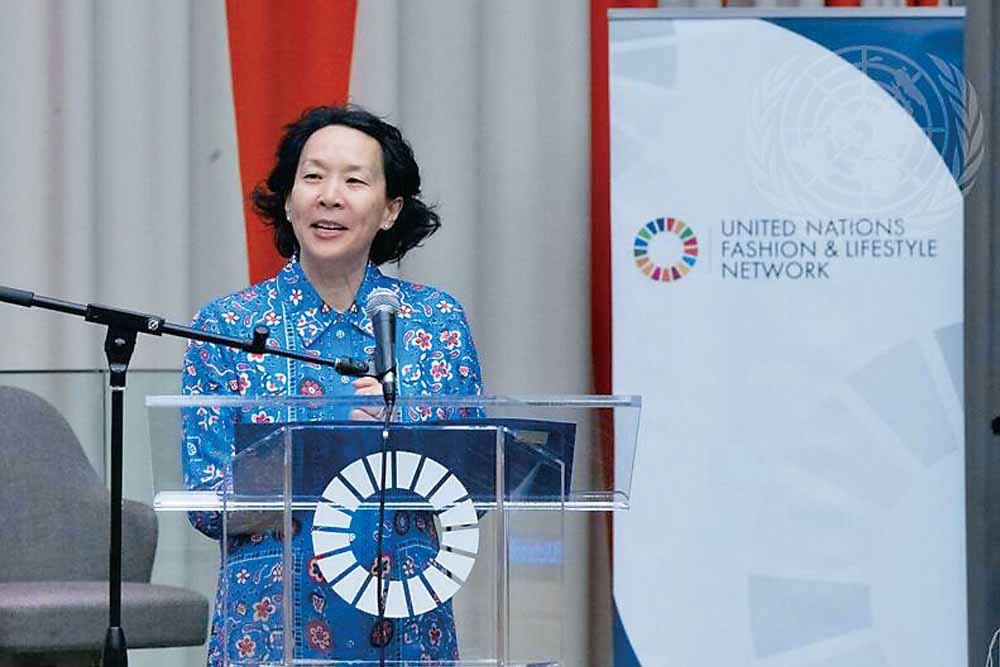
YorkOn 19 May 2025, the United Nations Fashion and Lifestyle Network (UNFLN) held its fourth annual meeting in the iconic ECOSOC Chamber of the UN Headquarters, New York. This high-level gathering united more than 340 members from 125 countries, including brands, policymakers, UN entities, innovators, and creatives. Hosted by the UN Office for Partnerships and the Fashion Impact Fund, a PVBLIC Foundation initiative, alongside the UN Sustainable Fashion Alliance and supported by Lenzing, the event served as a platform to explore how the fashion and lifestyle industries can meaningfully contribute to advancing the Sustainable Development Goals (SDGs).
Agenda and Key Speakers
The event began with opening remarks from Kerry Bannigan, Co Founder of UNFLN and President of the PVBLIC Foundation, and remarks from Annemarie Hou, Executive Director of the UN Office for Partnerships. H.E. Erik Ullenhag, Sweden’s Consul General in New York, offered a special address on the importance of global collaboration in sustainability.The programme included diverse sessions such as:
• High level fireside chat with moderator Riefqah Jappie and Aisling Camps of Aisling Knits Inc. discussing quality, slow fashion, and zero waste knits
• “Policy for People and Planet” panel, featuring voices like Sara Ziff of Model Alliance, Abrima Erwiah (Studio One Eighty Nine), Michelle Gabriel, and other advocates
• “Innovation by Design”, moderated by Adriana Galijasevic, featuring designers Tricia Carey (Avalo), Beth Esponette (Unspun), and Sarika Bajaj (Refiberd)• Sessions titled Industry in Transition, “Forever in Style”, “The Art of Change”, and “Zero Waste in Action”, each highlighting sustainability, inclusion, and creative innovationThe day concluded with closing remarks from Kerry Bannigan, Lucie Brigham (Chief of Office, UN Office for Partnerships), and a message from the UN Alliance for Sustainable Fashion.
Central Themes and Discussions1. Responsibility and Quality in Fashion
Kerry Bannigan urged the audience to match creativity with responsibility, highlighting the social and environmental impacts of industry decisions on garment workers and artisans. Featured creative Aisling Camps stressed the importance of craftsmanship and rejecting disposable fashion to encourage long-lasting, high-quality garments.
2. Circular Models and Zero Waste Design
Dialogue centered on circular systems, repurposing, repairing, and recycling—as essential solutions to environmental and resource challenges. Sessions like “Zero Waste in Action” featured designers such as Zero + Maria Cornejo, Zero Waste Daniel, and FABSCRAP’s Camille Tagle, underscoring waste reduction across the design-to-disposal lifecycle.
3. Innovation and Material Science
Industry leaders, including Jean Hegedus of Lycra, spoke on renewable bio-based fibers. Jean shared insights on Qore, a fiber made from 70% corn waste that could reduce carbon emissions by up to 44%. Recover™, a recycled cotton fiber company, was recognized as a 2024 Thought Partner, emphasizing traceable, circular supply chains.
4. Digital Strategies and Second Hand Market
Second hand markets and digital platforms emerged as key disruptors. Representatives from Vestiaire Collective, Global Fashion Exchange, and Global Fashion Agenda discussed how resale and technology are transforming consumption, enabling more sustainable behaviors.
5. Policy Integration and Worker Rights
“Policy for People and Planet” panels spotlighted policy-driven sustainability and decent work standards. Sara Ziff and others tackled challenges of overconsumption, gender equity in labor, and empowering local suppliers to overcome precarious conditions.
6. Culture as Catalyst
Sessions like “The Art of Change” celebrated the intersection of culture, mental health, and science in driving industry transformation. Showcase: UN Tour Guide Uniforms One highlight was the debut of sustainably designed UN Tour Guide uniforms, developed collaboratively by the Department of Global Communications, the UN Office for Partnerships, Sofia Hedström de Leo and the Swedish Government, with support from the University of Borås and Paul Frankenius Foundation. These uniforms feature digital prints, corozo buttons, and eco-fabrics, symbolizing large-scale sustainable design. Network Impact and Reach The UN Fashion and Lifestyle Network serves as a global coalition of change—340+ members across 125 countries. Members gain opportunities for knowledge exchange, visibility through events, and advocacy aligned with the SDGs. Registered initiatives are showcased on their platform, amplifying innovative case studies and collaborative solutions.
The Network is co-led by the UN Office for Partnerships, the Fashion Impact Fund, and UN DESA, supporting multilateral collaboration from local to global scales.Achievements & Future CommitmentsThe fourth annual meeting reaffirmed UNFLN’s core mission: to mobilize fashion and lifestyle sectors toward a sustainable future rooted in creativity, responsibility, inclusivity, and innovation. Dialogues tackled pressing issues—waste, labor, materials, and policy—while showcasing actionable innovations like recycled fiber initiatives, bio-based materials, zero waste design, and the circular economy. Practical outputs included launching sustainable uniforms, strengthening the role of second hand markets, engaging designers in zero waste production, and integrating circular materials through collaborations with companies like Lycra, Recover™, Refiberd.
Looking Ahead
While the UNFLN advances ambitious goals, the path forward will rely on persistent collaboration across UN agencies, governments, developers, brands, creatives, and civil society. The regional UN Fashion and Lifestyle Hub in Tuscany reflects this, hosting SDG-focused events throughout 2025 to spotlight local innovation. Recover™’s thought partnership, launching at the 2024 and continuing through 2025, highlights the scaling potential of recycled fiber technologies and traceable circularity. Initiatives like the UN Tour Guide uniform, along with policy frameworks and second hand market strategies, set powerful precedents for replicable sustainable solutions across other UN platforms and countries.
Conclusion
The 4th UN Fashion and Lifestyle Network Annual Meeting marked a transformative milestone—amplifying creative leadership, system-level thinking, and model solutions tailored for sustainability. The event set the stage for the next series of global and regional actions, including policy alignment, capacity-building, material innovation, and community integration across value chains—and, crucially, continued support of the 2030 SDG Agenda. By equipping stakeholders with knowledge, collaboration channels, and inspiration, UNFLN is helping fashion and lifestyle sectors evolve from environmental challenges to purposeful, creative platforms for positive global impact.

