

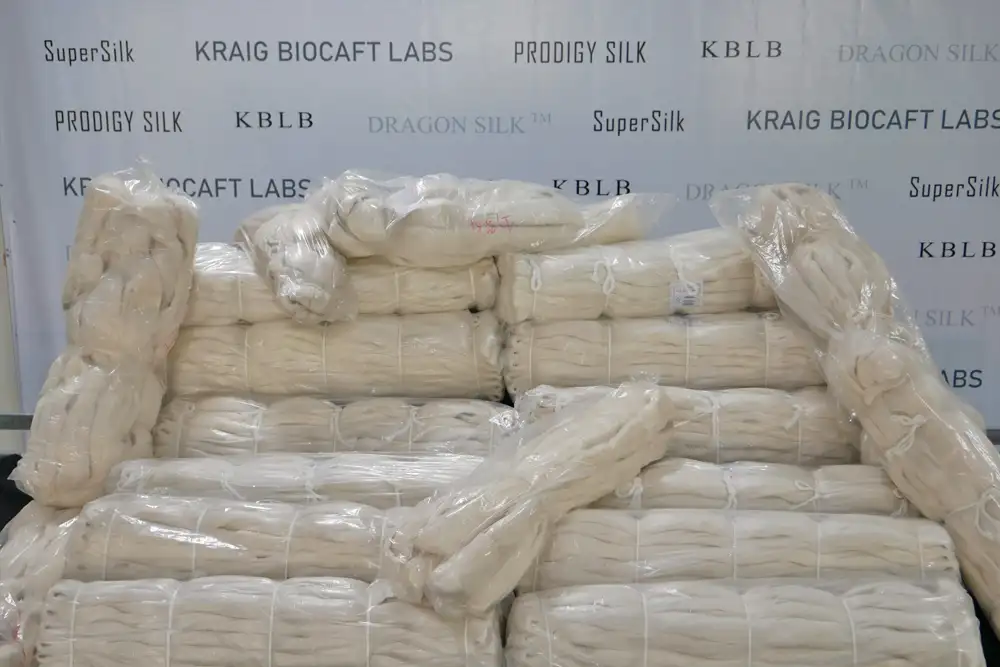
The company says roughly half of its nearly 1.8-ton recombinant spider silk cocoon batch has now been converted into reeled silk, moving the material closer to yarn and fabric development.
Kraig Biocraft Laboratories has reported a further step in its spider silk commercialization programme, confirming that processing of its recently produced recombinant spider silk cocoons into reeled silk is now about 50% complete. The Ann Arbor-based biotechnology company said the batch represents the largest volume of recombinant spider silk it has produced and processed to date.
From cocoon volume to usable fiber
The update follows Kraig Labs’ April 20 announcement that it had begun processing nearly 1.8 metric tons of recombinant spider silk cocoons. That total included more than 1.3 metric tons produced in March, plus an additional roughly half-ton of cocoons subsequently confirmed by the company.
For textile users, the commercial significance lies less in the cocoon total itself than in the conversion step. Reeled silk is the intermediate form needed before further processing into yarns, fabrics and technical material applications. Kraig Labs said the completed cycle should create a “substantial inventory” for product development and future commercial opportunities.
A scale-up test for spider silk
Recombinant spider silk has long attracted interest because of its potential strength, light weight and performance properties, but industrial reliability has remained the central challenge. Kraig Labs’ model is based on genetically engineered silkworms that incorporate spider silk proteins, allowing the material to be produced through a silk-style cocoon and reeling route rather than purely laboratory-scale fermentation.
Chief executive Kim Thompson described the reeling progress as the next step toward commercially available yarns and fabrics, after what the company called a landmark cocoon production run. The company has positioned the programme as an attempt to build a reliable and cost-effective supply chain for spider silk, though commercial validation will depend on downstream yarn conversion, fabric trials, customer testing and repeatable production economics.
What to watch next
The next test is whether this reeled inventory can move smoothly into twisting, yarn development and application trials for fashion, performance textiles or industrial materials. For mills, brands and technical-textile buyers, repeatability will matter more than a single batch: consistent fiber quality, scalable processing yields and credible delivery timelines will determine whether spider silk shifts from biomaterials promise to textile supply-chain reality.
