

For technical-textile producers, quality is increasingly defined by real-time control of alignment, coating weight, moisture, temperature and basis weight—not by final inspection alone.
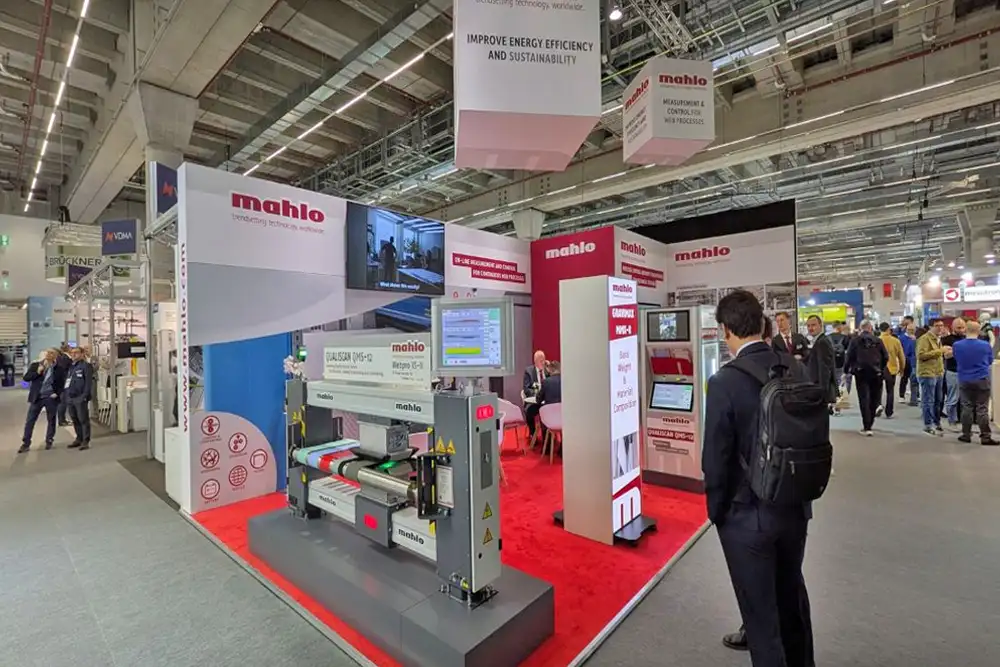
Mahlo used Techtextil 2026 to underline a central message for technical-textile manufacturing: performance materials depend on process precision. At the Frankfurt fair, held from April 21–24, the sector’s focus on filtration, protective textiles, nonwovens, composites, coatings and high-performance materials showed how small deviations in production can quickly become functional defects.
Precision before inspection
In woven technical fabrics, alignment remains a decisive quality variable. Distortion, skewing or bowing can compromise dimensional stability, coating uniformity, filtration performance or downstream converting. Mahlo’s Orthopac systems are designed to correct fabric distortion during processing, helping producers maintain consistent fabric geometry before defects become embedded in the product.
This matters especially where woven substrates are used in applications such as membranes, reinforcement fabrics, protective textiles and industrial filtration. In these segments, the commercial cost of poor alignment is not only waste, but also rejected batches and unreliable product performance.
Nonwovens need continuous measurement
For nonwovens, the key control point is often basis weight. Materials used in hygiene, automotive, filtration and medical applications must meet tightly defined specifications, even at high production speeds. Mahlo’s Qualiscan QMS is a modular web-gauging system that measures and controls parameters across the working width of running material, including basis weight, coating weight, thickness and moisture.
The value for manufacturers is operational: instead of discovering off-spec material after production, operators can detect variation during the run and make immediate corrections. That reduces scrap, stabilizes quality and supports more efficient use of fibers, binders, coatings and energy.
Coatings, moisture and temperature move upstream
Modern technical textiles increasingly rely on multi-layer constructions and precisely engineered surfaces. Coating thickness, residual moisture and thermal conditions can determine whether a product performs as intended. Mahlo’s sensor portfolio targets these variables through online measurement, including infrared and microwave-based moisture monitoring, while systems such as Optipac and Ecopac support process control around stenter and thermal-treatment operations.
The next competitive advantage in technical textiles will not come only from new fibers or finishes. It will come from making production more measurable, repeatable and controllable. At Techtextil, Mahlo’s argument was clear: in advanced materials, quality is engineered continuously—or it is lost silently.
