

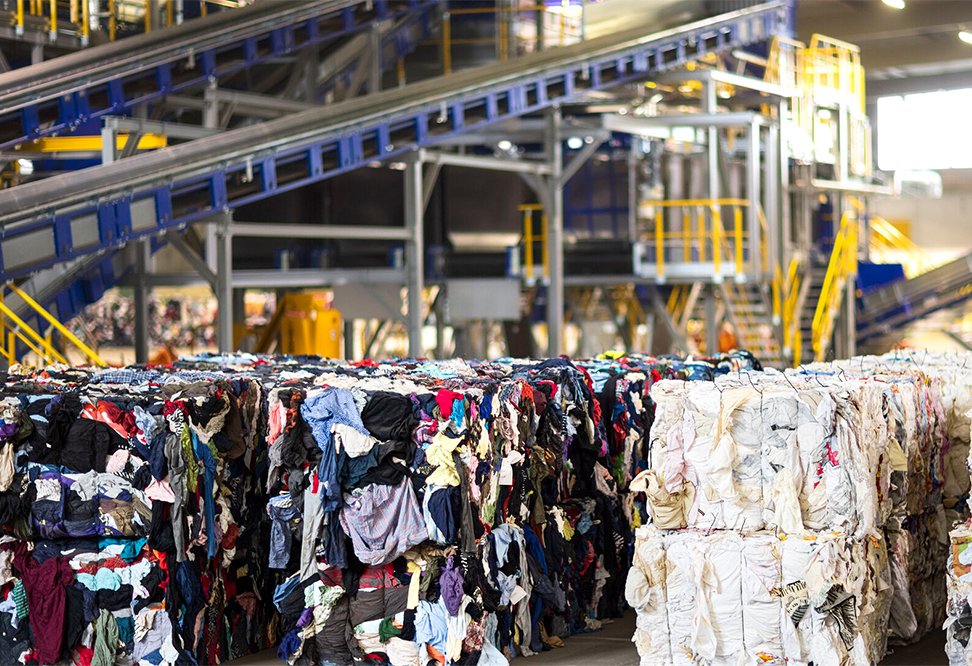
Demand for automated sorting, fibre-opening and recycling systems is rising as textile producers face mounting pressure to convert post-industrial and post-consumer waste into usable raw materials.
The global textile waste recycling machinery market is projected to expand from $4.6 billion in 2023 to $7.1 billion by 2034, according to Transparency Market Research (TMR), representing a compound annual growth rate of 4.0% between 2024 and 2034.
The forecast points to a steadily expanding machinery opportunity as circularity policies, waste-management requirements and demand for recycled fibres push mills and recyclers to increase processing capacity.
Automation moves up the agenda
The market covers machinery used in spinning, carding and combing, with applications across cotton, polyester, nylon, wool and other textile streams. TMR also segments equipment by manual, semi-automatic and automatic operation and by capacities ranging from below 0.5 tonnes per hour to above 2 tonnes per hour.
Manufacturers are increasingly targeting fully automated textile sorting and recycling systems, while equipment is also incorporating dust-removal and waste-handling capabilities.
Recovered fibres can feed applications including rotor spinning and nonwovens, extending the machinery opportunity across spinning mills, weaving and garment operations, nonwoven producers and dedicated recycling plants. A persistent technical constraint, however, is fibre damage: repeated mechanical processing can shorten fibre length and reduce quality.
Asia-Pacific leads demand
Asia-Pacific held the largest market share in 2023, supported by its extensive textile manufacturing base. Cotton was the largest material segment, according to TMR. Major machinery suppliers covered by the study include Laroche, Loptex, AUTEFA Solutions, Valvan Baling Systems, Vecoplan and Luwa Air Engineering, alongside several Asian manufacturers.
Regulation strengthens the investment case
Europe provides an additional structural demand driver. EU member states have been required to separately collect textiles since January 2025, while the revised Waste Framework Directive introduces mandatory extended producer responsibility schemes for textiles and footwear. The European Commission says only around one-fifth of the EU’s 12.6 million tonnes of textile waste generated in 2019 was separately collected for reuse or recycling.
For machinery makers, the bigger opportunity therefore extends beyond conventional shredding and opening equipment. Automated sorting, fibre identification, contamination removal and technologies capable of processing blended textiles are likely to become increasingly important as regulation shifts the industry from waste collection toward scalable fibre-to-fibre recycling.
