

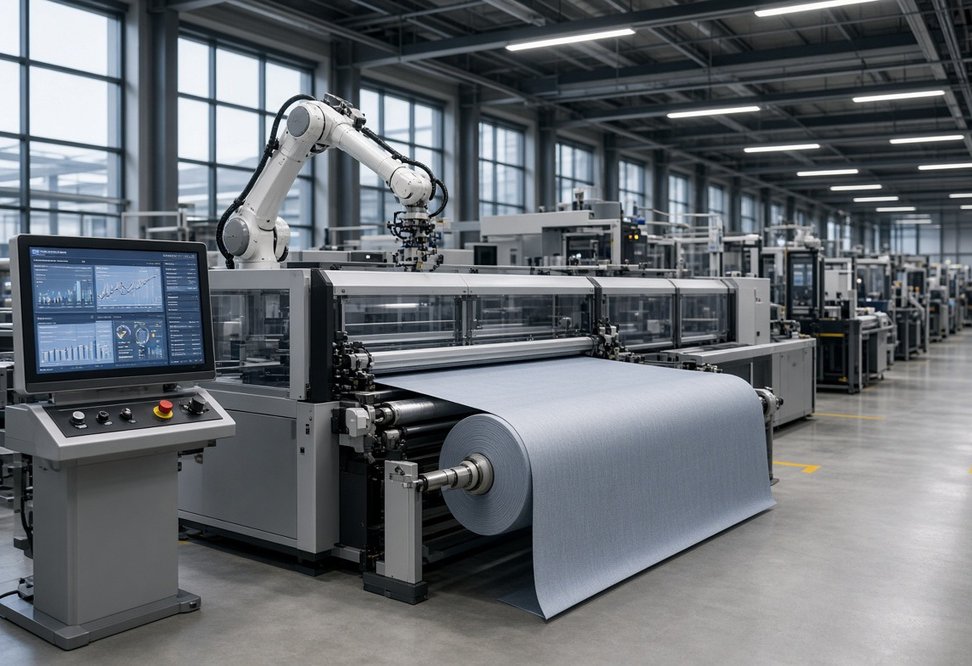
The Mönchengladbach project is moving technologies ranging from sensor-integrated garments and AI fibre analysis to fungal decolourisation and microplastic control closer to commercial textile production.
Germany’s Textile Factory 7.0 (T7) is emerging as a test bed for how digitalisation, biotechnology and circular manufacturing could converge in the next generation of textile factories. During an August visit by North Rhine-Westphalia Economy Minister Mona Neubaur, researchers demonstrated smart garments, AI-assisted fibre analysis, conductive-yarn embroidery, laser processing and lower-impact textile finishing technologies.
From smart jackets to AI fibre analysis
T7 researchers demonstrated a sensor-equipped jacket capable of recording movement data in real time and transmitting it via Bluetooth to an application where movements can be visualised and analysed. Potential applications include physiotherapy, health monitoring and other data-driven wearable systems.
Conductive yarns are also being incorporated into textile structures using embroidery technology, while AI-based systems are being developed to identify natural fibres and determine material composition more rapidly and precisely. These capabilities sit within T7’s broader Digital Textiles programme, which is developing modular manufacturing systems for smart and responsive textiles.
Cleaner finishing enters the factory
Sustainability research includes natural dyes extracted from materials such as tea and pomegranate skins, alongside alternatives to conventional bleaching and decolourisation. Researchers demonstrated denim decolourisation using both laser technology and fungal cultures, with resulting materials potentially feeding other circular applications.
T7 is also developing methods to quantify fibrous microplastics released through laundering and textile production, study how textile design influences fibre shedding, and investigate filtration technologies for removing microplastics from wastewater.
A real-world laboratory for industrialisation
Being established at Mönchengladbach’s Monforts Quartier, Textile Factory 7.0 is designed as a fully operational real-world laboratory rather than a conventional research project. Its four major areas are On-Demand Manufacturing, MicroFactory Engineering, Digital Textiles and Biosphere. The initiative brings together Hochschule Niederrhein, RWTH Aachen’s Institut für Textiltechnik and regional textile industry organisations, with German federal and North Rhine-Westphalian public funding.
The important test now is industrial economics: whether these technologies can move beyond successful demonstrations into scalable processes that reduce labour, chemicals, waste and environmental impacts without increasing production costs. For machinery suppliers and textile manufacturers, T7 could provide an early indication of which technologies are likely to become commercially relevant in increasingly automated, traceable and circular factories.
