

Hexcel’s CAMX 2026 portfolio focuses on a central aerospace challenge: reducing qualification and manufacturing time while preserving the performance demanded by aircraft, defence and space structures.
Hexcel Corporation is using CAMX 2026 in Atlanta, September 22–24, to showcase new composite materials, qualification milestones and expanded US manufacturing capacity aimed at accelerating aerospace, defence and space production.
The company’s latest developments span aerospace honeycomb, rapid-curing prepregs and highly formable core materials—technologies designed to shorten certification and production cycles as manufacturers prepare for higher-rate programmes.
Honeycomb qualification lowers adoption barriers
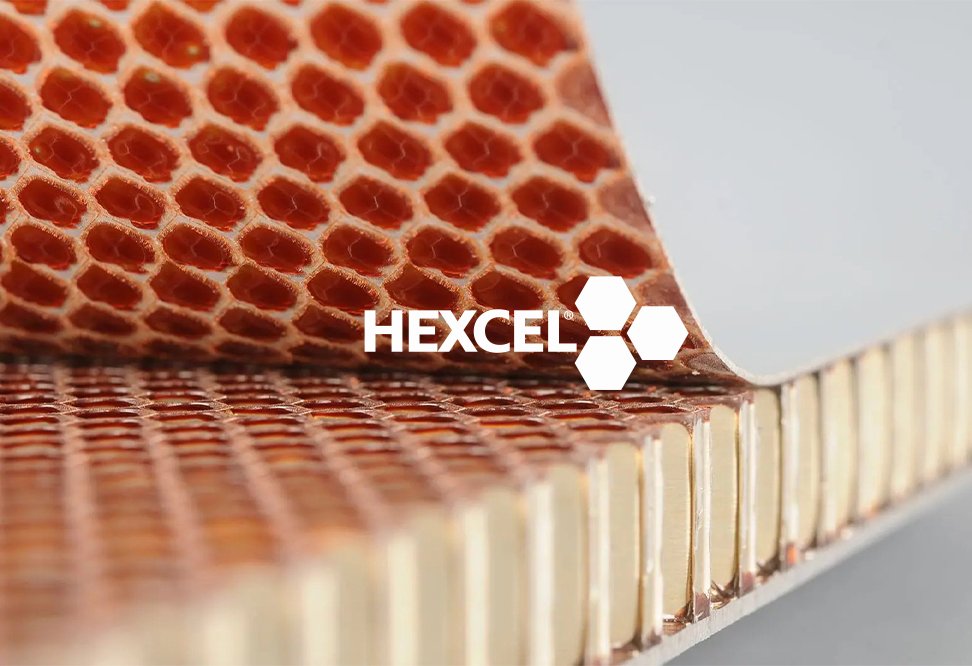
A key development is the NCAMP qualification of HexWeb HRH-10, an aramid-fibre/phenolic-resin honeycomb widely suited to lightweight sandwich structures. Hexcel says the programme creates the first publicly available NCAMP database for aerospace honeycomb core, giving engineers standardised material-property data for design and certification.
Shared qualification datasets can reduce duplicate testing across individual programmes, lowering qualification cost and potentially speeding the introduction of composite structures.
Four-to-five-minute cure cycle
Hexcel is also highlighting expanded US production of HexPly M901 at its Salt Lake City facility. The fast-curing prepreg can support cure cycles of just four to five minutes, targeting applications where traditional aerospace composite processing can constrain production rates. Potential uses include unmanned systems, defence platforms, automotive structures, medical devices and industrial composites.
Higher-throughput materials are becoming increasingly important as the sector attempts to move composites from relatively labour-intensive manufacturing towards more automated, repeatable production.
New core targets complex geometries
Hexcel will additionally introduce an enhanced HexWeb Vented Flex-Core aluminium honeycomb combining high formability with integrated venting. The material is intended for strongly contoured structures, including next-generation space-launch applications, where conventional honeycomb can be difficult to form without compromising core geometry.
The broader strategic message is vertical integration. Hexcel produces carbon fibre, reinforcements, prepregs, resin systems, honeycomb and composite structures across 18 manufacturing locations, with 2025 sales of about $1.89 billion.
For technical-textile and composite manufacturers, CAMX 2026 therefore highlights where competition is moving: qualified material systems, faster cure chemistry, automation compatibility and production-ready core structures rather than material performance alone.
