


 Apogy extends Lectra’s digital reach beyond patternmaking and cutting into the fragmented decisions between initial design and a production-ready garment.
Fashion technology group Lectra has launched Apogy, a cloud-based product-development platform built around agentic artificial intelligence, marking a strategic expansion upstream from its established CAD, patternmaking and manufacturing systems. The platform was officially unveiled on September 15 after three years of development and consultation with several dozen customers.
From concept to industrial prototype
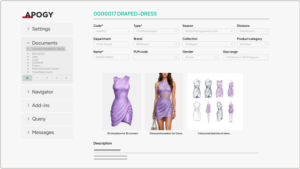
Apogy targets the stage between creative design and production, bringing design information, 2D patterns, 3D virtual samples, fabrics, components, specifications and approval workflows into a shared digital product.
Designers can generate concepts from prompts, sketches or images, while patternmakers can search existing product data, develop patterns collaboratively and estimate material consumption earlier. Photorealistic rendering and 3D simulation are intended to reduce physical prototyping and accelerate approvals.
Lectra says Apogy can reduce overall product-development time by more than 30%, although this is a company performance claim rather than an independently verified industry benchmark.
AI agents move beyond the chatbot
The more significant change is the use of agentic AI. Rather than only responding to prompts, specialised software agents can retrieve product information, assist decisions, automate repetitive operations and orchestrate tasks as a style progresses from concept towards industrialisation.
 That could also help preserve technical knowledge held by experienced patternmakers and product developers. O’Neills is already using Apogy across teams, while Oniverse, owner of Calzedonia, Intimissimi and Tezenis, sees the platform partly as a tool for transferring expertise to younger product-development staff.
Digital competition moves upstream
Apogy also supports standard industry file formats, reducing the need for every supplier to operate within a closed Lectra environment. It is delivered as software-as-a-service, with additional AI functions planned over time.
 For apparel manufacturers, the strategic implication is important: AI investment is moving beyond forecasting, inspection and factory optimisation into pre-production engineering. Earlier material-consumption estimates, fewer samples, better version control and faster pattern decisions can affect lead time, fabric utilisation and development cost before cutting begins.
The next test will be measurable results from commercial deployments—particularly whether Apogy’s AI agents deliver sustained reductions in sampling, development cycles and material waste at scale.
