

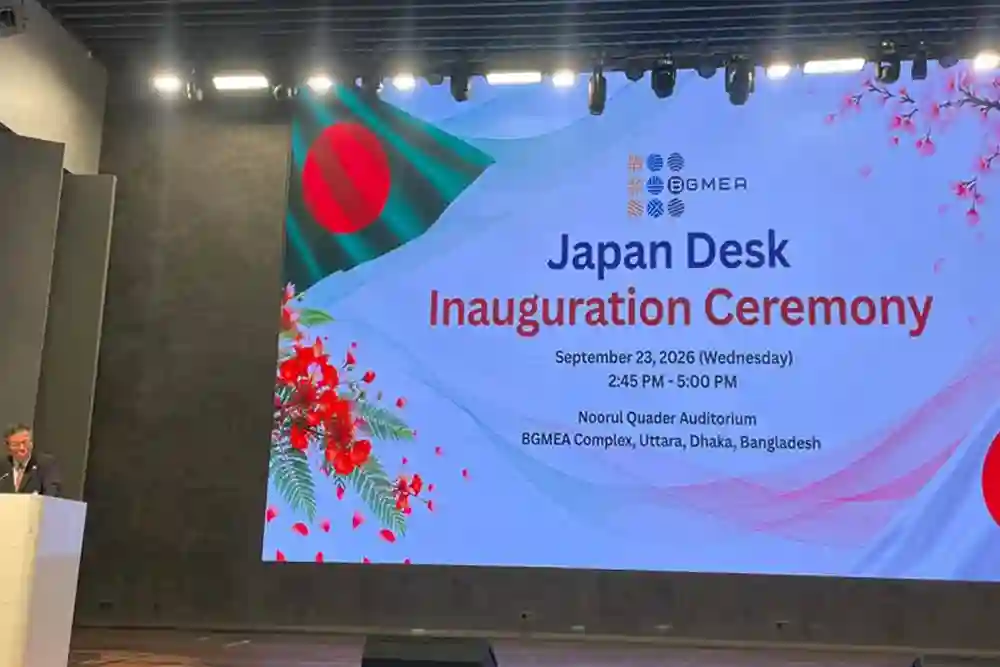
Bangladesh is building a dedicated buyer-support platform for Japan as it seeks to diversify beyond traditional Western markets and move further into higher-value apparel.
The Bangladesh Garment Manufacturers and Exporters Association (BGMEA) has launched a dedicated Japan Desk at its Dhaka complex to connect local manufacturers with Japanese buyers, provide market intelligence and strengthen garment exports to one of Asia’s largest apparel-import markets. The initiative was inaugurated on September 23 in the presence of Japanese Ambassador Saida Shinichi.
$1.37 billion against a $24 billion market
BGMEA estimates Japan’s annual apparel imports at around $24.28 billion, while Bangladesh currently supplies approximately $1.37 billion, equivalent to about 5.63% of the market. Bangladesh exported $1.185 billion of garments to Japan in FY2024-25, underscoring the market’s growing importance but also the remaining headroom for expansion.
The Japan Desk will support factories through market research, buyer identification and coordination with JETRO, JICA, the Japan-Bangladesh Chamber of Commerce and other Japanese organisations. It will also help resolve commercial disputes involving Japanese companies and Bangladeshi suppliers.
EPA strengthens the opportunity
Bangladesh and Japan signed their Economic Partnership Agreement on February 6, 2026, Bangladesh’s first EPA. The agreement—signed but not yet in force—provides for tariff elimination across a wide range of goods and establishes rules covering investment, services, e-commerce, customs and trade facilitation.
BGMEA is also working with Marubeni Corporation on a “Model Factory Programme”, targeted supplier identification and a mechanism for resolving buyer-supplier claims. Marubeni is expected to share three-year sourcing plans to help selected Bangladeshi factories develop more targeted offers.
Japan demands a different export proposition
The challenge is not simply increasing volume. Japanese buyers typically place strong emphasis on quality consistency, reliability, technical specifications and delivery discipline. BGMEA itself has identified functional fabrics and higher-value production as areas requiring greater capability.
For Bangladesh, the Japan Desk therefore represents more than geographical diversification. Its success will depend on whether manufacturers can move from low-cost mass production toward MMF, functional apparel, smaller specialised orders and higher-value products. The key indicator will be whether Japan’s share of Bangladesh’s RMG exports rises once the EPA enters into force.
