

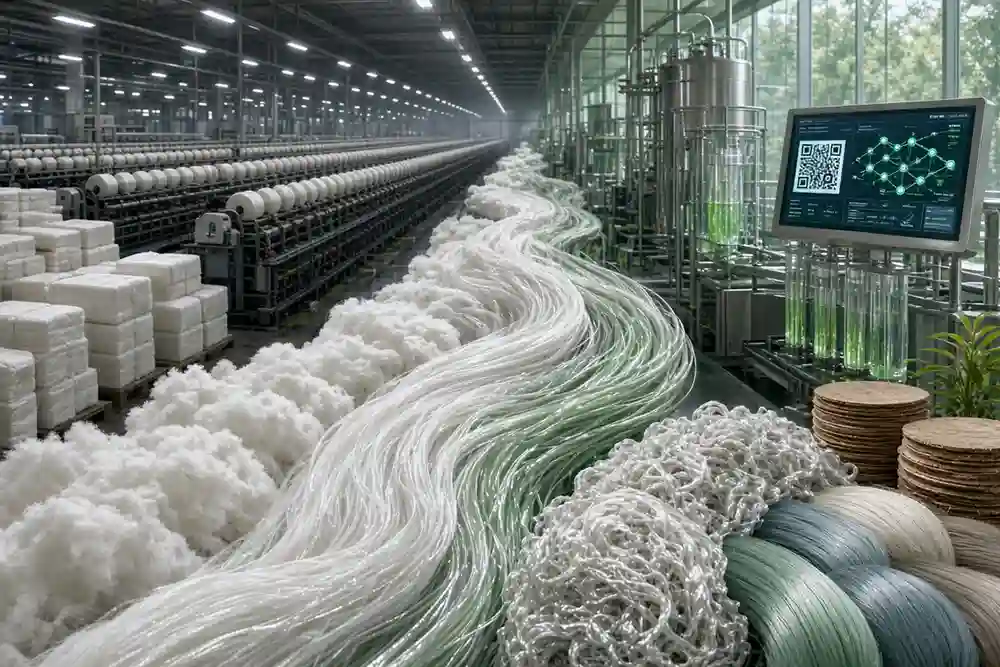
Man-made cellulosic fibres continue to grow, but new investment is increasingly dividing between low-cost Asian capacity and higher-value recycled, specialty and traceable fibre platforms.
The global man-made cellulosic fibre (MMCF) market is entering a more competitive phase as conventional capacity expands while producers invest selectively in lyocell, recycled feedstocks and specialty applications. Canopy’s 2026 Hot Button update says the sector is being reshaped simultaneously by feedstock volatility, geopolitical disruption, regulatory scrutiny and concerns about overcapacity.
MMCF production—including viscose, lyocell, modal, acetate and cupro—reached about 8.4 million tonnes in 2024, up from 7.9 million tonnes in 2023. Viscose accounted for roughly 80%, or 6.7 million tonnes, while lyocell remained much smaller at around 0.4 million tonnes.
Overcapacity changes investment logic
The pressure is visible in Europe. Finland’s Metsä Group cancelled its proposed 100,000-tonne-per-year Kuura textile-fibre mill in August, saying substantial new global MMCF capacity—particularly in Asia—had created overproduction and that too few customers were willing to pay a premium for responsibly produced fibre.
Lenzing is similarly prioritising profitability over volume. Its 2026 strategy involves withdrawing progressively from low-margin standard textile fibres while concentrating on premium specialties, nonwovens and next-generation technologies.
India, however, is still expanding. Grasim Industries has announced ₹30.94 billion ($350 million-plus) of investment for another 110,000 tonnes of annual lyocell capacity at Harihar. Together with projects already underway, its lyocell capacity is expected to approach 210,000 tonnes by 2030, while total cellulosic staple-fibre capacity surpasses one million tonnes.
Circular feedstocks move towards scale
Canopy reports 20 commercially available “Next Gen” MMCF product lines, up from 16 in 2025, with Chinese producers supplying 12. These incorporate alternatives such as recycled textiles, agricultural residues and selected non-forest feedstocks. 22 of 28 assessed producers achieved Canopy Green Shirt status, although their share of global MMCF capacity slipped from 54% to 53%.
Canopy’s rating principally evaluates forest-sourcing and Next Gen practices, rather than the complete environmental performance of a fibre.
For spinning and textile manufacturers, the market is therefore becoming more segmented: commodity viscose faces increasing price competition, while lyocell, recycled-content MMCFs, traceability and specialised functionality offer stronger differentiation. The next competitive test will be whether brands commit enough volume to make these higher-value fibre investments economically scalable.
