

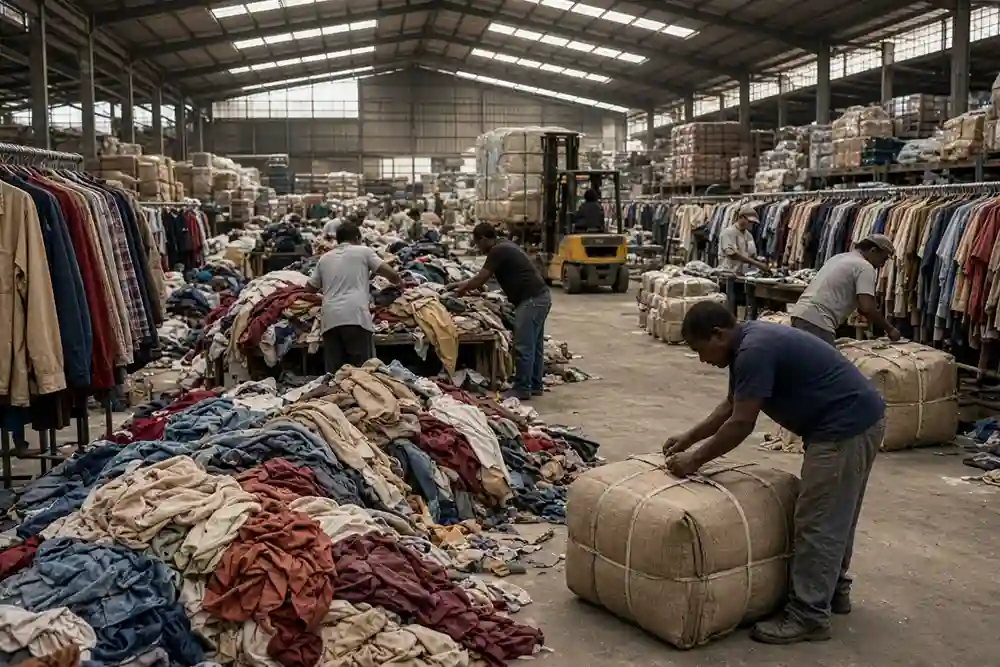
The Apparel Recovery Coalition will test whether producer-responsibility funding can follow second-hand garments across borders instead of stopping in the markets where they were first sold.
Adidas, Bestseller, H&M Group and Inditex have joined The Or Foundation to launch the Apparel Recovery Coalition (ARC), a two-year initiative testing how fashion brands could help finance reuse, upcycling, recycling and waste management in countries receiving exported second-hand clothing. Circle Economy will serve as secretariat.
The initiative addresses a structural weakness in Extended Producer Responsibility: fees are generally collected where garments are first marketed, although many products eventually cross borders as used clothing.
1.44 million tonnes leave Europe
EU countries exported more than 1.44 million tonnes of used textiles in 2025, equivalent to about 3.2 kg per person. Africa received 43% and Asia 48%, according to the European Environment Agency.
ARC’s first demonstration project will operate around Kantamanto Market in Accra, Ghana, where The Or Foundation estimates about 25 million garments are recirculated every month. Funding will support infrastructure, environmental remediation, training and other circular-economy activities.
A second demonstration project is planned in another recipient country. The four brands will make voluntary contributions during 2026–27, although contribution amounts have not been disclosed.
Testing globally accountable EPR
The Or Foundation has long advocated “globally accountable EPR”, under which waste-management funding would travel with clothing into second-hand markets. Its policy proposal recommends eco-contributions starting at $0.50 per newly produced garment, although this is an advocacy proposal, not the ARC funding formula or current EU law.
Pakistan could become highly relevant
The EEA identifies Pakistan and the UAE as the largest individual recipients of EU used textiles over 2005–25, with Asian imports used heavily for recycling and re-export.
That makes the ARC experiment relevant to Pakistan’s emerging circular-textile industry. If cross-border EPR eventually becomes mainstream policy, countries receiving used textiles could potentially gain stronger financing incentives for sorting, fibre identification, recycling, traceability and responsible residual-waste management.
The key test over the next two years will be whether ARC can turn voluntary brand funding into a workable model that regulators can eventually scale across international textile flows.
