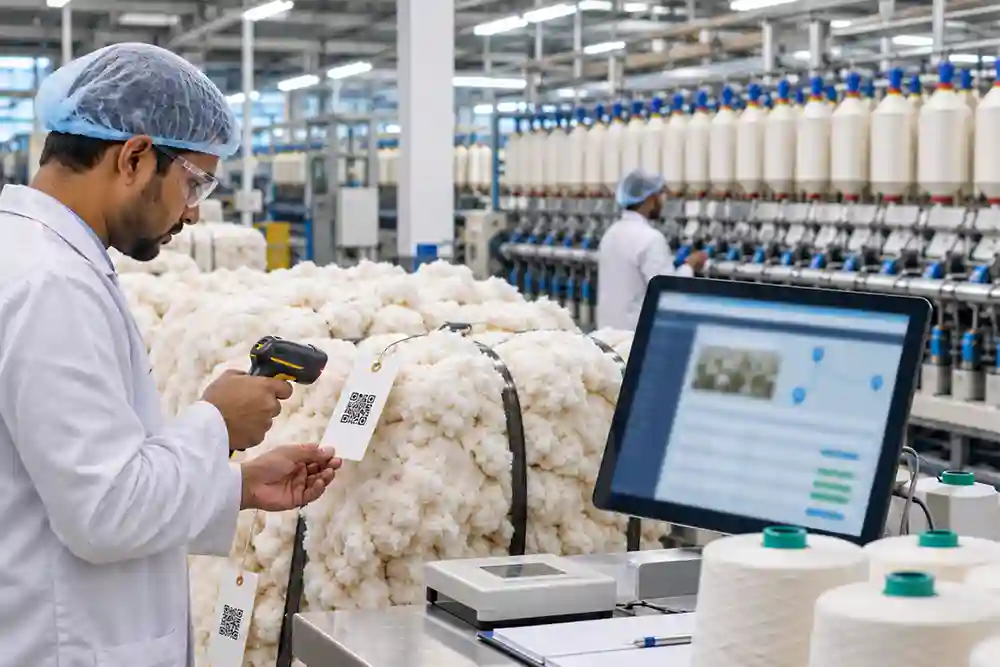
Physical fibre markers and digital production records are helping spinning mills verify raw-material origins, strengthen buyer relationships and differentiate yarns in increasingly demanding global textile markets.
Fibre traceability is becoming a commercial capability for spinning mills as international fashion brands seek verifiable information about raw-material origins, recycled content and manufacturing processes.
Rather than competing solely on yarn price and quality, mills can increasingly differentiate their products by providing reliable material records and evidence supporting customer sourcing claims.
Physical Markers Enable Fibre Verification
Traceability technologies combine digital batch records with physical identification methods, including DNA markers, fluorescent pigments and other detectable tracers.
In Pakistan, Soorty Enterprises partnered with Rieter and Haelixa to incorporate DNA-based traceability into its spinning operations.
The technology was integrated into Rieter’s UNImix B 72 fibre-mixing machine, enabling Soorty to mark 20,000 kg of fibre for a garment order without interrupting production.
The markers remain detectable through subsequent textile processing, allowing physical verification of material identity.
In Bangladesh, BEXIMCO announced a partnership with FibreTrace to incorporate detectable pigments into cotton, hemp, recycled cotton and recycled polyester during spinning.
Chain-of-Custody Systems Strengthen Buyer Confidence
Better Cotton introduced its physical traceability programme in November 2023, enabling participating companies to trace eligible cotton to its country of origin.
Its Chain of Custody Standard establishes requirements for recording material movements and maintaining traceability across supply-chain stages.
For spinning mills, linking fibre-bale identification with mixing records, production batches and yarn consignments can improve documentation and support customer verification.
Turning Traceability into Business Value
Reliable traceability can strengthen access to sustainability-focused buyers, support differentiated yarn offerings and reduce uncertainty surrounding material claims.
However, physical identification alone does not prove sustainable farming practices, lower emissions or ethical production.
Nor does traceability automatically generate higher selling prices.
Manufacturers must evaluate implementation costs, verification expenses and customer demand before investing.
The next competitive opportunity lies in combining fibre traceability with batch-level energy consumption, material yields and product carbon footprints. Mills capable of delivering yarn alongside verified material and environmental data will be better positioned to serve increasingly data-driven textile supply chains.