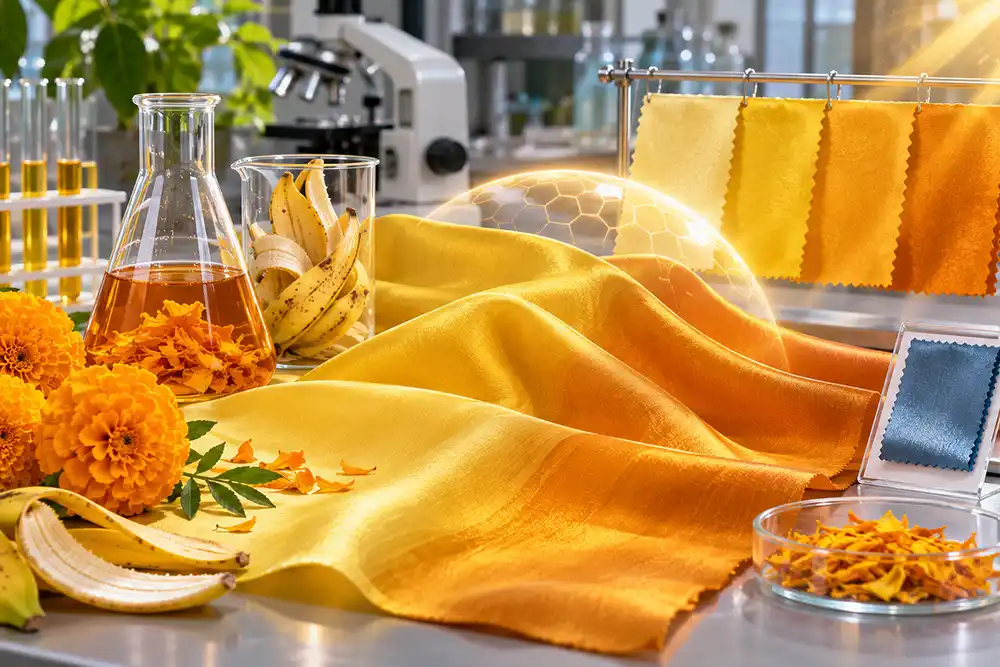
Researchers in Thailand have demonstrated that banana peel waste can improve natural dye uptake and UV protection in silk, although higher energy consumption and limited colour-fastness gains remain obstacles to commercial adoption. Researchers in Thailand have developed a banana peel-based biomordant that improves the colour strength of silk dyed with marigold flower extract, offering a potential alternative to conventional copper-based dye-fixing chemicals.
The study, published in Cleaner and Circular Bioeconomy, found that banana peel extract produced deeper colour and strong ultraviolet protection while demonstrating the potential to convert agricultural waste into textile-processing auxiliaries.
Colour Strength Exceeds Copper Treatment
Researchers evaluated three mordanting techniques: pre-mordanting, simultaneous mordanting and post-mordanting. The optimum process involved treating previously dyed silk with banana peel extract at 90°C for 120 minutes. Under these conditions, the fabric achieved a colour strength (K/S) of 3.64, compared with 3.10 using copper sulphate and 1.65 without mordant.
The biomordant therefore delivered approximately 17% greater colour strength than copper treatment under the experimental conditions. Banana peels contain tannins and polyphenols that help improve interactions between natural colourants and silk fibres.
UV Protection Improves, but Fastness Remains Limited
The treated silk achieved an ultraviolet protection factor (UPF) exceeding 50 under both dry and wet conditions. However, washing fastness remained at grade 3, compared with 3–4 for copper-treated samples. Light fastness was grade 4 for both treatments. Antibacterial performance varied by microorganism, indicating that the treatment’s functional benefits are not uniform.
Energy Consumption Remains a Challenge
Despite eliminating the copper mordant, the banana peel process required additional heating for extract preparation. The laboratory procedure consumed approximately 7.6 kWh of thermal energy, exceeding the copper-based comparison. This highlights an important limitation: replacing synthetic chemicals with natural ingredients does not automatically reduce overall environmental impacts. For silk processors, the technology offers opportunities in bio-based auxiliaries and agricultural-waste utilisation.
The next research priority is reducing extraction energy, improving wash fastness and verifying environmental performance through lifecycle assessment before industrial-scale adoption.