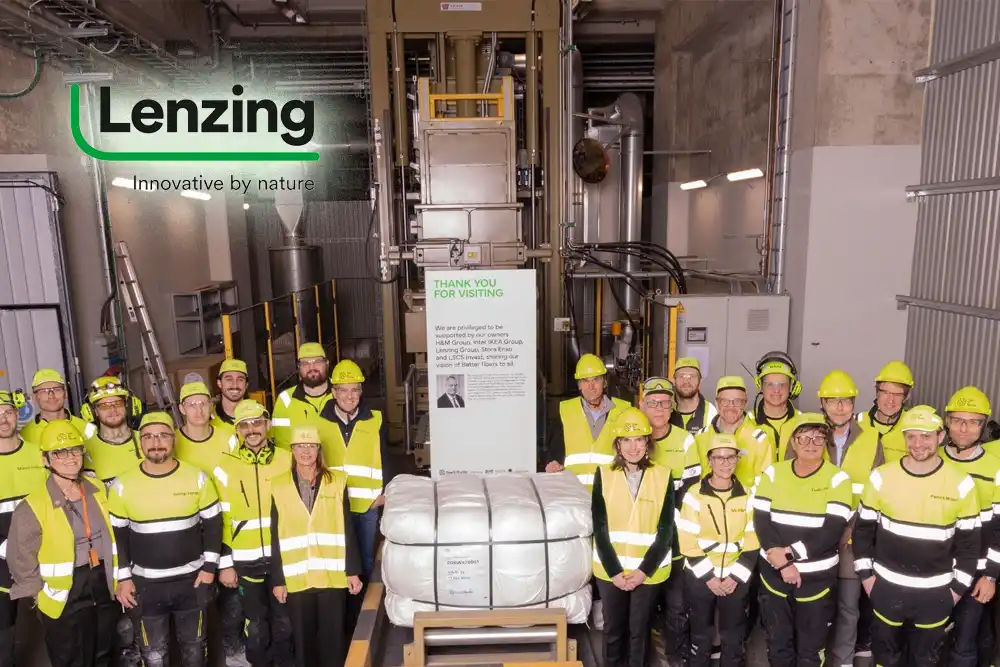
The Austrian fibre manufacturer is accelerating the commercialisation of a new cellulose production technology designed to improve resource efficiency, reduce manufacturing costs and compete with conventional cotton, viscose and polyester. Austrian fibre producer Lenzing Group has reaffirmed its commitment to scaling up Swedish company TreeToTextile’s next-generation cellulosic fibre technology, identifying its first full-scale European manufacturing plant as the next major development milestone.
The announcement, made on November 23, 2026, followed a visit by Lenzing CEO Georg Kasperkovitz and CFO Mathias Breuer to TreeToTextile’s demonstration facility in Nymölla, Sweden.
From Demonstration to Industrial Production
TreeToTextile has operated its Nymölla demonstration plant since early 2024, testing continuous fibre production and supplying materials for application development. The facility has a stated design capacity of 350 kg per hour, approximately 100 times larger than its original pilot line. Its proprietary technology converts dissolving cellulose pulp into staple fibres through an innovative all-alkaline production process, targeting improved resource efficiency and competitive manufacturing costs. The fibres are being developed for textile and nonwoven applications, potentially substituting selected cotton, viscose and polyester uses.
Lenzing Takes Majority Ownership
Lenzing first invested in TreeToTextile in February 2025 and acquired a controlling majority in February 2026. Other shareholders include H&M Group, Inter IKEA Group, Stora Enso and LSCS Invest. The partnership combines TreeToTextile’s patented technology with Lenzing’s industrial fibre-manufacturing expertise, supporting production optimisation and commercialisation.
EU Funding Supports Technology Validation
The demonstration facility hosts the EU-funded LIFE TreeTex project, which runs until the end of 2028. A separate SEK 8.6 million scale-up research project is examining dissolution, washing, drying and lifecycle environmental performance. The objective is to establish industrial feasibility and validate potential resource and cost advantages before large-scale investment.
Commercial Scale Remains the Critical Test
For fibre producers, spinning mills and apparel brands, the technology could expand access to alternative cellulosic materials. However, production costs, fibre performance, environmental benefits and commercial volumes still require validation. The next milestone is finalising investment and construction plans for the first European industrial plant, including capacity, financing and commissioning timelines