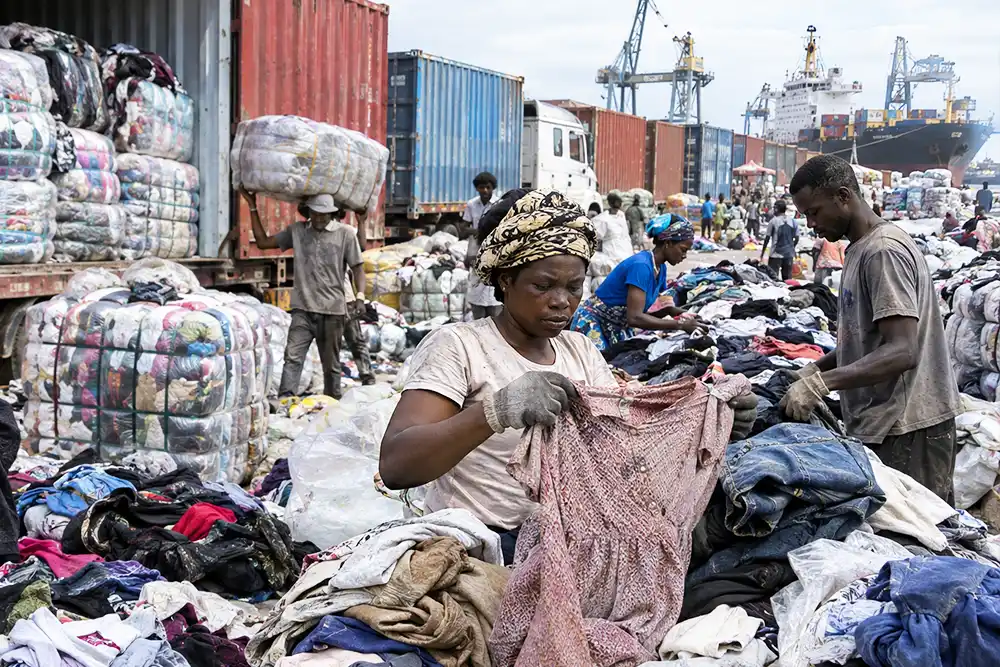
New scrutiny of the global second-hand clothing trade raises questions about who should finance textile collection, recycling and disposal when discarded garments move from wealthy consumer markets to developing countries. The European Union exported more than 1.44 million tonnes of used textiles in 2025, much of it destined for Africa and Asia, according to the European Environment Agency (EEA).
In a November 27, 2026 report, EARTHDAY.ORG argues that fashion’s growing waste problem is transferring substantial environmental and financial costs to importing countries, while existing producer-responsibility systems do not adequately address cross-border waste management.
Africa and Asia Bear the Downstream Costs
Asia received approximately 48% of EU used-textile exports in 2025, compared with 43% for Africa. Pakistan and the United Arab Emirates were among the largest importing countries over the period examined by the EEA. Much of this trade supports legitimate reuse, resale and recycling. However, unusable garments can create substantial disposal costs. Ghana’s Kantamanto market illustrates the challenge. According to the Or Foundation, approximately 15 million garments arrive weekly, with an estimated 40% eventually becoming waste. These estimates highlight pressure on local sorting, collection and disposal infrastructure.
EU Producer Responsibility Rules Expand
The EU’s revised Waste Framework Directive, effective October 16, 2025, requires member states to establish extended producer responsibility (EPR) schemes for textiles and footwear.
Producers will finance collection, sorting, reuse and waste management through fees linked partly to product durability and recyclability. Member states have until June 2027 to transpose the directive and until April 2028 to establish EPR schemes. EARTHDAY.ORG argues that some funding should also reach countries handling exported used clothing.
Stronger Export Controls Approach
The EU’s revised Waste Shipment Regulation introduces tighter export requirements from May 21, 2027. Separately collected textiles must undergo sorting before potential shipment, helping prevent waste from being misrepresented as reusable clothing.
For fashion brands, recyclers and textile manufacturers, these developments increase the importance of material identification, traceability, waste classification and verified recycling destinations.
The next policy test is whether producer-funded systems can support waste management beyond Europe’s borders while protecting legitimate international reuse and recycling businesses.