

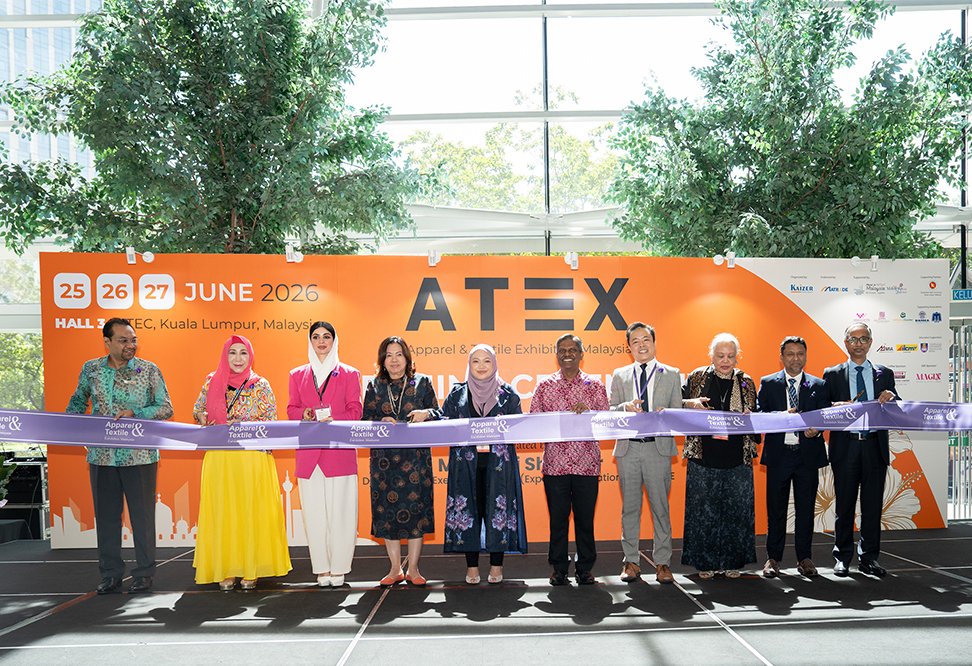
Malaysia’s opportunity lies in converting trade-show visibility into durable supplier linkages, higher-value production and cross-border investment.
The Apparel & Textile Exhibition Malaysia 2026 opened at the Malaysia International Trade and Exhibition Centre in Kuala Lumpur on June 25, bringing together 79 exhibitors from Bangladesh, China, India, Indonesia, Japan and Malaysia. Running through June 27, the event covers more than 4,212 square metres and spans apparel, fabrics, home textiles, machinery, printing, technical textiles, automation and sustainable-production solutions.
Trade momentum supports the ambition
The exhibition arrives as Malaysia seeks a more prominent role in Southeast Asian apparel sourcing. According to trade figures cited in the event release, Malaysia’s apparel and clothing-accessories sector generated RM18.24 billion in total trade during 2025, up 8.3% from the prior year. Exports rose 6.2% to RM6.88 billion, while January–May 2026 export growth was reported at 27.8%.
Those figures indicate positive momentum, but Malaysia’s commercial proposition cannot rest on scale alone. It sits among much larger export-oriented apparel ecosystems, including Bangladesh, China, India, Indonesia and Vietnam. Its more credible role is as a responsive regional platform for specialised manufacturing, automation, higher-value materials, product development and access to ASEAN markets.
Bangladesh seeks closer supply-chain ties
Bangladesh’s presence is commercially notable. The Bangladesh Knitwear Manufacturers & Exporters Association is an event partner, while Bangladesh’s High Commissioner to Malaysia outlined proposals for buyer missions, business matchmaking and a Bangladesh–Malaysia Textile Forum in Kuala Lumpur.
This presents scope for complementary, rather than purely competitive, trade. Malaysian buyers can access Bangladesh’s large-scale garment and knitwear capacity; Bangladeshi suppliers can strengthen relationships with Southeast Asian buyers, source selected materials or technology, and explore joint ventures serving regional markets.
Technology becomes the differentiator
ATEX’s exhibitor profile reflects where Malaysia intends to compete: machinery, digital manufacturing, automation, technical textiles, sustainable production and higher-value fashion capability. The organiser positions the exhibition as a sourcing platform connecting manufacturers, suppliers, brands, retailers and product-development teams across the regional value chain.
For manufacturers, this matters more than exhibition attendance. Buyers increasingly assess suppliers on lead time, compliance data, traceability, engineering capability and material innovation alongside price.
The immediate test is conversion. Business-matching and networking programmes are built into the three-day event, but Malaysia’s broader hub claim will depend on whether those meetings translate into repeat sourcing contracts, technology investment and lasting production partnerships beyond the exhibition floor.
