

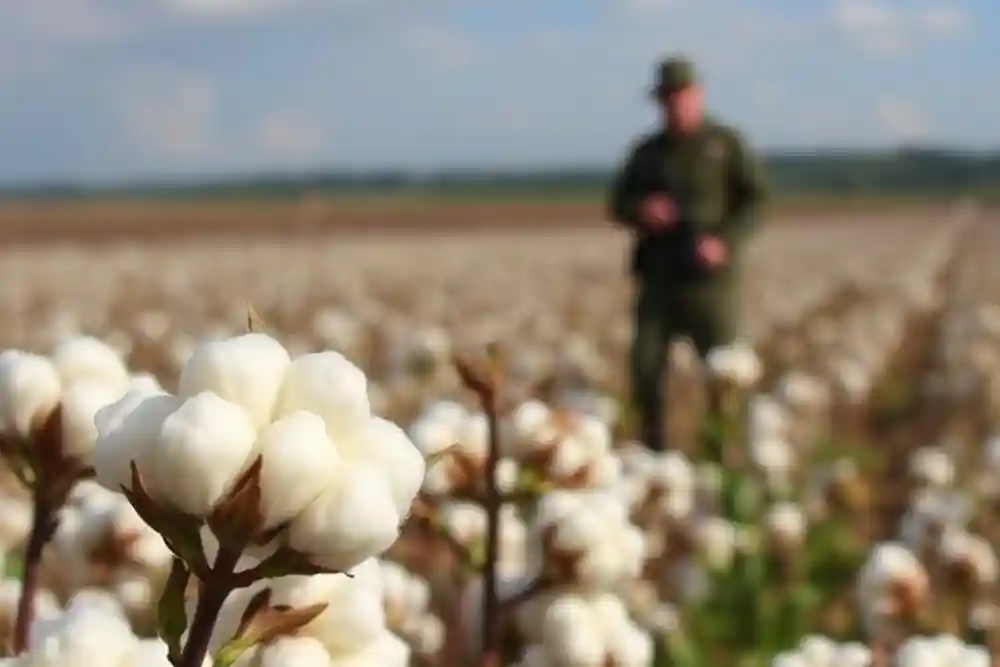
Russia’s war in Ukraine has triggered a structural rethink of defence policy across Europe. Under the ReArm Europe initiative—now reframed as Readiness 2030—European states are accelerating weapons and ammunition production. Beneath the headlines on tanks and missiles lies a quieter but strategically critical input: cotton cellulose, an indispensable raw material for gunpowder.
This reality is reshaping cotton geopolitics in ways that intersect uncomfortably with sanctions, forced labour concerns, and Europe’s own supply vulnerabilities.
Why Cotton Matters for Ammunition
Gunpowder production depends on cellulose, specifically cotton-derived cellulose obtained from the short fibres left after ginning. Without this input, modern propellants cannot be produced at scale. Unlike food or apparel cotton, this is a strategic industrial material, directly tied to military readiness.
Europe’s own cotton production—concentrated in Greece, Spain, and marginally Bulgaria—totals roughly 360,000 tonnes per year, a negligible volume in strategic terms and insufficient to underpin large-scale ammunition manufacturing.
Central Asia: Strategic Cotton Heartland
The most prolific cotton-producing region capable of supplying cellulose at scale is Central Asia, a legacy of Soviet-era agricultural planning designed to feed industrial demand in the European USSR.
Key producers include:
- Uzbekistan – among the world’s top cotton producers
- Kazakhstan – regionally significant, especially in Turkestan
- Turkmenistan – highly cotton-dependent but opaque
- Tajikistan and Kyrgyzstan – smaller players
While post-Soviet cotton production initially declined, demand from China and Turkey revived the sector. Today, however, Russia has reasserted itself as a dominant buyer, driven explicitly by wartime needs.
Uzbekistan: The Nerve Centre of Cotton Cellulose for Russia
Uzbekistan illustrates the problem starkly.
- 2025 harvest: 3.7 million tonnes (+23% YoY)
- Cotton fibre output: >1 million tonnes annually
- Processing: Largely domestic, including cellulose production
The Fergana chemical plant, a major cellulose producer, supplies the bulk of its output to Russia. Before the Ukraine war, Russia’s Kazan gunpowder factory imported less than 50 tonnes per year of cellulose. By 2022, imports surged to 1,225 tonnes, worth over €1 million.
Critically:
- ~85% of Fergana’s output is destined for Russia
- The company is controlled by Uzbek oligarch Rustam Muminov
- Both firms and individuals involved are now under Western sanctions
This makes Uzbek cotton cellulose a direct enabler of Russian war production, despite broader sanctions regimes.
The European Dilemma: Ethics vs. Strategic Reality
The European Union does not purchase Central Asian cotton, largely due to longstanding concerns over:
- Forced labour
- Child labour
- Weak transparency
While reforms under President Shavkat Mirziyoyev led many Western apparel brands to lift boycotts on Uzbek cotton, EU governments have avoided cotton trade, particularly for sensitive uses.
Yet this creates a paradox:
- Europe needs cellulose for defence production
- Central Asia has the scale
- Russia controls the flows
- Europe has no alternative supply strategy
In Kazakhstan and Turkmenistan, cotton flows have increasingly pivoted toward Russia since the war. Turkmenistan, in particular, sells to everyone—China, Turkey, Russia, and Europe—despite well-documented labour abuses and opaque statistics.
Sanctions Leakage and Strategic Blind Spots
Central Asia already functions as a sanctions circumvention corridor, with goods moving through complex re-export chains between East and West. Cotton cellulose now appears firmly embedded in this system.
Europe is actively courting Central Asia through energy, infrastructure, and trade agreements—but cotton is conspicuously absent from official agendas, even as it becomes strategically indispensable.
This omission reflects an unresolved tension:
- Treating cotton as a moral issue (labour rights)
- While it has become a military-industrial necessity
Strategic Implications
Several hard truths emerge:
- Cotton is no longer just an agricultural or textile commodity
It is a defence-critical industrial input. - Russia has secured upstream control
Through political influence, commercial ties, and sanctioned intermediaries. - Europe lacks redundancy
Domestic cotton output is trivial; alternative cellulose sources are limited and costly. - Ethical sourcing frameworks were not designed for wartime realities
The apparel lens does not translate cleanly to defence supply chains.
The Uncomfortable Conclusion
Europe is rearming for a long confrontation, but its supply chains remain strategically exposed at the raw-material level. Cotton cellulose illustrates how micro-inputs can become macro vulnerabilities.
Until Europe:
- Develops alternative cellulose pathways (synthetic, wood-based, or domestic expansion),
- Engages Central Asia with enforceable governance mechanisms,
- Or accepts the cost of building parallel supply systems,
it will remain dependent on a region where Russia already sets the terms.
Cotton may be soft, but in geopolitics, it is becoming hard power.

