

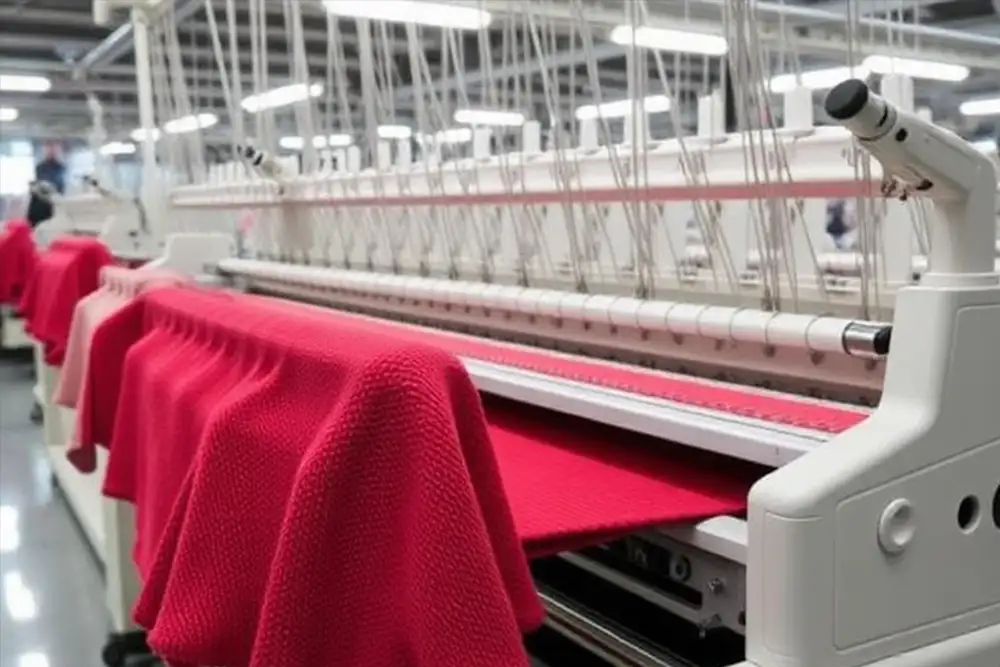
The next machinery cycle will be defined by whole-garment capability, digital production control and the economics of making more value with less labour and waste.
The global flat knitting machine market is projected to rise from US$2.28 billion in 2026 to US$2.94 billion by 2030, implying annual growth of 6.6%, according to The Business Research Company. The estimate measures manufacturer “factory-gate” revenues, including related services, rather than the total downstream value created by knitwear factories, brands and retailers.
The growth case is not simply a volume story. It reflects a shift towards computerised machinery that can deliver faster style changes, more complex structures, reduced dependence on manual operations and closer integration with digital product-development workflows.
Automation moves from feature to requirement
Fully automatic flat knitting systems are becoming central to investment decisions as manufacturers face shorter fashion cycles, labour scarcity and rising pressure to reduce production losses. Digital programming enables rapid changes in stitch, gauge, shape and pattern, while connected production systems can improve machine monitoring and production planning.
For knitwear exporters, the commercial advantage lies in reducing the interval between design approval and bulk production. Factories that can translate digital files directly into machine programmes are better positioned for shorter runs, sampling speed and higher product differentiation.
Whole-garment production broadens the prize
The market is also being supported by demand for seamless and near-net-shape knitting. Multi-needle-bed and whole-garment systems can produce shaped panels or complete garments with fewer cut-and-sew operations.
That can reduce material waste, seam-related defects, handling time and work-in-progress inventory. It also gives product developers greater freedom in engineered structures, including zonal stretch, ventilation, texture, intarsia, jacquard effects and integrated functional elements.
The opportunity extends beyond sweaters and fashion knitwear. Flat knitting is increasingly relevant to footwear uppers, sportswear, automotive interiors, medical supports and other technical-textile applications where fit, structural precision and material efficiency matter
Asia-Pacific remains the investment centre
Asia-Pacific was the largest flat-knitting-machine market in 2025 and is forecast to remain the fastest-growing region. China remains central, but machinery demand is also likely to be supported by modernisation in India, Bangladesh, Vietnam and other Asian sourcing hubs.
For machinery buyers, the procurement question is therefore changing. Machine speed alone is insufficient. The stronger investment case combines digital design compatibility, technician capability, energy performance, spare-parts support, yarn versatility and the ability to deliver commercially differentiated knitted products.
The next test will be whether apparel demand justifies capacity additions—or whether investment remains focused on replacing conventional machines with more flexible, automated platforms.
