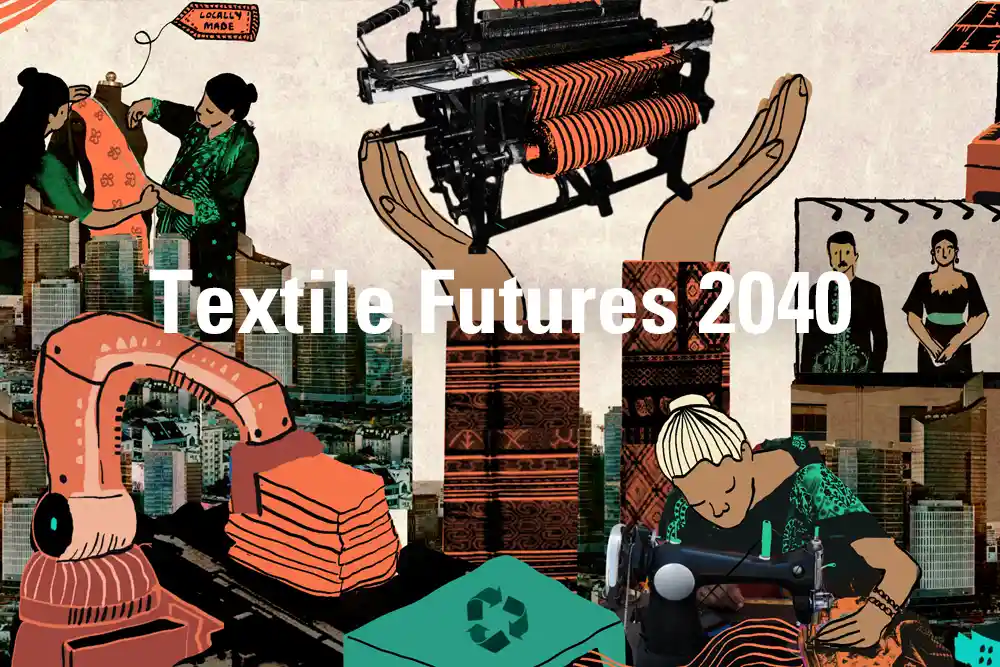
New research explores how artificial intelligence, climate disruption, shifting economic power and circularity could reshape textile production, sourcing and employment by 2040.
The H&M Foundation and sustainability organisation Forum for the Future have released Textile Futures 2040, a foresight report outlining four possible futures for the global textile industry.
Published on November 11, 2026, the study examines how changing economic conditions, technological developments, climate risks and consumption patterns could transform manufacturing and supply chains.
The research involved more than 60 stakeholders, including manufacturers, brands, labour organisations, academics and industry specialists.
Four Scenarios for Textile Manufacturing
- New Age Corporate Empire: Large corporations and manufacturers dominate global supply chains. Automation, advanced materials and efficient production expand, but economic inequality increases and decarbonisation remains subordinate to profitability.
- Power Shift: Economic influence moves towards Asia, where government-backed innovation, stronger labour protections and growing domestic consumption reshape textile manufacturing. Asian producers increasingly develop their own brands and capture greater value.
- Global Storms, Local Shields: Climate disruption and resource shortages fragment international supply chains. Local production, textile repair, reuse and recycling become central economic activities as communities prioritise self-sufficiency.
- The New Noosphere: Artificial intelligence increasingly determines production volumes, material allocation and manufacturing decisions. Rapid decarbonisation and extensive fibre recycling emerge alongside concerns about employment and algorithmic control.
Climate Commitments Face Structural Challenges
According to the report, 88% of brands reporting to Textile Exchange have formal climate targets. However, achieving these commitments will require substantial changes in manufacturing technologies, energy systems, sourcing relationships and investment priorities.
The scenarios are not forecasts. They are designed to test business strategies against different possible developments.
Implications for Textile Manufacturers
For manufacturers in Pakistan, Bangladesh, India and other production centres, the findings highlight the importance of resilient energy systems, recycling capabilities, workforce development and digital integration.
The organisations have released an open-access toolkit enabling businesses to evaluate investment and sourcing decisions against all four scenarios.
The central challenge is identifying investments that remain commercially viable across uncertain futures, while supporting emissions reductions, resource efficiency and sustainable industrial employment.