

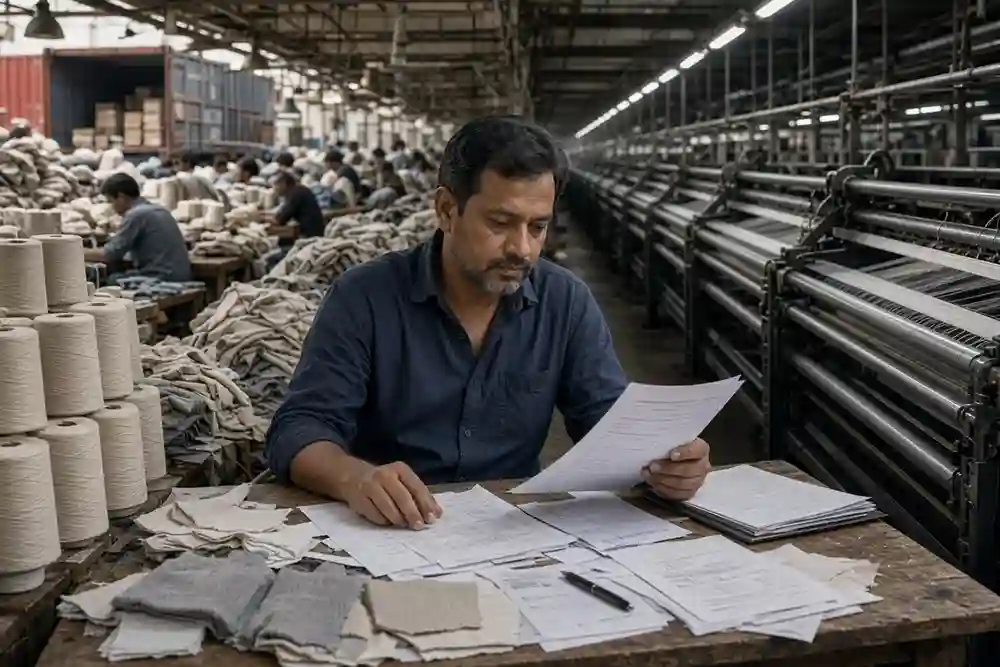
Frequent changes to yarn-import, bonded-warehouse and logistics rules are raising sourcing costs and delivery risk just as Bangladesh competes for increasingly flexible global apparel orders.
Inditex has warned Bangladesh that repeated trade-policy changes could make the country less attractive as an apparel sourcing base, potentially shifting orders toward competitors including Pakistan and Cambodia.
Officials from the Zara owner raised concerns with Bangladesh’s Commerce Minister over withdrawal of bonded-warehouse facilities for some cotton-yarn imports, restrictions on yarn movement through land ports and cancellation of a transshipment facility. Meeting sources cited by The Financial Express estimate Inditex sources around $2.5 billion of garments annually from Bangladesh.
Yarn costs jump
A central dispute concerns imports of 10–30 count cotton yarn, widely used by Bangladesh’s knitwear industry.
Knitwear manufacturers say local yarn prices increased from around $3.15/kg to as much as $3.70/kg after bonded-import rules were tightened. BGMEA and BKMEA argue that abrupt policy changes disrupt raw-material planning and weaken exporters’ ability to quote globally competitive prices.
BTMA disputes claims that imports have been banned, noting that qualifying exporters can still bring in yarn under a bank-guarantee mechanism, which it argues protects domestic spinning mills while preventing misuse of duty-free imports.
Growth has not disappeared
Bangladesh’s RMG exports still increased 6.1% to $10.58 billion during July–September 2026, with September shipments up 8.56% to $3.08 billion. However, industry leaders caution that some of this growth reflects a weak comparison base and that Western demand remains soft.
The underlying policy challenge is balancing Bangladesh’s large domestic spinning industry against garment exporters’ need for flexible, internationally priced inputs.
Opportunity for Pakistan
The warning creates a potential opening for Pakistan, but orders will not shift automatically. Buyers seeking alternatives will compare price, lead time, raw-material flexibility, reliability and policy predictability.
Pakistan therefore has an opportunity to position its vertically integrated textile base as a stable sourcing platform—provided it avoids similar uncertainty around energy, taxation, import schemes and export incentives.
In modern sourcing, predictable policy is becoming part of the supplier proposition itself.
