


Page 45 - TEXtalks International April/May 2022
P. 45
44                                                                                                             45
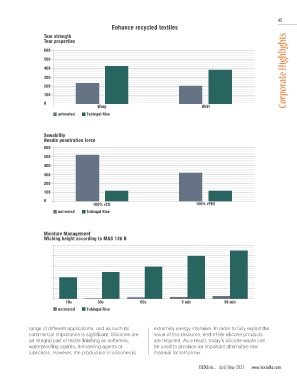
                                             Enhance recycled textiles
                   Tear strength                                                                                                                                                  Four stage Circular System                        For a fully integrated end product of circularity, this
                   Tear properties                                                                                                                                                ReTake: Post-consumed products are taken and      softener can be applied on recycled fibres like rPES
                                                                                                                                                                                  prepared for the next step.                       or rCO. These textiles have the potential to be used
 Rise up to circularity with   500                                                                                                                                                purification process, the post-consumed products   and subsequently recycled again.
                   600
                                                                                                                                                                                  ReGenerate: Through a radical regeneration and
                                                                                                                                                                                  are recycled back to their purity. The innovated
                                                                                                                                                                                                                                    New way of thinking - new way of creating
                   400
                                                                                                                                                                                  reaction at CHT and the addition of renewable
 CHT TUBINGAL RISE  300                                                                                                                                                           emulsifiers led to the ground-breaking TUBINGAL   Post-consumed products normally become waste.
                                                                                                                                                                                                                                    CHT uses this post-consumed materials as new raw
                                                                                                                                                                                  RISE.
                   200
                                                                                                                                                                                                                                    material. TUBINGAL RISE can be applied on new
                                                                                                                                                                                  ReMake: TUBINGAL RISE is processed into e.g.
                                                                                                                                                                                                                                    textiles. These textiles can be used and subsequently
                                                                                                                                                                                  knitted or woven fabrics.
                   100
 Silicone Softener made of   0  untreated  Tubingal Rise                         Weft                                                                                             ReUse: New textiles are created with              recycled back again. This represents a circular
                                                                                                                                                                                                                                    economy.
                                                                                                                                                                                  TUBINGAL RISE.
                                        Warp
 Recycled and Renewable
 raw materials     Sewability
                   Needle penetration force
                   600
                   500
 CHT Germany GmbH underline their commitment to   idea to create something new out of alleged waste
 sustainability by launching the first softener based on   was really fascinating and inspiring.”  400
 the concept of circular economy. With the traditional   300
 “take-make-use-waste” model every year the industry   As an innovative partner of the textile industry, CHT
 produces millions of tons of (textile) waste. For this   Group is working continuously on the ideas and   200
 reason a transition from this linear model to a circular   solutions of tomorrow. Circular economy is a major   100
 economy with “take-makeuse-reuse” is necessary.  topic, also for the CHT. The transition from a linear to
 a circular concept requires a joint effort and   0  100% rCO                  100% rPES

 According to the concept of circular economy   rethinking. Therefore, R&D, technical application   untreated  Tubingal Rise
 products are traded in “cycles”. Circular economy   experts and product safety are working closely with
 aims at optimally using resources, minimizing waste   customers and brands to reach the common goals
 and ensuring less pollution. Waste presents   and accelarate innovation. CHT is pushing
 problems all along the fashion supply chain: Every   boundaries by transforming post-consumed products   Moisture Management
 year, the present throw-away society and the   into new value streams.  Wicking height according to M&S 136 B
 corresponding linear “make-use-waste” model
 produces millions of tons of (textile) waste. This linear
 thinking strongly contributes to environmental
 pollution, climate change and depletion of finite
 resources. Ensuring long term sustainable prosperity
 which is in alignment with the United Nation’s (UN)   MAKE  USE
 Sustainable Development Goals – we believe that   CIRCULAR
 circular economy is the future and the right way to go.  TEXTILE
 ECONOMY
 For CHT, sustainability is not only a trend. It is one of   10s  30s  60s  5 min         30 min
 the most important core values and correlates with
 the innovative strength of CHT. It defines daily work   untreated  Tubingal Rise
 as well as our strategic focus. The CHT Group has   R E U SE
 great experience and a deep knowledge of all
 processes along the complete textile chain.  range of different applications, and as such its   extremely energy intensive. In order to fully exploit the
 CHT Reuse   commercial importance is significant. Silicones are   value of this resource, end-of-life silicone products
 According to Robert Zyschka, Head of Application   an integral part of textile finishing as softeners,   are recycled. As a result, today’s silicone waste can
 Field Finishing, CHT Group, “We started giving up   CHT’s Circular System  waterproofing agents, defoaming agents or   be used to produce an important alternative raw
 traditional models and thinking more freely. To us the   Silicone is a versatile material that finds use in a wide   lubricants. However, the production of silicones is   material for tomorrow.

 April/May 2022                                                                         April/May 2022

