


Page 80 - August-September-2017
P. 80
80                                                                                                                                                                                                                             81

               Wound-Healing bandage                                                                                                  New aqueous transparent FR coating


                                      with a voice                                                                                      Test combustion of paper with (right) and without Landex Coat
                                                                                                                                        Flame Retardant Clear treatment. © Teijin Limited Dainichi Giken,
                                                                                                                                        a pioneer of aqueous inorganic polymers in Japan, has
                                                                                                                                        co-developed a new aqueous transparent flame-retardant
                                                                                                                                        coating, Landex Coat Flame Retardant Clear, in partnership with
                                                                                                                                        Daimaru Kogyo, a leading Japanese chemical trading company,
                                                                                                                                        and Teijin, a technology-driven company with businesses in
                                                                                                                                        advanced fibres, plastics and films, composites, healthcare and
                                                                                                                                        information technology.

                                                                                                                                        Landex Coat Flame Retardant Clear, the halogen-free aqueous
                                                                                                                                        transparent acrylic flame-retardant coating, is said to significantly
                                                                                                                                        improve the flame retardancy of diverse combustibles, including
                                                                                                                                        timbers, papers, fibres, rubbers and plastics. The transparent
                                                                                                                                        coating is simply applied to the surface to maintain the material’s
                                                                                                                                        original texture.


                                                                                                                                     Energy harvesting


                                                                                                                                            yarns generate


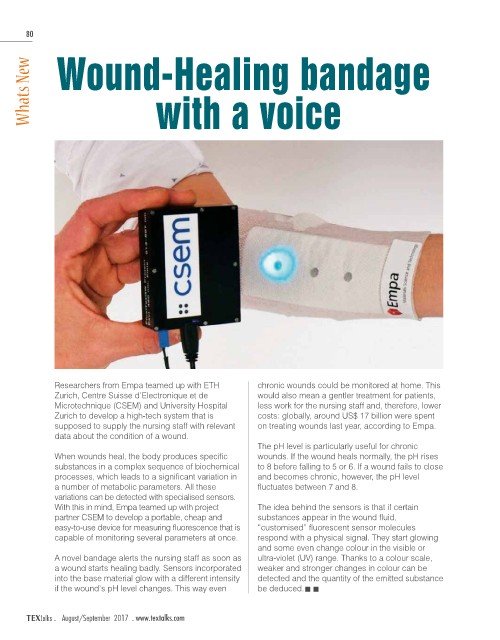
              Researchers from Empa teamed up with ETH        chronic wounds could be monitored at home. This
              Zurich, Centre Suisse d’Electronique et de      would also mean a gentler treatment for patients,                                        electricity
              Microtechnique (CSEM) and University Hospital   less work for the nursing staff and, therefore, lower
              Zurich to develop a high-tech system that is    costs: globally, around US$ 17 billion were spent
              supposed to supply the nursing staff with relevant   on treating wounds last year, according to Empa.                 An international research team led by scientists at   simple as a mixture of ordinary table salt and water.
              data about the condition of a wound.                                                                                  The University of Texas at Dallas and Hanyang   “Fundamentally, these yarns are supercapacitors,”
                                                              The pH level is particularly useful for chronic                       University in South Korea has developed high-tech   said Dr Na Li, a research scientist at the NanoTech
              When wounds heal, the body produces specific    wounds. If the wound heals normally, the pH rises                     yarns that generate electricity when they are   Institute and co-lead author of the study. “In a normal
              substances in a complex sequence of biochemical   to 8 before falling to 5 or 6. If a wound fails to close            stretched or twisted.                           capacitor, you use energy — like from a battery — to
              processes, which leads to a significant variation in   and becomes chronic, however, the pH level                                                                     add charges to the capacitor. But in our case, when
              a number of metabolic parameters. All these     fluctuates between 7 and 8.                                           The yarns are constructed from carbon nanotubes,   you insert the carbon nanotube yarn into an electrolyte
              variations can be detected with specialised sensors.                                                                  which are hollow cylinders of carbon 10,000 times   bath, the yarns are charged by the electrolyte itself. No
              With this in mind, Empa teamed up with project   The idea behind the sensors is that if certain                       smaller in diameter than a human hair. The      external battery, or voltage, is needed.”
              partner CSEM to develop a portable, cheap and   substances appear in the wound fluid,                                 researchers first twist-spun the nanotubes into
              easy-to-use device for measuring fluorescence that is   “customised” fluorescent sensor molecules                     high-strength, lightweight yarns. To make the yarns   When a harvester yarn is twisted or stretched, the
              capable of monitoring several parameters at once.  respond with a physical signal. They start glowing                 highly elastic, they introduced so much twist that   volume of the carbon nanotube yarn decreases,
                                                              and some even change colour in the visible or                         the yarns coiled like an over-twisted rubber band.  bringing the electric charges on the yarn closer
              A novel bandage alerts the nursing staff as soon as   ultra-violet (UV) range. Thanks to a colour scale,                                                              together and increasing their energy, Haines said.
              a wound starts healing badly. Sensors incorporated   weaker and stronger changes in colour can be                     In order to generate electricity, the yarns must be   This increases the voltage associated with the
              into the base material glow with a different intensity   detected and the quantity of the emitted substance           either submerged in or coated with an ionically   charge stored in the yarn, enabling the harvesting of
              if the wound’s pH level changes. This way even   be deduced.                                                          conducting material, or electrolyte, which can be as   electricity.


                August/September  2017                                                                                                                                                                    August/September  2017

