


Page 67 - February-March-2017
P. 67
67

 4DG TM


 Fibre


             definition have the same cross-sectional area
 A modified cross-section can provide added   Characteristics  when the polymer type and denier per filament are
 functionality, such as unique lustre or moisture   1. Move Fluids Spontaneously  the same.
 transport. Type 4DG ™ is a uniquely designed   Fluid movement is shown below in a nonwoven fabric
 product with deep grooves or channels along the   of 4DG fibre vs. round fibre using 6 denier per   Note: 1) the relative size and number of micro-denier
 longitudinal axis of the fibre.  These fibres can be   filament,  both being bonded with binder fibre and   round fibres and 2) the size of a single round fibre
 produced for a range of commonly used polymers.   with the same hydrophilic lubricant.  The fluid is    needed to match the perimeter or surface area of the
 These grooves provide unique features to the fibre   Milliken Syl-Tint®  blue and has spread for 20   4DG fibre.  The specific capillary volume (SCV)
 that can serve as ducts to move fluid spontaneously,   seconds.  In addition to this visual test, fluid   relates to the dark-coloured open area of the grooves
 store or trap substances, provide large surface areas   movement is measured by a maximum potential flux   as opposed to the light-coloured area of fibre
 for a given denier per filament, and many other   test (MPF) developed by Eastman and recorded as   mass shown.
 features.  Choices of finish applied to the fibres   cubic centimetres of fluid per gram of fibre per hour.
 include hydrophilic or hydrophobic, based on the
 needs being served by the fibre.
                                                              4. More Bulk and Cover Than Round Fibre
                                                              Fibre bulk is achieved by the same factors that
                                                              produce higher surface area. The space occupied by
                                                              the 4DG fibre in structures is much greater than
                                                              round fibre from the same polymer.  4DG has a
                                                              preferred bending modulus to provide unusual
                                                              softness rather than stiff resilience. Excellent cover is
 4DG™
                                                              a result of these features, also.
                                                              The diverse characteristics of 4DG fibre lend it to a
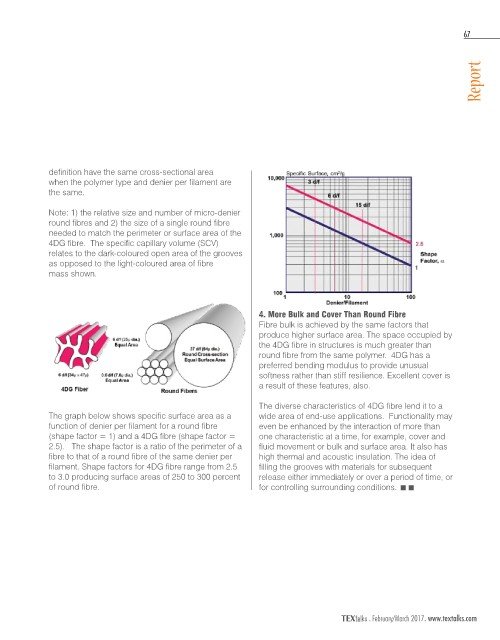
             The graph below shows specific surface area as a   wide area of end-use applications.  Functionality may
             function of denier per filament for a round fibre   even be enhanced by the interaction of more than
             (shape factor = 1) and a 4DG fibre (shape factor =   one characteristic at a time, for example, cover and
             2.5).   The shape factor is a ratio of the perimeter of a   fluid movement or bulk and surface area. It also has
             fibre to that of a round fibre of the same denier per   high thermal and acoustic insulation. The idea of
             filament. Shape factors for 4DG fibre range from 2.5   filling the grooves with materials for subsequent
 Round       to 3.0 producing surface areas of 250 to 300 percent   release either immediately or over a period of time, or
             of round fibre.                                  for controlling surrounding conditions.
 2. Store and Trap Substances
 The physical properties are given in the table below  The size  of the grooves are large enough  as
 indicated below  to contain many types of
 substances, whether they accumulate in use or are
 intentionally placed there for release while being
 used. Below are examples of dust particles collected
 in the grooves on the left and carbon particles placed
 in the grooves for odour absorbency on the right.


 3. Provides Large Surface Area
 The cross-sectional views above show the 4DG fibre
 compared to round cross-section fibre. Both fibres by

