


Page 64 - February-March-2018
P. 64
64
 time-consuming, laboor-intensive and   potassium permanganate (KMnO4), a strong
 chemical-reliant process of hand-finishing.  oxidizer. The chemical has its drawbacks, however. It
 • Create “photo-real” finished garments digitally.  can irritate workers’ skin and lungs if they aren’t
 • Take advantage of on-demand and even   wearing their protective equipment, and can be
 hyper-local production capabilities.  harmful to aquatic life if it isn’t treated properly before
 • Eliminate thousands of chemical formulations from   being disposed. A couple years ago, when Levi’s
 its supply chain.  started its Screened Chemistry program, to identify
 and eliminate undesirable chemicals from its supply
 In what it is billing as the biggest change in more   chain, the first one it realized it needed to phase out
 than a decade to a supply chain that turns out 150m   was potassium permanganate. Overall, the new
 pairs of jeans each year, the apparel company has   process will help the company reach its commitment
 begun deploying a legion of lasers that by 2020 it   to eliminate discharges of hazardous chemicals by
 hopes will replace almost all the humans doing the   2020. In addition, using fewer chemicals in washes
 labour-intensive, and sometimes toxic, finishing work.   and rinses will help the company expand its program
 Levi’s is introducing its new innovation at its major   to recycle water at its facilities.
 factory partners across the world, says Liz O’Neill,
 the company’s chief supply chain officer. “This is not   Levi’s has vowed to completely eliminate the
 just something we’re experimenting with and certain   discharge of any hazardous chemicals into the
 programs are going to be made this way,” she says.   environment. This new finishing system has the
 “We’re fully rolling this out.”  potential to go a long way toward helping them reach
 that goal. As of today, more than 50% of all Levi’s®
 The process reduces the number of chemicals   products are made with Water<Less® techniques.
 needed to produce today’s endless variations of   The potential is to reduce up to 96% of the water
 worn and faded jeans, according to Levi’s. It is   normally used in denim finishing, the final stage in
 In 2013, Levi’s established their Eureka Lab, a   potassium permanganate, to lighten certain areas,   common to finish a pair of denim jeans using pumice   making a pair of jeans. By 2020, Levi’s has set goal
 research and development centre that combined   and manually distress them with sandpaper, using   stones and 15 types of chemicals, including   for 80% of all Levi’s® products to be made using
 technology and fashion. This innovation lab’s latest   dremel tools to create holes. At a Levi’s supplier, the   bleaches, peroxides, enzymes, acids, lubricants,   Water<Less® innovations.
 breakthrough is Project F.L.X. (short for future-led   result is a room full of workers doing the “dry   wetting agents, and softeners. One finishing
 execution) — a new way of styling jeans that utilizes   processing” jobs of manually hand-sanding or   chemical Levi’s says it plans to do away with is   Integrating computer-aided design systems and
 software and lasers instead of sandpaper and   distressing jeans one by one, based on a sample
 chemicals. Project F.L.X. was built in-house at   pair hanging in front of them. On average, a worker
 LS&Co.’s Eureka Innovation Lab by a team of   makes two to three pairs per hour. Levi’s has
 designers, developers, chemists and engineers   recently unveiled new tech, which can automate
 passionate about revolutionizing the apparel industry   many new aspects of the company’s denim-making
 to better meet consumer needs while also doing   process, from the design and prototyping, to the
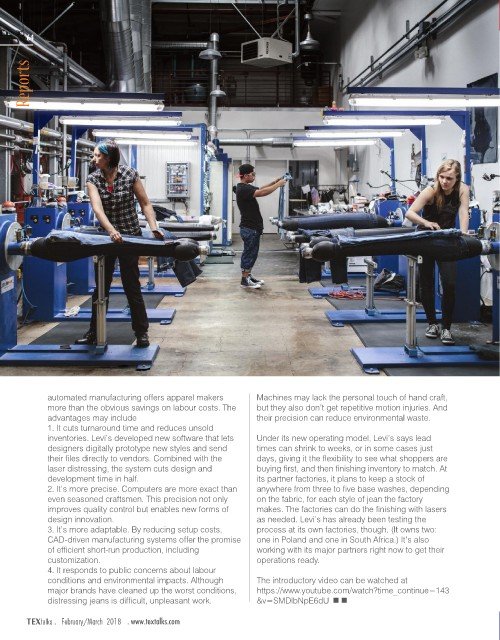
 right by the planet and the people who work in the   manufacturing, to catering to consumer demand.    automated manufacturing offers apparel makers   Machines may lack the personal touch of hand craft,
 apparel supply chain. Project F.L.X. could transform   more than the obvious savings on labour costs. The   but they also don’t get repetitive motion injuries. And
 the jean finishing process, or when the pants get   Levi’s designers use new software to sketch out a   advantages may include  their precision can reduce environmental waste.
 given their signature distressed look, from the   specific look for a pair of jeans. Then, they send that   1. It cuts turnaround time and reduces unsold
 prototype stage all the way to mass production. Levi   design file to the robot, which uses lasers to recreate   inventories. Levi’s developed new software that lets   Under its new operating model, Levi’s says lead
 Strauss worked with Spanish company Jeanologia,   the look on a basic pair of jeans. Instead of each   designers digitally prototype new styles and send   times can shrink to weeks, or in some cases just
 which specialises in industrial lasers, to develop the   prototype requiring between 12 and 18 steps, the   their files directly to vendors. Combined with the   days, giving it the flexibility to see what shoppers are
 new methods. Since 1993, Jeanologia operated with   process is now just three. Project F.L.X. also   laser distressing, the system cuts design and   buying first, and then finishing inventory to match. At
 the ambition of advancing sustainable apparel   streamlines the process of replicating the look of a   development time in half.   its partner factories, it plans to keep a stock of
 manufacturing by delivering disruptive technologies,   pair of genuinely vintage jeans. A designer simply   2. It’s more precise. Computers are more exact than   anywhere from three to five base washes, depending
 including ozone, laser and e-flow finishing systems.   takes a photograph of the jeans, illustrates it, and   even seasoned craftsmen. This precision not only   on the fabric, for each style of jean the factory
 The company’s like-minded focus on scalability was   send it to the robot. Wherever there’s a hole or a rip   improves quality control but enables new forms of   makes. The factories can do the finishing with lasers
 essential to supporting LS&Co.’s end-to-end,   in the illustration, the laser puts a hole or a rip in the   design innovation.  as needed. Levi’s has already been testing the
 transformative vision.  jeans. The robot completes in 90 seconds what   3. It’s more adaptable. By reducing setup costs,   process at its own factories, though. (It owns two:
 would take a human worker eight to 12 minutes.   CAD-driven manufacturing systems offer the promise   one in Poland and one in South Africa.) It’s also
 Levi’s offers over a thousand-different finish looks   Once a designer decides on a look, Levi’s can use   of efficient short-run production, including   working with its major partners right now to get their
 per season. They’re all produced with very   the digital file to accurately mass produce it in their   customization.  operations ready.
 labour-intensive, repetitive motion jobs, and a long   factories across the globe. Specifically, Project F.L.X.   4. It responds to public concerns about labour
 list of chemical formulations. Traditionally, Levi’s   can enable to:  conditions and environmental impacts. Although   The introductory video can be watched at
 might sponge or spray on chemicals, such as   • Replace manual techniques and automate the   major brands have cleaned up the worst conditions,   https://www.youtube.com/watch?time_continue=143
            distressing jeans is difficult, unpleasant work.   &v=SMDlbNpE6dU

                February/March  2018

