


Page 66 - February-March 2021
P. 66
66                                                                                                                                                                                                                             67
                                                          Recycling fibers from


                                                          garment waste into


                                                          technical textiles


            Pureko to install a new Andritz eXcelle needle-punching line for the recycling of
            garments. Founded in 2009, Pureko is one of the most important producers of
            nonwovens in Poland. The company’s nonwoven products are mainly used for wadding;
            they are free of chemicals, do not involve any health hazards, and are hypoallergenic.
            Pureko’s products carry top certificates such as INTERTEK, FIRA, OEKO-TEX, and the
            National Institute of Hygiene.

            The final products will have fabric weights ranging from 300-500 gsm, and production
            capacity will be up to 750 kg/h. Installation and start-up are scheduled for the third
            quarter of 2021. This is the second ANDRITZ line to be supplied to Pureko, thus
            demonstrating the strong partnership between both companies. Three years ago, Pureko
            invested in a new, modern plant supplied by ANDRITZ Asselin-Thibeau to produce soft
            nonwovens in the furniture, textile, and clothing industries. The new line will enable
            Pureko to continue its ongoing growth.


                                                          Color Max won                                                               FabBRICK: An innovative company


                                                          the best product                                                                    converting textile waste into

                                                                                                                                                              beautiful bricks
                                                          for ISPO 2021/22                                                         Textile waste is a big problem around the globe. In   with an ecological glue that Merlet developed herself,


                                                          sports category                                                          France, it's estimated to be around 4 million tons, and   then pressed into a brick mold. This mold uses
                                                                                                                                                                                    mechanical compression to form the bricks, so it
                                                                                                                                   that's just a fraction of what gets tossed globally; it
                                                                                                                                   was 17 million tons in the United States three years
                                                                                                                                                                                    requires no energy beyond what a human worker needs
                                                                                                                                   ago. Very little of that discarded clothing is collected
                                                                                                                                                                                    mold and set out to dry for two weeks before using.
                                                                                                                                   for reuse or recycling, less than a third in France, and   to press it down. The wet bricks are removed from the
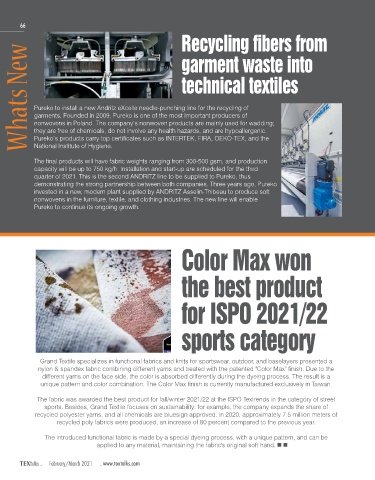
              Grand Textile specializes in functional fabrics and knits for sportswear, outdoor, and baselayers presented a
             nylon & spandex fabric combining different yarns and treated with the patented "Color Max" finish. Due to the         half of that (15%) in the U.S.                   At FabBRICK all creations are thought out and
              different yarns on the face side, the color is absorbed differently during the dyeing process. The result is a                                                        handcrafted in workshop in the heart of Paris. Since
              unique pattern and color combination. The Color Max finish is currently manufactured exclusively in Taiwan.          Clarisse Merlet, a French architecture, came up with
                                                                                                                                   the idea for FabBRICK, her award-winning company   the creation at the end of 2018, the company had
                                                                                                                                   that makes decorative and insulative bricks out of old   already designed more than 40,000 bricks which
             The fabric was awarded the best product for fall/winter 2021/22 at the ISPO Textrends in the category of street       clothes. The basic component of the bricks is    represent 12 tons of recycled textiles. Three
               sports. Besides, Grand Textile focuses on sustainability: for example, the company expands the share of                                                              machines have been developed to make the project
            recycled polyester yarns, and all chemicals are bluesign approved. In 2020, approximately 7.5 million meters of        shredded clothing, which Merlet purchases        bigger. The latest version has been duplicated five
                                                                                                                                   pre-ground from a supplier in Normandy. Each brick
                   recycled poly fabrics were produced, an increase of 80 percent compared to the previous year.                                                                    times, to be able to increase the production capacity.
                                                                                                                                   uses the equivalent of two to three T-shirts' worth of   The next step is to industrialize the manufacturing
                                                                                                                                   material and, any kind can be used, including cotton,
               The introduced functional fabric is made by a special dyeing process, with a unique pattern, and can be             polyester, elastane, PVC, etc. The scraps are mixed   process so that we will be able to recycle even more
                                applied to any material, maintaining the fabric's original soft hand.                                                                               textile waste.

                February/March 2021                                                                                                                                                                        February/March 2021

