


Page 72 - February-March 2021
P. 72
Recycling
       72                                                                                                                                                                                                                              73


                                                                                                                                             breakthrough:


                                                                                                                                  Researchers have


                                                                                                                                                 successfully


                                                                                                                                     converted cotton


                                                                                                                                    into Spandex and


            Purissimo: A natural allergen control                                                                                                                  Nylon


                                                                                                                                     So far, recycling cotton means converting into other cotton products. What if we could recycle cotton into
                               technology for textiles                                                                               Nylon and Spandex? Is it possible? The answer is a big YES! Researchers from Sweden’s Lund University
                                                                                                                                     have found a way to convert cotton into sugar, which in turn can be made into spandex, nylon, or ethanol.

                                                                                                                                        Edvin Ruuth is working at the Department of Chemical Engineering in Lund. There is a great deal of
                                                                                                                                    information about using micro-organisms and enzymes to transform the “tougher” carbohydrates in biomass
                                                                                                                                    into simpler molecules. This means that everything from biological waste and black liquor to straw and wood
                                                                                                                                      chips can become bioethanol, biogas and chemicals. In the new research, scientists have succeeded in
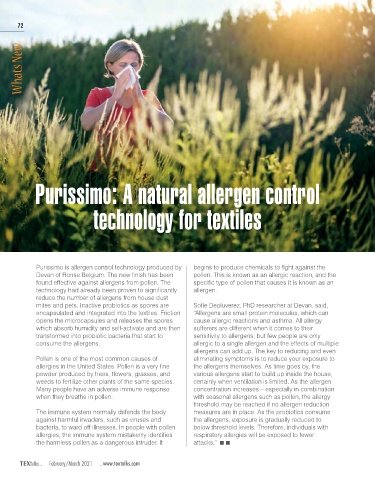
            Purissimo is allergen control technology produced by   begins to produce chemicals to fight against the                breaking down the plant fiber in cotton, the cellulose, into smaller components. However, no micro-organisms
            Devan of Ronse Belgium. The new finish has been   pollen. This is known as an allergic reaction, and the                 or enzymes are involved. Instead, the process involves soaking the fabrics in sulphuric acid. The result is a
            found effective against allergens from pollen. The   specific type of pollen that causes it is known as an                                           clear, dark, amber-colored sugar solution.
            technology had already been proven to significantly   allergen.
            reduce the number of allergens from house dust                                                                           The researchers started making glucose out of fabrics a year ago, the return was a paltry three to four per
            mites and pets. Inactive probiotics as spores are   Sofie Depluverez, PhD researcher at Devan, said,                      cent. Now he and his colleagues have reached as much as 90 per cent. Once the recipe formulation is
            encapsulated and integrated into the textiles. Friction   “Allergens are small protein molecules, which can             complete, it will be both relatively simple and cheap to use. However, for the process to become a reality, the
            opens the microcapsules and releases the spores   cause allergic reactions and asthma. All allergy                     logistics must work. There is currently no established way of managing and sorting various textiles that are not
            which absorb humidity and self-activate and are then   sufferers are different when it comes to their                                                sent to ordinary clothing donation points.
            transformed into probiotic bacteria that start to   sensitivity to allergens, but few people are only
            consume the allergens.                            allergic to a single allergen and the effects of multiple              Fortunately, a recycling center unlike any other in the world is currently under construction in Malmö, where
                                                              allergens can add up. The key to reducing and even                    clothing is sorted automatically using a sensor. Some clothing will be donated, rags can be used in industry
            Pollen is one of the most common causes of        eliminating symptoms is to reduce your exposure to                       and textiles with sufficiently coarse fibers can become new fabrics. The rest will go to district heating.
            allergies in the United States. Pollen is a very fine   the allergens themselves. As time goes by, the
            powder produced by trees, flowers, grasses, and   various allergens start to build up inside the house,                  Hopefully, the proportion of fabrics going to district heating will be significantly smaller once the technology
            weeds to fertilize other plants of the same species.   certainly when ventilation is limited. As the allergen           from Lund is in place. From a normal sheet, they extract five liters of sugar solution, with each liter containing
            Many people have an adverse immune response       concentration increases – especially in combination                    the equivalent of 33 sugar cubes. However, you couldn’t turn the liquid into a soft drink as it also contains
            when they breathe in pollen.                      with seasonal allergens such as pollen, the allergy                                                       corrosive sulphuric acid.
                                                              threshold may be reached if no allergen reduction
            The immune system normally defends the body       measures are in place. As the probiotics consume                       Ruuth said, “What makes cotton unique is that its cellulose has a high crystallinity. This makes it difficult to
            against harmful invaders, such as viruses and     the allergens, exposure is gradually reduced to                         break down the chemicals and reuse their components. In addition, there are a lot of surface treatment
            bacteria, to ward off illnesses. In people with pollen   below threshold levels. Therefore, individuals with            substances, dyes and other pollutants which must be removed. And structurally, a terrycloth towel and an old
            allergies, the immune system mistakenly identifies   respiratory allergies will be exposed to fewer                      pair of jeans are very different. Thus it is a very delicate process to find the right concentration of acid, the
            the harmless pollen as a dangerous intruder. It   attacks.”                                                                                     right number of treatment stages and temperature.”


                February/March 2021                                                                                                                                                                        February/March 2021

