


Page 50 - January-February-2021
P. 50
EL PRIMER SUAVIZANTE RECICLABLE
 THE FIRST RECYCLED SOFTENER
 El sistema circular de la CHT
 CHT’s Circular System
 La silicona es un material versátil que se utiliza en una
 Silicone is a versatile material that finds use in a wide
 amplia gama de aplicaciones diferentes y, como tal, su
 range of different applications, and as such its commercial
 importance is significant. Silicones are an integral part
 importancia comercial es significativa. Las siliconas son
 parte integral del acabado de los artículos textiles en forma
 of textile finishing as softeners, waterproofing agents,
 de suavizantes, agentes impermeabilizantes, antiespumantes
 defoaming agents or lubricants. However, the production
 of silicones is extremely energy intensive. In order to
 o lubricantes. Sin embargo, la producción de siliconas es
 extremadamente intensiva en energía. Con el fin de explotar
 fully exploit the value of this resource, end-of-life silicone
 plenamente el valor de este recurso, los productos de
 products are recycled. As a result, today’s silicone waste
 silicona al final de su vida útil se pueden reciclar. Como
 can be used to produce an important alternative raw
 resultado, los residuos de silicona de hoy pueden ser
 material for tomorrow.
 utilizados para producir una importante materia prima
 alternativa para el mañana.
 New way of thinking - new way of creating
 Post-consumed products normally become waste. CHT
 Nueva forma de pensar - nueva forma de crear
 uses this post-consumed materials as new raw material.
 Los productos consumidos se convierten en desperdicios.
 TUBINGAL RISE can be applied on new textiles. These
 La CHT usa estos productos consumidos como nueva
 textiles can be used and subsequently recycled back again.
 materia prima. El TUBINGAL RISE, se puede aplicar
 This represents a circular economy.
 a textiles nuevos. Estos textiles se pueden usar y
 End-of-life Silicones
 posteriormente volver a ser reciclados otra vez. Esto es
 la economía circular.
       50
                   Wicking height according to M&S 136 B            136 B [mm]      MOISTURE MANAGEMENT
                   100
                   80
                   60
                   40
                   20
 RETAKE  REGENERATE  REMAKE  REUSE
 „End-of-life Silicones“   Recycling to silicone oil,   Application of softener   New textiles are used   0  10 s  30 s  60 s  5 min  30 min
 are collected and   then processing to the   on textiles (e.g. recycled   and can be recycled   untreated  TUBINGAL RISE
 processed  softener TUBINGAL RISE  materials rPES, rCO)  again.
                   Wicking height according to M&S 136 B            136 B [mm]     MOISTURE MANAGEMENT
                   100
                    80
                    60
 characteristics of TUBINGAL® RISE are:
 • Made of recycled silicone and renewable   40
 CHT has launched World's First-ever recycled   market. TUBINGAL® RISE enriches recycled   bio-based emulsifiers  End-of-Life Polymer  20
 silicone softener named Tubingal® Rise. Silicone is a   materials by creating a fully integrated and   • Hydrophilic silicone softener, microemulsion
 versatile material that finds use in a wide range of   • Soft, flowing feel with pronounced core softness  0
 different applications, and as such, its commercial   • Treated products have excellent re-wetting   10 s  30 s  60 s  5 min  30 min
 importance is significant. Global sales in the silicone   properties  WASTE   Silicone recycling follows the waste-to-value process    untreated  TUBINGAL RISE
 market in 2017 amounted to over USD 16.3 billion.   • Improved sewability  TO   and takes place across several stages. End-of-life   textiles. This can be avoided by applying   and fast-drying properties are ensured
 Silicones are an integral part of textile finishing as   • Improved tear resistance  polymers are catalytically split into silicone monomers,  TUBINGAL® RISE, which delivers excellent surface   (BeSo®ACTIVE). Both are core properties for the
 softeners, waterproofing agents, defoaming agents,   • Can be combined very successfully with selected   VALUE  modified, and then finally polymerized into e.g. a new   smoothness. The flexibility of meshes is   moisture management of modern functional textiles.
 or lubricants.  optical brighteners  amino-modified silicone in virgin quality, which can be   strengthened, and friction between the sewing   Hydrophilic textiles show a better moisture
 • Excellent resistance to yellowing, therefore well   Polymer  Monomere  needle and the textiles (fiber/metal friction) is   absorption; moisture is absorbed quickly and
 The production of silicones is hugely   suited to all-white products  formulated into a fabric softener.  reduced significantly by up to 75%.  transported to the outside, where they can

 energy-intensive. To fully exploit the value of this   • Suitable for pad applications  evaporate. The determination of the wicking
 resource, end-of-life silicone products are recycled.   The softeness avoids unnecessary textile wastage.   properties is a rate for the hydrophilic properties of
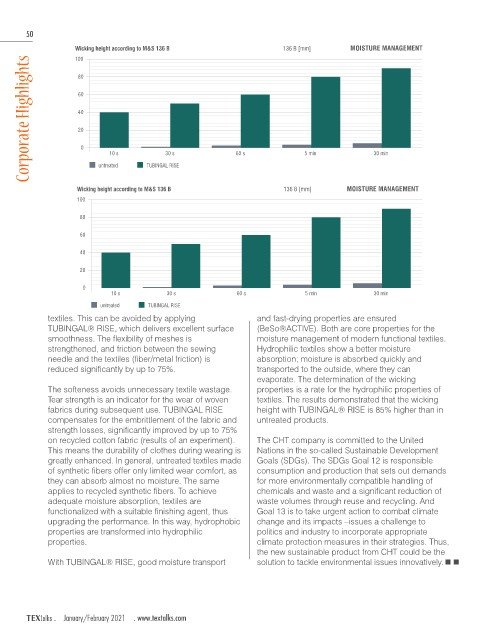
 As a result, today's silicone waste can be used to   In the past, production methods for manufacturing   Tear strength is an indicator for the wear of woven   textiles. The results demonstrated that the wicking
 produce a critical alternative raw material for   silicone fabric softeners were based entirely on linear   fabrics during subsequent use. TUBINGAL RISE   height with TUBINGAL® RISE is 85% higher than in
 tomorrow. The approach to silicone recycling follows   concepts. With the development and production of   compensates for the embrittlement of the fabric and   untreated products.
 the waste-to-value process and takes place across   TUBINGAL® RISE (Recycled Innovative Silicone   strength losses, significantly improved by up to 75%
 several stages. The end-of-life polymers are   Emulsion), the world's first fabric softener made of   mean particle size of < 100 nm. This means the   on recycled cotton fabric (results of an experiment).   The CHT company is committed to the United
 catalytically split into silicone monomers, modified,   more than 60% recycled and reprocessed silicone   active ingredients can penetrate far into the fiber's   This means the durability of clothes during wearing is   Nations in the so-called Sustainable Development
 and then finally polymerized into, e.g., a new   waste and renewable bio-based emulsifiers has now   interior, making it possible to achieve exceptional   greatly enhanced. In general, untreated textiles made   Goals (SDGs). The SDGs Goal 12 is responsible
 amino-modified silicone in virgin quality can be   been made available to the market. The quality of   core softness with a very soft, flowing feel. Not only   of synthetic fibers offer only limited wear comfort, as   consumption and production that sets out demands
 formulated into a fabric softener.  this pro- duct deserves to be mentioned, as it is   can TUBINGAL® RISE be used to achieve softness   they can absorb almost no moisture. The same   for more environmentally compatible handling of
 identical to a silicone softener made of primary raw   (BeSo®SOFT) excellently, but the innovative product   applies to recycled synthetic fibers. To achieve   chemicals and waste and a significant reduction of
 To date, the circular economy strategy has been   resource-efficient recycling-based product right to   materials.  also serves as a processing aid by noticeably   adequate moisture absorption, textiles are   waste volumes through reuse and recycling. And


 applied primarily to recycled fibers. But in the future,   the principles of a modern circular economy.  improving the confection of clothing products and   functionalized with a suitable finishing agent, thus   Goal 13 is to take urgent action to combat climate
 we can expect to see this trend also make its way   their properties while being used/worn.  upgrading the performance. In this way, hydrophobic   change and its impacts –issues a challenge to
 into the world of textile finishing to an increasing   TUBINGAL® RISE meets the wide-ranging   The softener consisting of recycled silicone is   properties are transformed into hydrophilic   politics and industry to incorporate appropriate
 degree. CHT has already set out on a clear path   requirements for textile standards (Bluesign, ZDHC,   suitable for all types of fiber. Potential areas of   The softener was applied on fabrics, and the test   properties.  climate protection measures in their strategies. Thus,
 down this road. Whereas textile auxiliaries' previous   GOTS, Standard 100 by Oeko-Tex, and GRS). A   application include apparel, sports, and outdoor   results were conducted to investigate sewability and   the new sustainable product from CHT could be the
 production for textile functionalization was based on   critical characteristic of this recycled softener is that it   clothing, as well as home textiles. TUBINGAL® RISE   tear resistance and the wicking height results.   With TUBINGAL® RISE, good moisture transport   solution to tackle environmental issues innovatively.
 the use of primary raw materials, a softener made   has been specially designed to be suitable for the   is the perfect match for recycled materials to achieve   Embrittlement and losses in strength and the
 from recycled silicone and renewable bio-based   production of textile products that are certified to the   a fully integrated recycling concept.  everincreasing speeds at which industrial sewing
 emulsifiers is now available for the first time for this   GRS Standard (Global Recycled Standard). The   machines run can cause damage in the form of
 The hydrophilic softener is a microemulsion with a   sewing damages, which impairs the sewability of the
                January/February 2021

