


Page 74 - January-February-2021
P. 74
74                                                                                                                                                                                                                             75
                                                                                                                                           A novel method of cotton dyeing with


                                                             A new sustainable                                                            improved dye fixation by 31.13% and

                                                                                                                                           decreased dye discharge by 72.41%
                                                             woven fabric                                                          Cotton and other cellulose substrates comprise over   only 9.31, 56.63%, respectively. Therefore, the new


                                                             range by Artistic                                                     40% of the world's textile consumption. Cotton   method improved the dye fixation by 31.13% and
                                                                                                                                                                                    reduced the effluent discharge by 72%.
                                                                                                                                   dyeing with reactive dye requires enormous amounts
                                                                                                                                   of salts to facilitate dye adsorption. Large quantities
                                                                                                                                   of water are used to clean hydrolyzed dyes, which   The silicone reverse emulsion dyeing system
                                                                                                                                   generates large volumes of wastewater and        contains a small amount of water. These dyeing
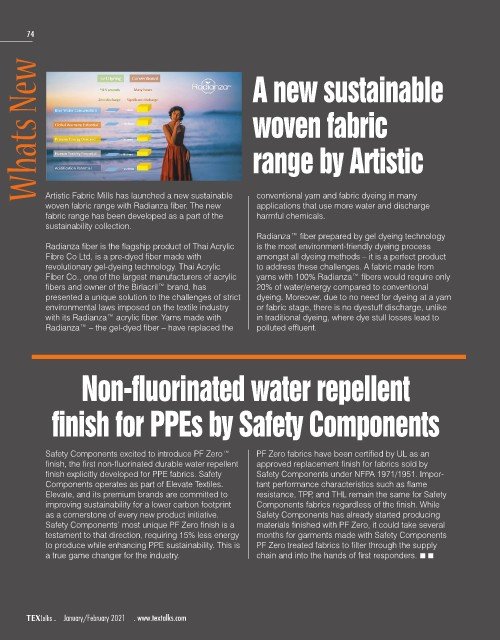
            Artistic Fabric Mills has launched a new sustainable   conventional yarn and fabric dyeing in many                     consumes high energy. The amount of salts ranges   conditions may reduce the hydrolysis of dye. The
            woven fabric range with Radianza fiber. The new   applications that use more water and discharge                       from 5 to 125 on the weight of the fabric. As a result,   energy gap between vinyl sulfone and β-hydroxyethyl
            fabric range has been developed as a part of the   harmful chemicals.                                                  conventional reactive dyeing is not environmentally   sulfone is 51.0 kcal/mol in the aqueous system,
            sustainability collection.                                                                                             friendly. Researchers are trying hard to reduce   which is lower than that in the silicone reverse
                                                              Radianza™ fiber prepared by gel dyeing technology                    pollution to the environment by the dyeing of cotton.   emulsion dyeing system (52.2 kcal/mol in silicone).
            Radianza fiber is the flagship product of Thai Acrylic   is the most environment-friendly dyeing process                                                                The same trend is observed for the energy gap
            Fibre Co Ltd, is a pre-dyed fiber made with       amongst all dyeing methods – it is a perfect product                 Recently a report published by the prestigious   between the triazine dye and the hydroxyl triazine dye
            revolutionary gel-dyeing technology. Thai Acrylic   to address these challenges. A fabric made from                    research journal, Cellulose, highlighted a silicone   (26.5 kcal/mol in silicone vs. 22.8 kcal/mol in water),
            Fiber Co., one of the largest manufacturers of acrylic   yarns with 100% Radianza™ fibers would require only           reverse emulsion dyeing system to dye cellulosic   confirming that the hydrolysis of the bifunctional
            fibers and owner of the Birlacril™ brand, has     20% of water/energy compared to conventional                         textile with reactive dye. When the dye amount is the   reactive dye needs higher energy in the silicone
                                                                                                                                                                                    reverse emulsion dyeing system.
            presented a unique solution to the challenges of strict   dyeing. Moreover, due to no need for dyeing at a yarn        same, the color depth of dyed cotton fiber is 13.82,
            environmental laws imposed on the textile industry   or fabric stage, there is no dyestuff discharge, unlike           and the fixation of dye is 87.76% in the new process.   The utilization of the new method could be a
            with its Radianza™ acrylic fiber. Yarns made with   in traditional dyeing, where dye stull losses lead to              In the traditional water-based dyeing system, the   sustainable approach to reduce dye wastage and
            Radianza™ – the gel-dyed fiber – have replaced the   polluted effluent.                                                color depth of dyed cotton fiber and dye fixation is   environmental pollution.


                    Non-fluorinated water repellent                                                                                      Innovative, durable, and sustainable


             finish for PPEs by Safety Components                                                                                   water repellent finish DOWSIL™ IE-8749


            Safety Components excited to introduce PF Zero™   PF Zero fabrics have been certified by UL as an                       A new generation of durable water repellent finishes   optimum levels of water repellency and durability.
            finish, the first non-fluorinated durable water repellent   approved replacement finish for fabrics sold by             for fabrics has been launched by Dow Materials
            finish explicitly developed for PPE fabrics. Safety   Safety Components under NFPA 1971/1951. Impor-                    Science Company. The new product, DOWSIL™       A typical formulation should be adjusted, based on
            Components operates as part of Elevate Textiles.   tant performance characteristics such as flame                       IE-8749 Emulsion, is fluoroalkyl-free silicone   the fabric pick-up, to enable 2–3% of DOWSIL™
            Elevate, and its premium brands are committed to   resistance, TPP, and THL remain the same for Safety                  emulsion concentrate for durable water repellent   IE-8749 Emulsion actives (solids)
            improving sustainability for a lower carbon footprint   Components fabrics regardless of the finish. While              finishes on textiles.  The product is non-ionic, and its
            as a cornerstone of every new product initiative.   Safety Components has already started producing                     chemistry is modified polydimethylsiloxane.     on-weight-of-fabric (owf). Besides, a blocked
            Safety Components’ most unique PF Zero finish is a   materials finished with PF Zero, it could take several                                                             isocyanate crosslinker should be included at a ratio
            testament to that direction, requiring 15% less energy   months for garments made with Safety Components                Formulations using DOWSIL™ IE-8749 Emulsion are   of 4:1 silicone actives to crosslinker actives. Finally,
            to produce while enhancing PPE sustainability. This is   PF Zero treated fabrics to filter through the supply           intended to be applied in a factory in a continuous   a glycol penetrant is recommended to be added at
            a true game changer for the industry.             chain and into the hands of first responders.                         manner where heat curing can be done to fully set the   1–3% owf. Of course, these values and ratios are a
                                                                                                                                    finish on the fabric. The company ecommends to   starting point. The formulation parameters for each
                                                                                                                                    include a blocked isocyanate crosslinker and a glycol   application should be thoroughly evaluated before
                                                                                                                                    penetrant in the formulated finish bath to achieve   commencing with fabric finishing production.


                January/February 2021                                                                                                                                                                     January/February 2021

