


Page 65 - TEXtalks. January-February 2023
P. 65
64                                                                                                              65
 A new grading system for moisture   Project Arrow Smart


 management testing   textiles with knitted sensors


 Users can now be confident through the James Heal test method and grading system. UK-based textile testing   and actuators
 solutions provider James Heal has announced a revolutionary new grading system for moisture management
 testing that literally turns the assessment of wicking behavior within a fabric on its head. A good wicking fabric or
 textile needs to encompass characteristics that allow the movement of moisture effectively across a large area
 using capillary action. This is incredibly important to the wearer's comfort and also safety in many circumstances
 such as extreme heat or cold conditions.

 The WickView instrument technology has advanced more quickly than the industry test standards, which use
 basic distance and time as a measure to assess the spread of moisture, rather than the exact movement in
 multiple directions.

 James Heal has created a test method and system of grading to ensure systematic, accurate product testing in
 laboratories, and a software system that also enables the sharing of data and real-time video footage recorded
 of the actual test, electronically with colleagues or partners based in other locations. Results can be read
 individually or in different combinations to suit the scope of the testing, enabling users to understand and
 interpret their meaning in the context of the textile being tested, and where needed shared via email or online
 with their customers such as retailers or brand owners.


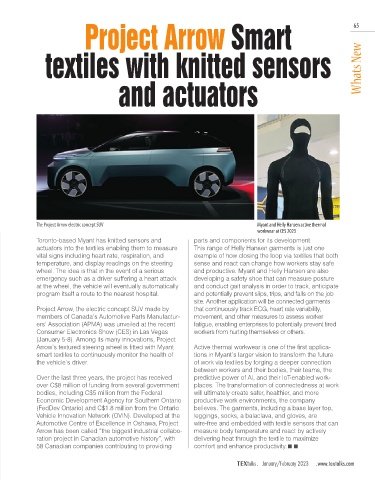
             The Project Arrow electric concept SUV                               Myant and Helly Hansen active thermal
                                                                                  workwear at CES 2023
             Toronto-based Myant has knitted sensors and      parts and components for its development.
             actuators into the textiles enabling them to measure
                                                              This range of Helly Hansen garments is just one
 Smart textile sensor for early   vital signs including heart rate, respiration, and   example of how closing the loop via textiles that both
             temperature, and display readings on the steering
                                                              sense and react can change how workers stay safe
                                                              and productive. Myant and Helly Hansen are also
             wheel. The idea is that in the event of a serious
 detection of tuberculosis (TB)  emergency such as a driver suffering a heart attack   developing a safety shoe that can measure posture
             at the wheel, the vehicle will eventually automatically
                                                              and conduct gait analysis in order to track, anticipate
                                                              and potentially prevent slips, trips, and falls on the job
             program itself a route to the nearest hospital.
                                                              that continuously track ECG, heart rate variability,
             Project Arrow, the electric concept SUV made by   site. Another application will be connected garments
 Textiles are no more commodity items. With each passing day, technological advancements are taking   members of Canada’s Automotive Parts Manufactur-  movement, and other measures to assess worker
 textiles to a new level. Textile-based smart sensors are the perfect example of these rapid developments.   ers’ Association (APMA) was unveiled at the recent   fatigue, enabling enterprises to potentially prevent tired
 Scientists are developing a low-cost smart textile sensor for early detection of tuberculosis in people and   Consumer Electronics Show (CES) in Las Vegas   workers from hurting themselves or others.
 cattle which they hope will help tackle the spread of the disease in Asia and Africa.   (January 5-8). Among its many innovations, Project
             Arrow’s textured steering wheel is fitted with Myant   Active thermal workwear is one of the first applica-
 The Nottingham Trent University project – the first of its kind – aims to target disease transmission in farms   smart textiles to continuously monitor the health of   tions in Myant’s larger vision to transform the future
 and farming communities in developing countries. The researchers are creating a smart textile wearable   the vehicle’s driver.  of work via textiles by forging a deeper connection
 sensor that would alert the wearer to early-stage TB when detected in their sweat, along with a separate   between workers and their bodies, their teams, the
 sensor that would identify it in the saliva of cattle during the milking process. TB is caused by bacteria that   Over the last three years, the project has received   predictive power of AI, and their IoT-enabled work-
 typically affects the lung and is a zoonotic disease, meaning it can be naturally transmitted from animals to   over C$8 million of funding from several government   places. The transformation of connectedness at work
 humans. While human TB can be treated with antibiotics, this is not the case for cattle, and many countries   bodies, including C$5 million from the Federal   will ultimately create safer, healthier, and more
 have poor detection systems and healthcare.   Economic Development Agency for Southern Ontario   productive work environments, the company
             (FedDev Ontario) and C$1.8 million from the Ontario   believes. The garments, including a base layer top,
 The Nottingham researchers aim to develop a cheap, biodegradable, and non-invasive device with a tiny   Vehicle Innovation Network (OVIN). Developed at the   leggings, socks, a balaclava, and gloves, are
 fabric strip sensor, about 0.1 mm thick, that would react with TB bacteria and give a reading of latent TB or   Automotive Centre of Excellence in Oshawa, Project   wire-free and embedded with textile sensors that can
 nothing. The technology would help to reduce transmission among people in communities and enable   Arrow has been called “the biggest industrial collabo-  measure body temperature and react by actively
 intervention through the early segregation of infected cattle, minimizing the risk of endangering and potential-  ration project in Canadian automotive history”, with   delivering heat through the textile to maximize
 ly slaughtering other animals.    58 Canadian companies contributing to providing   comfort and enhance productivity.

 January/February 2023                                                              January/February 2023

