


Page 60 - July-August-2017
P. 60
be neglected because they rarely visit us twice.” That
who want information on the products they
™ Antimicrobial, Dow’s advanced odor-control
is sound advice for the global textile and apparel
purchase and their performance attributes. In
technology for apparel and textiles.
industry when it comes to marketing to millennials,
July 2016, Dow Microbial Control addressed
whose mindset, consumer behaviors and spending
this issue by introducing the INTELLIFRESH™
This intelligent technology neutralizes odor-causing
power are reshaping the global economy and
brand, which is designed to give consumers
bacteria on fabric surfaces, which directly plays into
creating a substantial and viable marketing opportunity
consumer desires for healthy, sustainable lifestyles.
peace of mind that the products they purchase
for product manufacturers and brand owners.
are providing the reliable, durable odor control
For example, apparel products treated with
and long-lasting freshness protection that is so
SILVADUR stay fresher longer, which reduces the
How substantial an opportunity? Millennials, generally
need for frequent launderings, saving water and
important to them. The INTELLIFRESH brand on
defined as people born between about 1980 and the
a product is a signal that Dow’s SILVADUR
energy, as well as time that is so valuable to today’s
early 2000s, number 1.7 billion people or approximately
technology is in the product and performing at
busy millennials.
one out of every four people on the planet.
a high level.
Since its introduction, SILVADUR technology has
Shared Values
INTELLIFRESH is available to select manufacturers
enabled many brands to provide long-lasting odor
A growing body of research shows that while
protection across a wide array of product lines.
and retailers of consumer goods who collaborate
millennials are impacted by their local cultures, there
These include, but are not limited to,
with Dow through a brand licensing and quality
are more commonalities among them than there are
assurance program. The quality assurance program
commonly-worn base-layer products where odor
differences. That is because they share the same
is designed to ensure that all products featuring the
can build up, such as t-shirts and underwear, sports
information channels and media content with their
and fitness apparel, socks and shoes. SILVADUR is
INTELLIFRESH label meet measurable and
peers in other countries, courtesy of the internet and
quantifiable performance standards, specifications
also adding value in denim, including jeans, and
social media, helping them form common
and quality protocols and comply with industry and
casual clothes for men, as well as home textiles,
perspectives, values, behaviors and motivations.
regulatory requirements.
such as bed linens, sheets, pillows and rugs, and
other product categories.
The research highlights some overarching trends that
An Opportunity for the Taking
provide a roadmap to successfully marketing textile
Extensive testing has shown that SILVADUR has a
Clearly, the opportunity has never been greater for
and apparel products to millennials no matter where
those manufacturers and retailers of apparel and
high degree of efficacy against a wide range of
they live. Findings from the research company
textile products who understand the enormity of the
odor-causing bacteria and is highly durable.
Nielson, which are confirmed by Dow Microbial
millennial cohort and the importance they and other
Feedback from apparel manufacturers indicates
Control proprietary research, show that:
consumers place on personal and family health and
that the technology is efficient and effective and the
• Among the most prominent trends among
wellness. Those who partner with Dow Microbial
application process is easy to adopt and use. The
millennials is a desire for sustainable, balanced,
solution is compatible with softeners, optical
Control to take advantage of this opportunity by
healthy lifestyles and a need to assert greater control
manufacturing and marketing products that feature
brighteners and most auxiliary agents and does not
business practices of the companies that produce
over their personal and family health and wellness.
react with other chemical treatments. It can be
advanced odor control technology and longer
and sell them.
• Almost 75 percent of millennials are willing to pay
lasting freshness can be rewarded with increased
easily incorporated into the existing operating
extra for sustainable offerings and believe that their
systems of a mill, using either exhaustion or
sales, higher margins and repeat purchases
personal values are more important than personal
Dow: Ahead of the Trend
by loyal customers.
padding processes, without requiring excessive
benefits, such as cost savings.
Dow Microbial Control recognized the emerging
processing temperatures, times or added binders. It
need among millennials and others for a healthy,
• Millennials expect today’s products to have
Author Karel Williams is global strategic marketing
can also be applied by spraying or other methods.
more sustainable lifestyle and developed a strategy
increasingly better performance benefits than
associate director and brand manager for Dow
yesterday’s products.
to help apparel and textile manufacturers take
Microbial Control. He can be reached at
Giving Consumers Peace of Mind
advantage of it. That strategy initially played out in
• Millennials want to be more informed about how
klwilliams@dow.com
SILVADUR is an ingredient technology, making it
60 “Opportunities,” it has often been said, “should not the products they purchase perform and the September 2012 with the introduction of SILVADUR invisible to millennials and other consumers
producers as well as on-demand production of measures to achieve it at the highest level Spain, and supported by Mimaki distributor Digidelta, help reduce environmental impact, and many
we have the production solutions for that. We There are smart textiles, functional textiles and short run custom printed fabrics. possible. Our established environmental purchased the printer from the show floor. more. Unfortunately, only 3% of today’s textile
took the opportunity in Frankfurt to listen to the sportswear – and this is not a classical technical management system, which is operated production worldwide is done through digital printing.
customers and offer our solutions for the textile in terms of industry textile. So, technical TEXtalks: How different ink types in the new Mimaki company-wide, monitors and supports continuous TEXtalks: What was the customer response at Therefore, we want to keep educating the market so
production of manmade fibers. fibers will be more and more part of our daily printers can be helpful in changing the printing in improvement. This earned us ISO 14001 Techtextil/Texprocess? that people are more aware about the advantages of
life. But there is another topic at the Techtextil textile? certification in 2009. We promote recycling Yuji Ikeda: We’ve also had positive feedback from digital textile printing. We feel that the Digital Textile
TEXtalks: How do you see the future of technical that you can see more and more coming up – Yuji Ikeda: The variety of inks we have for our programmes, waste segregation, and thorough our participation in the Digital Textile Micro Factory Micro Factory was a good platform to introduce that
textiles? it’s the composites topic. There are also a lot of printers enables users to access a more diverse control of harmful chemicals to reduce our feature at Texprocess. Digital print technology has complete workflow for digital textile production, and
André Wissenberg: The future of technical textiles technical textiles in this regard. So, I see the range of materials. It also allows companies to industrial waste. We also adopt the “doing it right so much to offer to the textile industry; it can print we are glad that visitors to the show were as
has many opportunities and as we can see here Techtextil will grow and will adapt and take over think differently about their production the first time” policy, reducing failure rate during small-runs more effectively, has the potential to enthusiastic as we are.
at Techtextil in Frankfurt more and more other topics like apparel and maybe environments and not be limited only to one type manufacturing to eliminate waste and run a
technical textiles will be used in daily apparel. hometextiles – like the composites. of ink, while still using the technology they are smooth production process.
familiar with.
In terms of products, our Tx300P series is also as
In addition, in the textile print market, there is environmentally sustainable as it is innovative. The
Mimaki is a leading manufacturer of wide-format TEXtalks: Comparatively to the recent market, to what growing demand for shorter runs, faster deliveries, entry-level model utilises both textile pigment and An Interview with
inkjet printers and cutting machines for the extent these machines will be cost effective in terms and more customised production of textile sublimation dye inks in one machine, reducing the
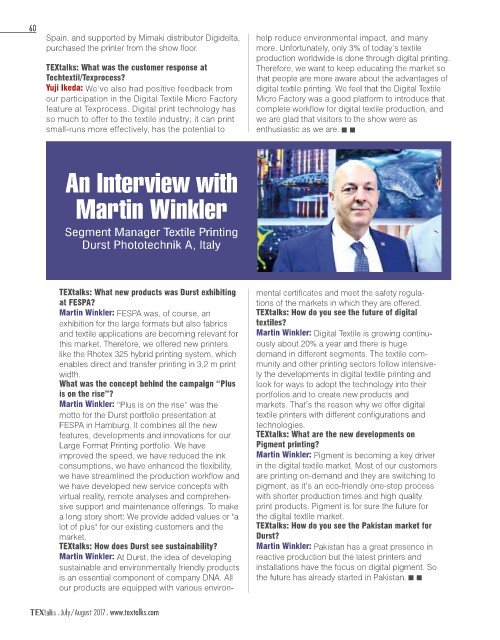
sign/graphics, textile/apparel and industrial of digital printing, in coming days? products across the board. The combination of our amount of water usage. Furthermore, our Martin Winkler
markets. Managing director of Mimaki Europe, Mr Yuji Ikeda: Traditionally, only one ink per printer can diverse range of ink types and affordable digital sublimation inks have achieved The STANDARD
Yuji Ikeda, while talking to TEXtalks at Fespa be selected at the time of installation. A textile textile printers is the perfect solution to 100 by OEKO-TEX® product certification, which
Hamburg, briefed about the new products and producer would need two machines if they want to accommodate this demand. validates the safety of our inks to be used in Segment Manager Textile Printing
their efficiency to textile sector. print on both cotton and polyester, as they require sustainable textile production. These are just a few Durst Phototechnik A, Italy
different inks: textile pigment inks for cotton and TEXtalks: What is the response for the new 3D printer,
TEXtalks: Mimaki believes in “Dare to Print Different” hemp materials, sublimation inks for Mimaki 3DUJ-P? examples of Mimaki’s innovative approach to
what difference do you expect, will be brought by polyester-based fabrics. With dual ink capability on Yuji Ikeda: Many visitors expressed their interest in meeting today’s environmental requirements.
Mimaki machines in the world of digital textile the Mimaki Tx300P series, the company will only TEXtalks: How do these machines relate and flourish
printing? need one single printer to print on all these the technology demonstration of our 3D printer. the ideas of industry 4.0? TEXtalks: What new products was Durst exhibiting mental certificates and meet the safety regula-
Yuji Ikeda: Our products offer new possibilities to materials, significantly reducing the They were also especially impressed with the 3D Yuji Ikeda: We are still exploring the idea of Industry at FESPA? tions of the markets in which they are offered.
our customers—they open up new business cost of entry. samples we exhibited, which transcended the 4.0. We do have a vision on the Internet of Things Martin Winkler: FESPA was, of course, an TEXtalks: How do you see the future of digital
usual sign and graphics market, from product
opportunities and new ways to create applications. prototyping to architecture. Visitors were especially approach to a global manufacturing supply chain, exhibition for the large formats but also fabrics textiles? AD
We were, for instance, the first one to launch a Furthermore, neither ink type generally requires pleased to see the water-soluble support materials. and we’ve had the opportunity to show this a and textile applications are becoming relevant for Martin Winkler: Digital Textile is growing continu-
small format UV flatbed printer, which steaming or washing in the post-treatment Typically in 3D printing, there is effort required to couple of times over the years. At last year’s this market. Therefore, we offered new printers ously about 20% a year and there is huge
revolutionized the promotional product industry. process, there is no need for a large space, a huge remove the support “tags” left after printing. With a drupa, for example, we showed our UJF-7151plus like the Rhotex 325 hybrid printing system, which demand in different segments. The textile com-
We also have an affordable solution for printing quantity of water, or special expertise in handling Mimaki 3D print, you simply wash away the UV flatbed printer with a robotic arm to facilitate enables direct and transfer printing in 3,2 m print munity and other printing sectors follow intensive-
directly to cylindrical objects and have taken a very the printed fabric. All that is required is the printer supporting material, and voila, you have a finished unmanned operation. width. ly the developments in digital textile printing and
unique approach to 3D printing. In textiles, we also and colour fixing equipment, making these piece! it is the world’s first truly full-colour What was the concept behind the campaign “Plus look for ways to adopt the technology into their
have very unique solutions that make it easier and entry-level printers very cost-effective. modelling solution and supports up to 10 million TEXtalks: What was the overall customer response on is on the rise”? portfolios and to create new products and
more affordable than ever to produce short to different colours. I think we are off to a good start FESPA 2017? Martin Winkler: “Plus is on the rise” was the markets. That’s the reason why we offer digital
mid-sized runs of digitally printed textiles, TEXtalks: The company is having good sales number with Mimaki 3DUJ-P. Yuji Ikeda: FESPA 2017 was a thrilling success for motto for the Durst portfolio presentation at textile printers with different configurations and
especially in demand for the Fast Fashion industry. for Tx300P-1800B, what is the market response? Mimaki. We are very pleased about the results we FESPA in Hamburg. It combines all the new technologies.
Yuji Ikeda: The Tx300P-1800B has been well features, developments and innovations for our TEXtalks: What are the new developments on
TEXtalks: What features, in Tx300P-1800 and received by the market due to the versatility that it TEXtalks: What is the next approach of Mimaki in achieved. The show continues to exceed our Large Format Printing portfolio. We have Pigment printing?
Tx300P-1800B, are presented in the new offers. By adding the belt system to the already bringing innovation in the world of textile printing? expectations every year and it was indeed our improved the speed, we have reduced the ink Martin Winkler: Pigment is becoming a key driver
direct-to-textile printers that were not available in the popular Tx300P-1800 model, we have enabled a Yuji Ikeda: Aside from the dual ink capability for the most successful edition to date. consumptions, we have enhanced the flexibility, in the digital textile market. Most of our customers
previous versions? wide variety of materials to be produced with this Tx300P series, we also just introduced our first we have streamlined the production workflow and are printing on-demand and they are switching to
Yuji Ikeda: We recently updated our Tx300P-1800 machine, including modern stretchable materials, high volume production direct-to-textile printer, the In addition to the well-received Mimaki 3DUJ, our we have developed new service concepts with pigment, as it’s an eco-friendly one-step process
and Tx300P-1800B direct-to-textile printers with giving our users an even more versatile machine. Tiger-1800B. We are definitely committed to first 3D printer, visitors to the show also responded virtual reality, remote analyses and comprehen- with shorter production times and high quality
bringing more innovative products to the world of
positively to our new offerings for the textile
dual ink capability which is unique in the industry, textile printing. Further developments and industry. In the textile hall, the new Mimaki sive support and maintenance offerings. To make print products. Pigment is for sure the future for
meaning that the printers can now simultaneously With this, Mimaki has done what it has historically information will be revealed when we feel the time Tiger-1800B high-speed direct-to-textile printer a long story short: We provide added values or "a the digital textile market.
load both textile pigment and sublimation dye inks. shown itself to be incredibly good at; making is right. took centre stage, alongside the award-winning lot of plus" for our existing customers and the TEXtalks: How do you see the Pakistan market for
This enables the use of a single printer to print innovative technology accessible at all levels of Tx300P-1800 and Tx300P-1800B. It was the first market. Durst?
directly on a wide range of textiles without the need production. This machine can be used by industrial TEXtalks: What is Mimaki’s belief about sustainability time we showed Tiger-1800B with sublimation ink, TEXtalks: How does Durst see sustainability? Martin Winkler: Pakistan has a great presence in
to change out ink systems—a breakthrough that production factories for sampling and proofing, and how do these machines facilitate the idea? after demonstrating the machine with reactive ink Martin Winkler: At Durst, the idea of developing reactive production but the latest printers and
will improve productivity and increase flexibility for while it is an equally excellent and affordable Yuji Ikeda: Mimaki has always cared about in previous shows. In fact, textile company sustainable and environmentally friendly products installations have the focus on digital pigment. So
these Mimaki textile printers. solution for smaller, entry-level designers and is an essential component of company DNA. All the future has already started in Pakistan.
environmental sustainability and has taken Estampados Hermanos Perez, located in Mataró, our products are equipped with various environ-

