


Page 80 - TEXtalks International July/August 2022
P. 80
80                                                                                                                                                                                                                              81

                                                                 Reima and WWF                                                          Circ developed the revolutionary


                                                                            launched a                                                    technology system that returns


                                                                         new capsule                                                          clothes to the raw materials


                                                                               collection

                                                                                                                                   Circ's central, the Virginia-based textile recycling
                                                                                                                                   startup, claims that it can recycle cotton-polyester   investors Patagonia, Marubeni, and Fashion For Good.
                                                                                                                                   textile blends containing any ratio of the two fiber   The company's technology is uniquely capable of
                                                                                                                                   types. Circ developed the revolutionary technology   separating and recovering mixed polymer streams,
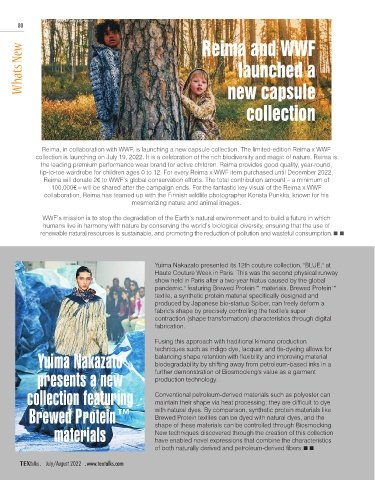
              Reima, in collaboration with WWF, is launching a new capsule collection. The limited-edition Reima x WWF             system that returns clothes to the raw materials from   specifically any blend of polyester and cotton, which
            collection is launching on July 19, 2022. It is a celebration of the rich biodiversity and magic of nature. Reima is   which they were made, preserving the earth's natural   account for most fabrics manufactured and hence,
              the leading premium performance wear brand for active children. Reima provides good quality, year-round,             resources in nature.                             most of the clothing that hangs in our collective
              tip-to-toe wardrobe for children ages 0 to 12. For every Reima x WWF item purchased until December 2022,                                                              closets. Circ's technology is projected to reduce
               Reima will donate 2€ to WWF’s global conservation efforts. The total contribution amount – a minimum of             Most people are unaware of the ingredients that   carbon emissions created by the fashion industry
                 100,000€ – will be shared after the campaign ends. For the fantastic key visual of the Reima x WWF                make our clothing, often forgetting that those   substantially. Circ has raised $30 million in a Series B
               collaboration, Reima has teamed up with the Finnish wildlife photographer Konsta Punkka, known for his              materials come directly from the earth in the form of   funding round. The investment was led by the Bill
                                           mesmerizing nature and animal images.                                                   natural fibers like cotton and synthetic fibers like   Gates-founded Breakthrough Energy Ventures and
                                                                                                                                   polyester, made entirely from petroleum-dependent   joined by the clothing retailer Inditex and the textile
              WWF’s mission is to stop the degradation of the Earth’s natural environment and to build a future in which           plastic. Circ's innovation has caught the attention of   manufacturer Milliken, among other new and
               humans live in harmony with nature by conserving the world’s biological diversity, ensuring that the use of         major brands and organizations, including early   existing investors.
              renewable natural resources is sustainable, and promoting the reduction of pollution and wasteful consumption.


                                                  Yuima Nakazato presented its 12th couture collection, "BLUE," at
                                                  Haute Couture Week in Paris. This was the second physical runway
                                                  show held in Paris after a two-year hiatus caused by the global                                                        OrganoClick introduced
                                                  pandemic." featuring Brewed Protein™ materials. Brewed Protein™
                                                  textile, a synthetic protein material specifically designed and
                                                  produced by Japanese bio-startup Spiber, can freely deform a                                                           food waste-derived binders
                                                  fabric's shape by precisely controlling the textile's super
                                                  contraction (shape transformation) characteristics through digital
                                                  fabrication.

                                                                                                                                   OrganoClick of Sweden has developed a range of 100% bio-based binders for nonwovens derived from waste
                                                  Fusing this approach with traditional kimono production                           components from residual streams in the food industry, such as orange peel, shrimp shells, and wheat bran,
                                                  techniques such as indigo dye, lacquer, and tie-dyeing allows for                and they are fully compostable. Common binders are mainly made of fossil plastic polymers such as ethyl vinyl
             Yuima Nakazato                       balancing shape retention with flexibility and improving material                  technical textiles, and properties that can be enhanced include dry strength, wet strength, and dimensional
                                                                                                                                     acetate (EVA) and acrylates. The binders are used to improve the mechanical properties of nonwoven and
                                                  biodegradability by shifting away from petroleum-based inks in a
             presents a new                       further demonstration of Biosmocking's value as a garment                         stability, with varying degrees of stiffness or softness. Binders that improve fire protection are also included in
                                                  production technology.
                                                                                                                                                                        the OC-BioBinder range.
                                                                                                                                      The binders are adapted for several nonwoven processes such as airlaid, wetlaid, spunlace, spunbond,
          collection featuring                    Conventional petroleum-derived materials such as polyester can                   carded, and drylaid. They can also be used with most natural fibers, such as wood, cotton, viscose, hemp, and
                                                  maintain their shape via heat processing; they are difficult to dye
                                                                                                                                         pulp, and adapted for synthetic fibers such as polyester, PLA, mineral, glass, and blended fibers.
          Brewed Protein™                         with natural dyes. By comparison, synthetic protein materials like                Existing binder products are already used in airlaid napkins, tablecloths, wetlaid agricultural sheeting, wetlaid
                                                  Brewed Protein textiles can be dyed with natural dyes, and the
                  materials                       shape of these materials can be controlled through Biosmocking.                   projects with customers. OrganoClick was founded as a spin-off company from Stockholm University and the
                                                                                                                                      hygiene products, and knitted textile inserts. OrganoClick is currently involved in late-stage development
                                                  New techniques discovered through the creation of this collection
                                                  have enabled novel expressions that combine the characteristics
                                                  of both naturally derived and petroleum-derived fibers.                                                    Swedish University of Agricultural Sciences in 2006.

               July/August 2022                                                                                                                                                                                July/August 2022

