


Page 11 - TEXtalks. March- April 2023
P. 11
10                                                                                                             11
 Better Cotton launches new


 2030 Impact Targets


 Better Cotton, the world’s largest cotton sustainability initiative, announced. These ambitious new metrics form
 part of its ongoing 2030 Strategy and detail plans to galvanize change at the field level in key areas. The new
 target sets out to reduce greenhouse gas emissions by 50% per tonne of Better Cotton lint produced by the
 end of the decade.


 With more than 22 million tonnes produced annually, cotton is one of the world’s most important renewable
 resources and exists in very diverse landscapes. The sector’s development has the potential to reduce poverty
 whilst promoting sustainability and equality which is why four Impact Targets were developed in conjunction
 with leading civil society organizations and industry experts:
 • Sustainable Livelihoods – Sustainably increase the net income and resilience of two million cotton farmers
 and workers.
 • Soil Health – Ensure 100% of Better Cotton farmers have improved the health of their soil.  World Water Day
 • Women’s Empowerment – Reach one million women in cotton with programs and resources that promote
 equal farm decision-making, build climate resilience, or support improved livelihoods. And ensure 25% of field
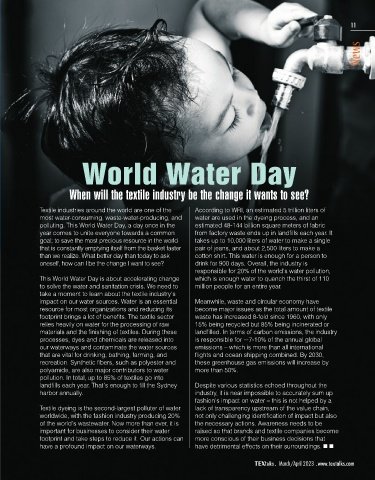
 staff are women with the power to influence sustainable cotton production.  When will the textile industry be the change it wants to see?
 • Pesticides – Reduce the use and risk of synthetic pesticides applied by Better Cotton farmers and workers by
 at least 50%.  Textile industries around the world are one of the   According to WRI, an estimated 5 trillion liters of
 • In the 2020-21 cotton season, Better Cotton and its network of field-level partners trained 2.9 million farmers   most water-consuming, waste-water-producing, and   water are used in the dyeing process, and an
 in 26 countries on more sustainable farming practices.  polluting. This World Water Day, a day once in the   estimated 48-144 billion square meters of fabric
              year comes to unite everyone towards a common    from factory waste ends up in landfills each year. It
              goal; to save the most precious resource in the world   takes up to 10,000 liters of water to make a single
              that is constantly emptying itself from the basket faster   pair of jeans, and about 2,500 liters to make a
              than we realize. What better day than today to ask   cotton shirt. This water is enough for a person to
              oneself, how can I be the change I want to see?  drink for 900 days. Overall, the industry is
 H&M promoting resale program  This World Water Day is about accelerating change   which is enough water to quench the thirst of 110
                                                               responsible for 20% of the world’s water pollution,

              to solve the water and sanitation crisis. We need to
                                                               million people for an entire year.
              take a moment to learn about the textile industry’s
              impact on our water sources. Water is an essential   Meanwhile, waste and circular economy have
 Fast-fashion retailer H&M has collaborated with ThredUp, an online consignment platform, a resale program to   resource for most organizations and reducing its   become major issues as the total amount of textile
 run their used clothing sales. ThredUp is already in partnership for this purpose with dozens of other brands   footprint brings a lot of benefits. The textile sector   waste has increased 8-fold since 1960, with only
 H&M is by far the largest retailer to work with ThredUp. A spokesperson of H&M said the brand has been   relies heavily on water for the processing of raw   15% being recycled but 85% being incinerated or
 working secondhand since 2015, and learned through this process. It was after this experience they decided to   materials and the finishing of textiles. During these   landfilled. In terms of carbon emissions, the industry
 make it user-friendly and easy to access."  processes, dyes and chemicals are released into   is responsible for ~7-10% of the annual global
              our waterways and contaminate the water sources   emissions – which is more than all international
 Initially, around 30,000 articles of clothing will be available on H&M’s resale site. Other clothing retailers,   that are vital for drinking, bathing, farming, and   flights and ocean shipping combined. By 2030,
 including Inditex's Zara and online fashion retailer SHEIN, have also launched resale marketplaces as shoppers   recreation. Synthetic fibers, such as polyester and   these greenhouse gas emissions will increase by
 express growing interest in sustainability initiatives. Brokerage Morningstar has estimated that the resale   polyamide, are also major contributors to water   more than 50%.
 market could grow to $300 billion by 2031.  pollution. In total, up to 85% of textiles go into
              landfills each year. That’s enough to fill the Sydney   Despite various statistics echoed throughout the
 H&M officials said that the resale of used clothing is a part of sustainable practices. Besides, it has launched   harbor annually.  industry, it is near impossible to accurately sum up
 denim clothing made with recycled materials which consumers are encouraged to buy.  fashion’s impact on water – this is not helped by a
 H&M was earlier accused of marketing its clothes as more eco-friendly which was partly true as the clothing   Textile dyeing is the second-largest polluter of water   lack of transparency upstream of the value chain,
 was not as eco-friendly as claimed by the brand. A lawsuit in this regard was filed against H&M in 2002. A   worldwide, with the fashion industry producing 20%   not only challenging identification of impact but also
 spokesman of the company conceded that after an investigation of irregularities most have been   of the world’s wastewater. Now more than ever, it is   the necessary actions. Awareness needs to be
 removed from its website.  important for businesses to consider their water   raised so that brands and textile companies become
              footprint and take steps to reduce it. Our actions can   more conscious of their business decisions that
              have a profound impact on our waterways.         have detrimental effects on their surroundings.

 March/April 2023                                                                        March/April 2023

