


Page 65 - May-June-2018
P. 65
Your way to
 Sustainability  Large amounts of non-renewable resources                           elasticity
 64


 A New Textiles Economy  are extracted to produce clothes that are often
             used for only a short period, after which the
             materials are largely lost to landfill or
             incineration. It is estimated that more than half
             of fast fashion produced is disposed of in
             under a year.
             This linear system leaves economic
             opportunities untapped, puts pressure on
             resources, pollutes and degrades the natural
             environment and its ecosystems, and creates
             significant negative societal impacts at local,
             regional, and global scales.

             Globally, customers miss out on USD 460
             billion of value each year by throwing away
             clothes that they could continue to wear, and
             some garments are estimated to be discarded
             after just seven to ten wears.
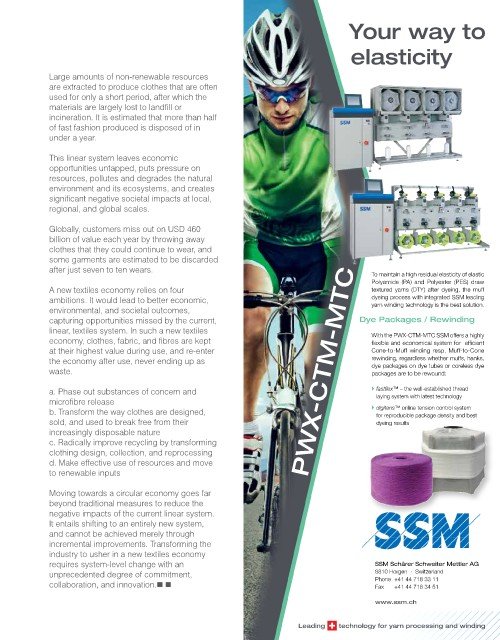
                                                                                         To maintain a high residual elasticity of elastic
                                                                                         Polyamide (PA) and Polyester (PES) draw
             A new textiles economy relies on four                                       textured yarns (DTY) after dyeing, the muff
             ambitions. It would lead to better economic,                                dyeing process with integrated SSM leading
                                                                                         yarn winding technology is the best solution.
             environmental, and societal outcomes,
             capturing opportunities missed by the current,                           Dye Packages / Rewinding
             linear, textiles system. In such a new textiles                             With the PWX-CTM-MTC SSM offers a highly
             economy, clothes, fabric, and fibres are kept                               flexible and economical system for  efficient
             at their highest value during use, and re-enter                             Cone-to-Muff winding resp. Muff-to-Cone
             the economy after use, never ending up as                                   rewinding, regardless whether muffs, hanks,
                                                                                         dye packages on dye tubes or coreless dye
             waste.                                                       PWX-CTM-MTC    packages are to be rewound:
             a. Phase out substances of concern and                                      ` fastflex™ – the well-established thread
                                                                                           laying system with latest technology
             microfibre release
             b. Transform the way clothes are designed,                                  ` digitens™ online tension control system
                                                                                          for reproducible package density and best
             sold, and used to break free from their                                      dyeing results
             increasingly disposable nature
             c. Radically improve recycling by transforming
             clothing design, collection, and reprocessing
             d. Make effective use of resources and move
             to renewable inputs

             Moving towards a circular economy goes far
             beyond traditional measures to reduce the
 Globally, the US$ 1.3 trillion clothing industry   middle-class population across the globe and   negative impacts of the current linear system.
 employs more than 300 million people along the   increased per capita sales in mature economies. The   It entails shifting to an entirely new system,
 value chain; the production of cotton alone accounts   latter rise is mainly due to the ‘fast fashion’   and cannot be achieved merely through
 for almost 7% of all employment in some low-income   phenomenon, with quicker turnaround of new styles,   incremental improvements. Transforming the
 countries. Clothing represents more than 60% of the   increased number of collections offered per year, and   industry to usher in a new textiles economy
 total textiles used and is expected to remain the   – often – lower prices.   requires system-level change with an   SSM Schärer Schweiter Mettler AG
 largest application.   unprecedented degree of commitment,                               8810 Horgen  ·  Switzerland
 The current system for producing, distributing, and   collaboration, and innovation.     Phone  +41 44 718 33 11
 In the last 15 years, clothing production has   using clothing operates in an almost completely   Hall 2 / Booth 052  Fax   +41 44 718 34 51
 approximately doubled, driven by a growing   linear way.                    (Makviz)     www.ssm.ch
 May/June 2018
                                                                        Leading    technology for yarn processing and winding

