


Page 126 - May-June-2019
P. 126
126                                                                                                                                                                                                                              127

                                                                Kornit Digital                                                         Oritain maps Supima cotton

                                                                                                                                          origin, tackling fraud in the
                                                                launches NeoPoly                                                          global cotton supply chain


                                                                technology


                                                                                                                                      Oritain has mapped all Supima cotton growing regions. Supima has addressed the problem of blending
                                                                                                                                     premium cotton with cheaper, head on by partnering with Oritain to protect the integrity of their high quality,
                                                                                                                                                                        extra-long staple cotton.
             Kornit Digital has released the new Kornit NeoPoly   prevents dye migration on polyester. The inks are
             Technology. It is the industry’s first digital, industrial   Oeko-Tex and Eco-Passport certified and do not             Using Oritain’s forensic technology, Supima licensees can test and authenticate the origin of their Supima
             process for high quality printing on polyester.  contain PVCs or other toxic ingredients.                               products at any stage in the supply chain, revealing if it has been blended or substituted and ensuring the
                                                                                                                                      product’s provenance. By testing the intrinsic natural properties of the cotton, Oritain identifies a unique
             The technological innovation is achieved by an   The first system equipped with the Kornit NeoPoly                    distinguishing fingerprint for each product verifying where it was grown. Unlike other traceability methods such
             innovative ink set and a physical and chemical   Technology is the new Kornit Avalanche Poly Pro, a                    as paper ledger systems, blockchain, RFID, barcodes, sprays, additives, or labels, this fingerprint cannot be
             process specifically developed for low temperature   member of Kornit’s industrial platform. The                        forged or altered and is unique to the land the cotton was grown on. Without the ability to authenticate the
             curing, and polyester enhancing functionalities   single-step Poly Pro is the perfect system for the                    underlying physical product throughout the supply chain no product claims can be effectively made. Oritain
             developed to maintain fabric characteristics and   industry, enabling easy and cost effective short-runs                enables brands and retailers to speak knowingly and knowledgeably about the authenticity of their product.
             provide superior fastness. This unique process   and on-demand printing on polyester garments.
                                                                                                                                     Mr Rupert Hodges, Executive Director, Oritain said, “Consumers are increasingly looking for guarantees of
                                                                                                                                    where their clothes are produced and that they are ethically made. Oritain’s partnership with Supima will allow
                                                                                                                                     brands to confidently reassure customers that their Supima product is made with 100% SUPIMA® cotton.”


                                                                   Biodegradable,


                                                                   sustainable                                                        Spider silk a Holy Grail to high tech textiles


                                                                   Lyocell fibers for                                              Biotechnology sounds like small universe within us. It is among the

                                                                                                                                   subjects like “never-stop-to-amuse-one” with successful unusual
                                                                                                                                   findings. Due  to  continuous biotechnological advancements,
                                                                   aquatic cultivation                                             laboratories like Polartec and Kraig Biocraft in their joint venture
                                                                                                                                   have been  able to develop  the  fabric that they  are going to
                                                                                                                                   commercialize  soon as first spider  silk  fabric. Since  2016 both
                                                                                                                                   laboratories have been trying to impart characteristics of spider silk
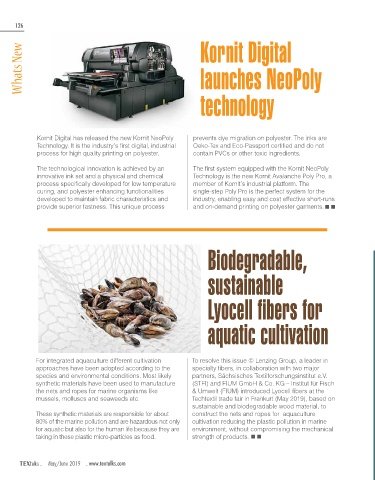
            For integrated aquaculture different cultivation   To resolve this issue © Lenzing Group, a leader in                            into yarn and their dream came true in 2019.
            approaches have been adopted according to the     specialty fibers, in collaboration with two major
            species and environmental conditions. Most likely   partners, Sächsisches Textilforschungsinstitut e.V.                Polactec expressed that “silk fabric  developed particularly  for
            synthetic materials have been used to manufacture   (STFI) and FIUM GmbH & Co. KG – Institut für Fisch                 military functions would be used as high performance textile”, the
            the nets and ropes for marine organisms like      & Umwelt (FIUM) introduced Lyocell fibers at the                     enhanced  physical attributes combined with  best handle and
            mussels, molluscs and seaweeds etc.               Techtextil trade fair in Frankurt (May 2019), based on               comfort properties due  to recombinant spider silk are truly
                                                              sustainable and biodegradable wood material, to                                         sensational for apparel.
            These synthetic materials are responsible for about   construct the nets and ropes for  aquaculture
            80% of the marine pollution and are hazardous not only   cultivation reducing the plastic pollution in marine          Spider silk represents a “Holy grail” of material science, is protein
            for aquatic but also for the human life because they are   environment, without compromising the mechanical            fiber that is biodegradable  and biocompatible  with super
            taking in these plastic micro-particles as food.   strength of products.                                               mechanical properties, flexibility, light weight, extensibility, ductility,
                                                                                                                                   resiliency and high strength to weight ratio.  It is comparable  to
                                                                                                                                                synthetic aromatic polyamide fibers.
                May/June 2019

