Page 71 - November-December-2017
P. 71

70                                                                                                             71

             Bolt Threads Engineered Silk™ fibres. The real
             spiders’ silk was studied to understand the
             relationship between the spiders’ DNA and the
             characteristics of the fibres they make. The
             technology allows to make those proteins without
             using spiders. Looking at the DNA of spiders, the
             company then creates sequences engineered for
             product performance. The whole process is                                                                                                                  process include Acrylic, Rayon, Aramid, and       performance and sustainability. It is possible to get
             informed by the understanding of how spiders                                                                                                               Spandex. The recipe for Engineered SilkTM is still   much better performance from textiles and garments
             make silks. The company is already actually                                                                                                                being refined. As the technology is scaled up, the   which are both softer and longer-lasting, and offer
             producing the Engineered Silk™ fibres at                                                                                                                   company commits to being completely transparent   better protection from a variety of elements.
             commercial scale, this is being done at a cost                                                                                                             about the process used to make the fibres. All of the   Unfortunately, it is no secret that the textile industry is
             that makes it viable for widespread use in                                                                                                                 production is currently in the United States and the   among the dirtiest industries on the planet:
             consumer products such as apparel. Looked                                                                                                                  plan is to keep it there. Making the products in the   According to the World Bank, 20% of water pollution
             under a microscope, Engineered Silk™ fibres                                                                                                                US, using domestically grown crops and            globally results from textile processing. Compare this
             have the exact same chemistry as naturally                                                                                                                 manufacturing resources, enables the company to   to polyesters which are made from petroleum.
             occurring animal silks from spiders or silk worms.                                                                                                         create jobs and also eliminate some of the        Currently, more than 60% of textiles are made of
                                                                                                                                                                        environmental impact of transportation.           polyester and other petroleum-derived fibres. The
                     Studied silk proteins found in nature to determine                                                                                                                                                   main input in the fibre-making process is sugar from
                     what gives them their incredible properties                                                                                                        The Engineered Silk™ fibres are made of           plants that are grown, harvested and replanted.
                                                                                                                                                                        protein—they contain no DNA and no genetically    Furthermore, the company is driven to produce
                                                                                                                                                                        modified organisms. The process by which the fibres   fabrics that can meet consumers’ needs while
                     Developed proteins inspired by these natural
                     silks by putting genes into yeast                                                                                                                  are made involves many steps. One step utilizes   minimizing impacts on the environment. However, the
                                                                                                                                                                        genetically engineered yeast. This step takes place in   life cycle analysis of the product is not yet reported.
                                                                                                                                                                        a closed loop process in a sterile facility, at the end of
                     Produced the protein in large quantities through                                                                                                   which the yeast is destroyed by heat. This is the   Natural silk is a wonderful, versatile fabric. It’s soft
                     fermentation, using yeast, sugar and water
                                                                                                                                                                        same process that is used to make most of the     and breathable and remarkably warm. Woven
                                                                                                                                                                        cheese, along with insulin and many other drugs. The   silk—think pyjamas and silky dresses—is very
                     Spun the silk protein into fibres                                                                                                                  technology has been in use for decades: It was    different from a silk knit, which was the original
                                                                                                                                                                        approved for making insulin and vaccines in the   technical base layer. Silk has fallen out of favour for
 Spinning the Future of High   Conversion of these fibers into fabrics and                                                                                              1990. There are concerns about GMO crops and      Fabrics from Engineered SilkTM claim to combine the
                                                                                                                                                                        1980s and has been used in cheese-making since
                                                                                                                                                                                                                          everyday wear because it is not an easy-care fabric.
                                                                                                                                                                        GMOs in food. It’s important to thoroughly examine
                                                                                                                                                                                                                          best qualities of silk, but will look and feel quite
                     garments
                                                                                                                                                                                                                          different from traditional silk, and also be easier to
                                                                                                                                                                        these technologies and balance reasonable
 Performance Fabrics  Production                                                                                                                                        concerns with the potential for doing good.       wash and wear.
             The primary ingredients are sugar, water, salts
                                                                                                                                                                        The process used to modify yeast has been in
                                                                                                                                                                                                                          It is pertinent to mention that creating synthetic silk is
             and yeast. In summary, yeast produces silk
 Mimicking the Spider Silk  protein in a liquid form during fermentation. After                                                                                         widespread use for decades, and the company claim   not the only option. For example, Kraig Labs invented
                                                                                                                                                                                                                          a new technology and acquired the exclusive right to
                                                                                                                                                                        that they are confident that it poses no harm.
             some processing, the liquid silk protein can be
                                                                                                                                                                        Currently, all large fermentation facilities in the US
                                                                                                                                                                                                                          use the patented genetic sequences for numerous
             turned into fibre through wet spinning. Wet
                                                                                                                                                                                                                          fundamental spider silk proteins. The company
                                                                                                                                                                        use corn sugar from genetically modified corn, so
             spinning is required for polymers that require
             dissolving in a solvent to be spun. It is named wet                                                                                                        that’s what Bolt Threads are using. The company   employed its proprietary genetic engineering spider
 Spiders produce silk fibres with remarkable   Bolt Threads claims to develop technology to   spinning because the fibres are extruded directly                         states that in the future, large-scale fermentation can be   silk technology to an organism which is already one
                                                                                                                                                                                                                          of the most efficient commercial producers of silk:
                                                                                                                                                                        done with non-food crops known as cellulosic feedstocks.
 properties including high tensile strength, elasticity,   replicate this amazing process sustainably at large   into a liquid bath. Being extruded into a liquid                                                         The domesticated silkworm. This is a developing
 durability and softness. Researchers have gone   scale. Bolt Threads is a venture backed, idea driven   provides a greater drag force on the filament than             Need of the new material                          area and we will keep our readers abreast of the
 through a menagerie of host organisms searching   company, led by world-class scientific and   those extruded directly into air, therefore the                         Bolt Threads identifies two key reasons are       future developments.
 for the secret to spider silk production. They’ve tried   engineering talent, as well as experienced executives   speeds at which this occurs is reduced from that
 using goats, modified silkworms, and   from the technology and apparel industries. Bolt   of melt and dry spinning. Once evaporated these
 microorganisms such as Salmonella and E. coli. And   Threads is a team of eighty people with robust   fibres then have to be drawn or stretched in order
 some of them did make silk. But no one ever   technology and It all started back when the   to orient the polymers to give the fibre its strength.
 achieved the holy grail of spider silk fibres: making   co-founders Dan, David, and Ethan met in 2009.  Wet spinning is based on precipitation, where a
 sufficient quantities at a price reasonable enough to   polymer is drawn through a spinneret into a
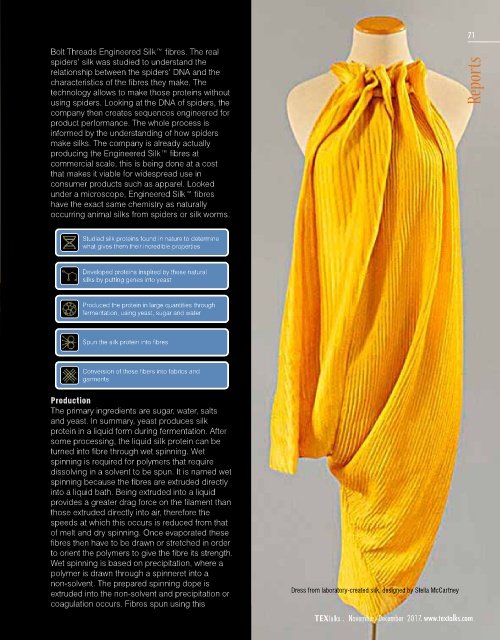
 sell commercially.   There are no spiders involved at all in the making of   non-solvent. The prepared spinning dope is   Dress from laboratory-created silk, designed by Stella McCartney
             extruded into the non-solvent and precipitation or
             coagulation occurs. Fibres spun using this
 November/December  2017                                                           November/December  2017
   66   67   68   69   70   71   72   73   74   75   76