


Page 77 - November-December-2017
P. 77
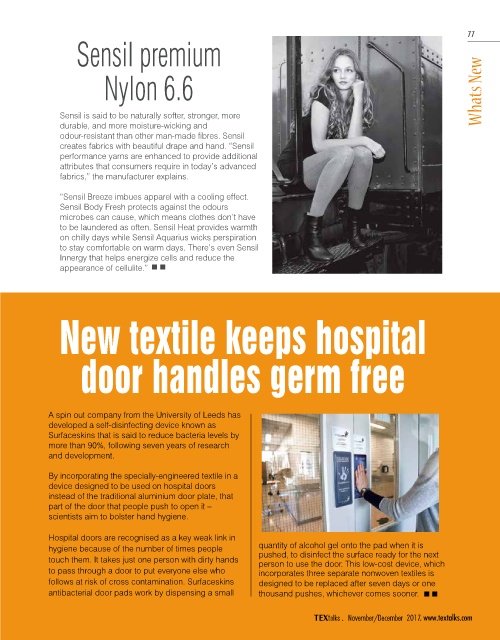
76                                                                                                             77
 Polish researchers develop layered   Sensil premium


 textile solutions for premature infants  Nylon 6.6


               Sensil is said to be naturally softer, stronger, more
               durable, and more moisture-wicking and
               odour-resistant than other man-made fibres. Sensil
               creates fabrics with beautiful drape and hand. “Sensil
               performance yarns are enhanced to provide additional
               attributes that consumers require in today’s advanced
               fabrics,” the manufacturer explains.

               “Sensil Breeze imbues apparel with a cooling effect.
               Sensil Body Fresh protects against the odours
               microbes can cause, which means clothes don’t have
               to be laundered as often. Sensil Heat provides warmth
               on chilly days while Sensil Aquarius wicks perspiration
               to stay comfortable on warm days. There’s even Sensil
               Innergy that helps energize cells and reduce the
               appearance of cellulite.”
 A team of researchers from Poland’s Lodz University   24 weeks gestational age, a baby's total body water
 of Technology (LUT) is working to develop innovative   content is close to 80% of total body weight. This
 textile clothing for premature infants that is to protect   slowly decreases until the child is around one year of
 them against dehydration and ensure thermal   age, when total body water content is about 60% of
 stability through special layered textile systems.  total body weight,” the study says. “After birth, infants
 are expected to lose approximately 5%-15% of their
 “The overall objective of the project is to develop   New textile keeps hospital
 innovative solutions for the construction of clothing   body weight, with more being lost in low birth weight
 products for prematurely born infants. These new   infants.” “The cotton knitwear that is currently used
 products should reduce dehydration due to   [to protect such infants] causes thermal discomfort
 evaporation, and, at the same time, provide thermal   because the water that is absorbed from an infant’s   door handles germ free
 comfort,”. “Total body water content changes   body and its surrounding evaporates, and, as a
 drastically from before birth until one year of age. At   result, it reduces its body temperature,”.

            A spin out company from the University of Leeds has
            developed a self-disinfecting device known as
 Teijin develops   The cooling vest is said to effectively reduce body   Surfaceskins that is said to reduce bacteria levels by
 temperature and heart rate through sweat absorption,
            more than 90%, following seven years of research
 cooling vest   quick drying and moisture permeability. The electric   and development.
 fans pull in outside air for up to eight hours.
 Conventional flame-retardant protective clothing for
 for firefighters  firefighters tends to trap body heat, raising the risk of   By incorporating the specially-engineered textile in a
            device designed to be used on hospital doors
 heat stroke, particularly in the summer. The cooling
            instead of the traditional aluminium door plate, that
 vest helps firefighters maintain performance and
 energy levels while fighting fires, as well as benefit   part of the door that people push to open it –
 from high levels of comfort and flexibility,” the   scientists aim to bolster hand hygiene.
 company explains.
            Hospital doors are recognised as a key weak link in
 The outermost of three fabric layers is made with   hygiene because of the number of times people   quantity of alcohol gel onto the pad when it is
 Teijin’s Teijinconex, a heat-resistant, flame-retardant      pushed, to disinfect the surface ready for the next
 meta-aramid fibre. The middle and innermost layers   touch them. It takes just one person with dirty hands   person to use the door. This low-cost device, which
 are made with high-functional polyester fabrics for   to pass through a door to put everyone else who   incorporates three separate nonwoven textiles is
 sweat absorption, quick drying and moisture   follows at risk of cross contamination. Surfaceskins   designed to be replaced after seven days or one
 permeability.  antibacterial door pads work by dispensing a small   thousand pushes, whichever comes sooner.

 November/December  2017                                                           November/December  2017

