


Page 16 - November-December-2020
P. 16
16                                                                                                                                                                                                                             17
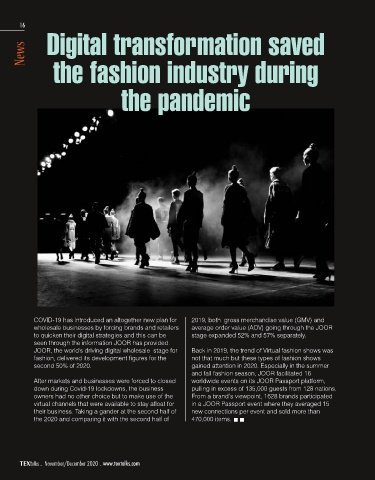
                Digital transformation saved


                  the fashion industry during


                                       the pandemic


                                                                                                                                     COVID-19 pandemic has affected


                                                                                                                                                 the global cotton trends


                                                                                                                                    Cotton is one of the most significant            the previous season. However, world cotton
                                                                                                                                    poverty-alleviating crops in the world. Approximately   consumption is estimated to have fallen sharply by
                                                                                                                                    150 million people around the globe rely on it for   12,7% in 2019/20. "This unprecedented decrease
                                                                                                                                    some, if not all, of their income. According to Kai   was driven by the rapidly developing impact of
                                                                                                                                    Hughes, executive director at the International Cotton   Covid-19 and the lockdown measures implemented
                                                                                                                                    Advisory Committee (ICAC), cotton provides a lifeline   by countries around the world to try to stop the
                                                                                                                                    in developing countries as it can grow where other   spread of the virus," explained Hughes.
                                                                                                                                    plants often cannot and it can be stored without the
                                                                                                                                    risk of deterioration. During a webinar he elaborated   China and India dominate cotton consumption,
                                                                                                                                    on the effect Covid-19 has on global cotton trends.  consuming little over half of the world’s cotton.
                                                                                                                                                                                     Consumption of the commodity is expected to
                                                                                                                                    Covid-19 has reminded us all how fragile our     recover by 7,2% in 2021 to approximately 24,3 million
                                                                                                                                    environment is. This is an important factor to   tonnes, but only if projected global economic growth
            COVID-19 has introduced an altogether new plan for   2019, both  gross merchandise value (GMV) and                      consider because unlike its synthetic competitors,   materialises and economic activity increases. "This is
            wholesale businesses by forcing brands and retailers   average order value (AOV) going through the JOOR                 cotton does not pollute water and air with trillions of   only likely to take effect when a vaccine against
            to quicken their digital strategies and this can be   stage expanded 52% and 57% separately.                            microplastics every year.                        Covid-19 can be distributed and applied on a global
            seen through the information JOOR has provided.                                                                                                                          scale," he said.
            JOOR, the world's driving digital wholesale  stage for   Back in 2019, the trend of Virtual fashion shows was           Covid-19’s effect on global cotton production and
            fashion, delivered its development figures for the   not that much but these types of fashion shows                     demand:                                          While Covid-19 and its effects cause devastation, it is
            second 50% of 2020.                              gained attention in 2020. Especially in the summer                     In 2019/20 global production increased by nearly 2%   not the first financial crisis the cotton industry has
                                                             and fall fashion season, JOOR facilitated 16                           to 26,2 million tonnes, which made it the        experienced within the past two decades. In previous
            After markets and businesses were forced to closed   worldwide events on its JOOR Passport platform,                    second-largest production year in the last five years.   years whenever the industry encountered financial
            down during Covid-19 lockdowns, the business     pulling in excess of 135,000 guests from 128 nations.                  India was the largest producer in 2019/20 with 6,2   difficulty, cotton consumption recovered.
            owners had no other choice but to make use of the   From a brand’s viewpoint, 1628 brands participated                  million tonnes, followed by China, the United States
            virtual channels that were available to stay afloat for   in a JOOR Passport event where they averaged 15               (US), Brazil and Pakistan. Those top five producing   This time, however, we predict that the recovery will
            their business. Taking a gander at the second half of   new connections per event and sold more than                    countries accounted for nearly 80% of the total world   take many months to normalise and it will be highly
            the 2020 and comparing it with the second half of   470,000 items.                                                      production.                                      dependent on the release of a vaccine. "We should
                                                                                                                                                                                     start putting together strategies that will affect an
                                                                                                                                    The cotton production forecast for 2021 is projected   increase in the demand for cotton," concluded
                                                                                                                                    at 25,1 million tonnes, which is a 4,2% decrease from   Hughes.

               November/December 2020                                                                                                                                                                    November/December 2020

