


Page 77 - TEXtalks November/December 2021
P. 77
76                                                                                                             77
 The SmartTex shirt for astronaut’s   James Heal introduces new


 vital functions monitoring  HydroView hydrostatic head tester


 In cooperation with DSI Aerospace Technology, the
 German Aerospace Centre (DLR) has developed a
 new SmarTex Shirt that will use integrated sensors to
 transfer physiological data from astronauts to Earth via
 a wireless communication network. SmartTex will be
 tested as part of the Wireless Compose-2 (WICO2)
 project. The SmartTex shirt is intended to provide a
 continuous picture of the vital functions of astronauts,
 which will be particularly relevant for future long-term
 human-crewed space missions to the Moon and Mars.
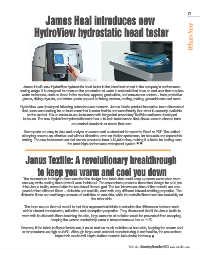
 Future transfer of the SmartTex technology to fitness   James Heal’s new HydroView hydrostatic head tester is the latest instrument in the company’s performance
 and telemedicine applications is expected.   testing range. It is designed to measure the penetration of water in materials that have an end-user that requires
              water resistance, such as those in the medical, apparel, geotextiles, and nonwovens sectors – from protective
 During the BEAT experiment (Ballistocardiography for   gloves, diving drysuits, and winter sports apparel to fishing waders, roofing, tenting, groundsheets and more.
 Extraterrestrial Applications and long-Term missions),
 Maurer will be the first astronaut to wear a T-shirt   HydroView was developed following extensive user research. James Heal’s product innovation team discovered
 equipped with sensors that measure his ballistocardiography data, such as pulse and relative blood   that users were looking for an instrument that is more flexible and user-friendly than what is currently available
 pressure. For this purpose, the sensors were calibrated in the envihab research facility at the DLR   on the market. It is an easier-to-use instrument with integrated proprietary TestWise software developed
 Institute of Aerospace Medicine in Cologne.   in-house. The new HydroView hydrostatic tester has a 10-inch touchscreen that allows users to choose from
                                           pre-loaded standards or create their own.
 In a typical SmarTex Shirt, the wireless communication network reads sensor data and can determine
 the position of people and objects in space by propagation times of radio pulses. It is also available as a   Test reports are easy to view and analyze on-screen and customized for export to Excel or PDF. The vertical
 platform for several experiments on the ISS. The data is temporarily stored within the network and read   clamping ensures an effective seal without distortion, even on thicker specimens, for accurate and repeatable
 out at regular intervals by the astronauts. It can give them indications regarding their vital signs and   testing. The new instrument can test across pressures from 0-10,000 mbar, making it suitable for testing even
 could be beneficial.                    the most high-performance waterproof system.


                Janus Textile: A revolutionary breakthrough
 Michelman's Unyte: A new surface modification solution for technical textiles


 Michelman (Cincinnati, Ohio, U.S.) announced a new   adhesion, and heat solutions provide heat resistance.   to keep you warm and cool you down
 surface modification solution that helps improve   Glide increases lubricity and slip and facilitates tow
 technical textiles' performance and functional   spreading of fibers in technical textile production.   The researchers in Belgium have unveiled the design for a fabric that could keep a person warm when worn
 behavior in applications including construction, ballistic,   Unyte Grip promotes the adhesion between fibers   one way while cooling them down if worn inside out. The researchers present a theoretical design for a 20 µm
 medical and hygiene, automotive, filtration media,   and polymeric matrices, helping to improve various   thick Janus textile, named after the two-faced Roman god. The two interwoven sides of the material are com-
 prepreg, and consumer products. Unyte is Michelman's   functional or mechanical properties. Unyte Slip helps   posed of two different fibers – dielectric and metallic, each with very different infrared-emitting properties. The
 versatile family of water-based technologies that help   prevent fabrics, nonwovens, and prepregs that need   dielectric fibers can emit large amounts of radiation on one side, while the metallic fibers have low emissivity on
 achieve advanced form and function in woven and   to be stacked or rolled without sticking together.   the other side.
 nonwoven materials used to design technical textiles
 and prepreg fabrics. These solutions enhance textile   Unyte Resist products are designed to provide   The team used a thermal model to test their asymmetrical fabric to calculate the differences between each
 products' performance, Michelman says, by   excellent wet-out and moisture/chemical resistance to   side’s infrared transmission, reflection, and absorption properties. They discovered that if the Janus textile is
 improving adhesion, binding, slip, processability, and   fabrics, wovens, and nonwovens. Unyte Print boosts   worn with its dielectric fibers touching the skin, large amounts of radiation could be prevented from escaping,
 chemical and heat resistance.   ink adhesion for improved print receptivity and   keeping the wearer comfortably warm in temperatures as low as 11°C.
 minimal color bleed. Fabrics that are over-printed for
 The Unyte family includes Unyte Bind, Unyte Heat,   decoration and branding; or identification codes   However, if the fabric is flipped inside-out, it could emit as much radiation as bare skin, keeping the wearer cool
 Unyte Glide, Unyte Grip, Unyte Slide, Unyte Print, and   where legibility is essential can benefit from these   in temperatures as high as 24°C. Although large-scale material manufacturing is not feasible, the researchers
 Unyte Resist. The Bind improves fiber-to-fiber   solutions.  hope their results will inspire further research into similar fabrics.

 November/December 2021                                                             November/December 2021

