


Page 11 - TEXtalks. November-December 2022
P. 11
10                                                                                                             11
 EU inaction on energy issue


 eroded competitiveness of EU                                  The 17th


 textile value chain


 After the European Council summit proposed measures to tackle the energy crisis, the European textiles   ITMF
 industry has expressed concerns on the loss of competitiveness of Europe demanding earliest action to save
 the industry. The major factor in the sharp decline in the competitiveness of European textiles is energy cost.  survey reports

 The energy cost in Europe is 6 times higher than the United States and China. Other textile economies also   atrocious business
 have access to cheap energy. This is the reason that most of the European textile companies still in operation
 are incurring losses while most have closed. The textile and clothing sector of Europe is still operating because   situation globally
 of its sense of responsibility towards European Society.

 While other economies like China, India and the US tackled the energy issue proactively the EU acted passively
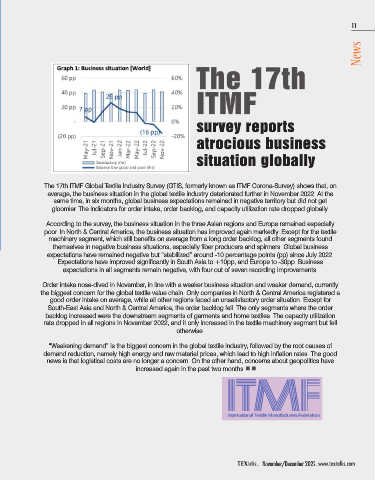
 and slowly in responding to the crisis. The Biden administration for instance came up with the 369-billion-dollar   The 17th ITMF Global Textile Industry Survey (GTIS, formerly known as ITMF Corona-Survey) shows that, on
 scheme of the Inflation Reduction Act.  average, the business situation in the global textile industry deteriorated further in November 2022. At the
                  same time, in six months, global business expectations remained in negative territory but did not get
 If the status quo is maintained, not only the EU will not be able to recover its competitive position on the global   gloomier. The indicators for order intake, order backlog, and capacity utilization rate dropped globally.
 business stage, but it will also fail its plans to reach zero-net emissions, achieve circularity and its sustainable
 objectives for the coming years.   According to the survey, the business situation in the three Asian regions and Europe remained especially
               poor. In North & Central America, the business situation has improved again markedly. Except for the textile
                machinery segment, which still benefits on average from a long order backlog, all other segments found
                 themselves in negative business situations, especially fiber producers and spinners. Global business
                expectations have remained negative but “stabilized” around -10 percentage points (pp) since July 2022.
                   Expectations have improved significantly in South Asia to +10pp, and Europe to -30pp. Business
 Textile and apparel in the US face   Order intake nose-dived in November, in line with a weaker business situation and weaker demand, currently
                     expectations in all segments remain negative, with four out of seven recording improvements.


 the highest import tariffs  the biggest concern for the global textile value chain. Only companies in North & Central America registered a
                good order intake on average, while all other regions faced an unsatisfactory order situation. Except for
                South-East Asia and North & Central America, the order backlog fell. The only segments where the order
               backlog increased were the downstream segments of garments and home textiles. The capacity utilization
               rate dropped in all regions in November 2022, and it only increased in the textile machinery segment but fell
 The new measures introduced by the U.S. Customs and Border Protection in fiscal year 2022 were tough in   otherwise.
 some cases to enforce trade laws and regulations governing textiles and apparel including tariffs collected,
 commercial fraud penalties, non-IPR seizures, but soft liquidated damages claims and audits completed.  “Weakening demand” is the biggest concern in the global textile industry, followed by the root causes of
              demand reduction, namely high energy and raw material prices, which lead to high inflation rates. The good
 The US Custom imposes one of the highest import tariffs on textile and apparel that are also subjected to   news is that logistical costs are no longer a concern. On the other hand, concerns about geopolitics have
 additional tariff under Section 301if imported from China.  Importers try many ways to bypass these tariffs that   increased again in the past two months.
 include under-invoicing, or false marking and labeling, wrong claims of origin, illegal transshipment, and false
 declarations of the right to make entry, wrong trade preference claims, and smuggling.

 Section 301 duties collected in the 4th quarter of 2002 stood at $953 million against $813 million in 3Q of the
 same year and $697 in the 4Q of 2021. Non-IPR seizure numbers were 379 in 4Q of 2022, 488 in 3Q of
 2022 and only 106 in 4Q of 2021.   Non-IPR seizure value was $6.99 million, $9.9 million and $1.2 million
 respectively. In 4Q of 2022 IPR seizure numbered 1,072 valuing $13.58 million, in 3Q of same year the number
 of seizures was 1149 and the value was $15.8 million. In the 4Q of 2021 the number of seizures were 1125
 valuing $21.7 million.


 November/December 2022                                                            November/December 2022

