


Page 11 - TEXtalks. November- December 2023
P. 11
10                                                                                                             11
 BCI is introducing methods to reduce


 the use of pesticides to reduce   Slight capacity growth and


 environmental impact and cost     higher fiber consumption: ITMF’s


 Better Cotton has developed a new framework to reduce the use of synthetic pesticides in cotton farming,   global textile industry statistics
 which, besides offering environmental benefits, is also expected to help farmers reduce input
 costs and increase profits.

 The new integrated pest management (IPM) approach has been designed to emphasize the growth of a
 healthy crop with the least possible disruption to agricultural ecosystems. To increase the awareness and
 adoption of IPM practices among farmers over time, Better Cotton Initiative requires producers to develop an
 IPM strategy under the principles and criteria (P&C) – our farm-level standard. The revised version of BCI, P&C,
 published earlier this year, emphasizes IPM as the basis of crop protection.

 The new framework will also support cotton farmers, associations, extension agents, and organizations working
 to foster better farming practices in their Better Cotton programs.

 Strengthening of IPM is being developed by Pesticide Action Network UK. It will identify strengths and
 weaknesses in current IPM practice and plan activities to promote techniques and increase their adoption. It
 will also monitor the uptake and efficiency of IPM practice adoption and implementation and provide a
 common understanding of best practices and means of improvement.

 When pest numbers are high enough that control measures are necessary, non-chemical methods such as
 biopesticides or traps are the first choice, with conventional pesticides as a last resort.


 EU’s Q3 imports fall 18.5% by


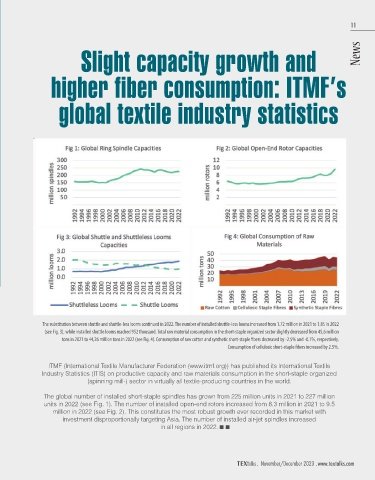
 value & 17.7% by volume  The substitution between shuttle and shuttle-less looms continued in 2022. The number of installed shuttle-less looms increased from 1.72 million in 2021 to 1.85 in 2022
               (see Fig. 3), while installed shuttle looms reached 952 thousand. Total raw material consumption in the short-staple organized sector slightly decreased from 45,6 million
                     tons in 2021 to 44,26 million tons in 2022 (see Fig. 4). Consumption of raw cotton and synthetic short-staple  bers decreased by -2.5% and -0.7%, respectively.
                                                                         Consumption of cellulosic short-staple  bers increased by 2.5%.
 Between July and September 2023, the EU’s clothing imports continued to fall, with a decline of 18.5 percent
 year on year by value and a drop of 17.7 percent from a year ago by volume. In the third quarter of the current   ITMF (International Textile Manufacturer Federation (www.itmf.org)) has published its International Textile
 year, the EU’s clothing imports from Turkey decreased 25.8 percent year over year by volume, mainly impacted   Industry Statistics (ITIS) on productive capacity and raw materials consumption in the short-staple organized
 by the rebound of the lira exchange rate.  (spinning mill-) sector in virtually all textile-producing countries in the world.

 In the quarter under review, imports from China slipped 17.9 percent by volume and 24 percent by value, while   The global number of installed short-staple spindles has grown from 225 million units in 2021 to 227 million
 those from Bangladesh slipped 16 and 22 percent by volume and value, respectively. In the third quarter, the   units in 2022 (see Fig. 1). The number of installed open-end rotors increased from 8.3 million in 2021 to 9.5
 unit price of Turkish garment imports fell 8.4 percent year over year in Euro terms, while those in China and   million in 2022 (see Fig. 2). This constitutes the most robust growth ever recorded in this market with
 Bangladesh dipped 14.4 and 14 percent in Euros.  investment disproportionally targeting Asia. The number of installed air-jet spindles increased
                                                    in all regions in 2022.
 Although China’s market share has decreased, China was still the largest source of supply for EU apparel in
 the third quarter, with Bangladesh ranking second.

 November/December 2023                                                            November/December 2023

