


Page 79 - TEXtalks. November- December 2023
P. 79
A durable water repellent   A high-precision
 78                                                                                                              79


 for polyester and blends   process removes the


                 need for expensive


             and time-consuming


                                   formwork


             Within the Airlements project, researchers at ETH Zurich in Switzerland have been using 3D printing to produce
              sustainable insulation elements for buildings – even those with complex shapes. The high-precision printing
              process generates less waste and removes the need for expensive and time-consuming formwork, and ETH
              spin-off FenX produced the mineral foam employed. It is based on industrial waste and is fully recyclable. The
                   foam has already gone through the first material cycle and can be recycled after use and reused.

              With 3D printing, the formwork needed for pouring material – which is very time-consuming and can only be
             partially reused afterward – is no longer required. Excessive wastage is a particular challenge when producing
             more complex geometrical shapes. Without automation, traditional construction methods that save on materials
                                  are time-consuming and expensive, mainly due to labor costs.
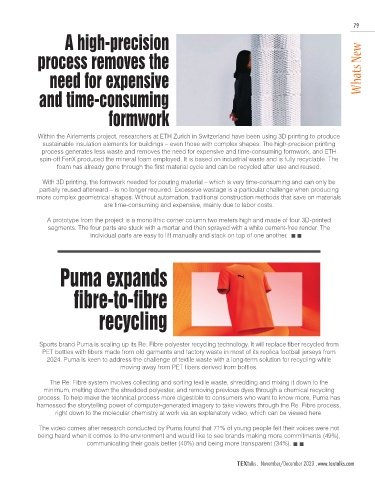
                A prototype from the project is a monolithic corner column two meters high and made of four 3D-printed
                segments. The four parts are stuck with a mortar and then sprayed with a white cement-free render. The
                              individual parts are easy to lift manually and stack on top of one another.


                    Puma expands


                        fibre-to-fibre


                                recycling


             Sports brand Puma is scaling up its Re: Fibre polyester recycling technology. It will replace fiber recycled from
 Pulcra Chemicals and its subsidiary Devan Chemicals are launching Devan Repel as a new range of   PET bottles with fibers made from old garments and factory waste in most of its replica football jerseys from
 water-repellency fabric treatments. The first product in the range, Devan Repel One, is a durable water   2024. Puma is keen to address the challenge of textile waste with a long-term solution for recycling while
 repellent for polyester and blends said to provide high water repellency performance with the versatility to   moving away from PET fibers derived from bottles.
 be applied to a wide range of materials, with excellent results on polyester and its blends. It is also
 accessible from perfluorinated compounds (PFCs) and isocyanates and is long-lasting.  The Re: Fibre system involves collecting and sorting textile waste, shredding and mixing it down to the
               minimum, melting down the shredded polyester, and removing previous dyes through a chemical recycling
 Durability and long-lasting performance can be further boosted with the new Devan Extender Gen3,   process. To help make the technical process more digestible to consumers who want to know more, Puma has
 which is free of Isocyanate, Butanone-oxime, and 2-dimethylpyrazole.  harnessed the storytelling power of computer-generated imagery to take viewers through the Re: Fibre process,
                  right down to the molecular chemistry at work via an explanatory video, which can be viewed here.
 “This collaboration underscores our shared commitment to delivering value to our customers,” said
 Thomas Bremer, global head of the textile business at Pulcra and managing director of Devan.   The video comes after research conducted by Puma found that 71% of young people felt their voices were not
 “Combining Pulcra’s extensive chemical expertise with Devan’s textile technology know-how, we are   being heard when it comes to the environment and would like to see brands making more commitments (49%),
 excited to bring a new high-performing and cost-effective product to the market.”  communicating their goals better (40%) and being more transparent (34%).


 November/December 2023                                                            November/December 2023

