


Page 46 - October-November-2017
P. 46
46                                                                                                                                                                                                                             47


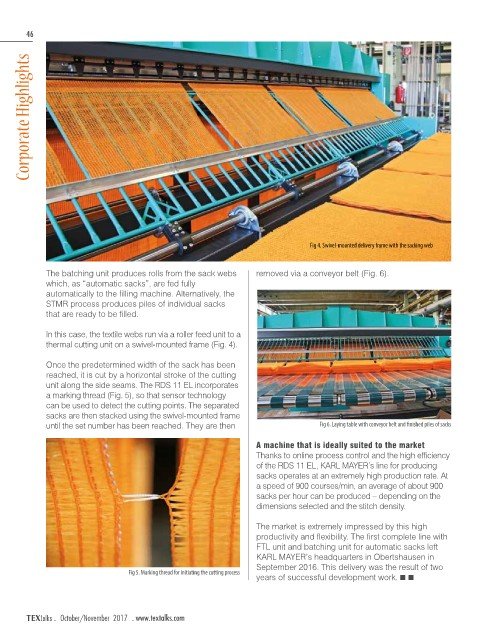
                                                                          Fig 4. Swivel-mounted delivery frame with the sacking web


            The batching unit produces rolls from the sack webs   removed via a conveyor belt (Fig. 6).
 elements comprising two compound needle bars,   unlike its predecessor, the RSD 11 EL has been   which, as “automatic sacks”, are fed fully
 two knock-over comb bars, four ground guide bars   equipped with a new feature, the EL pattern   automatically to the filling machine. Alternatively, the
 and seven pattern bars. With this configuration, the   drive (Fig. 3).   STMR process produces piles of individual sacks
 RDS 11 EL works a combination of a pillar stitch and   that are ready to be filled.
 weft lapping. Two separate webs are produced, one
 by ground guide bars, GB 4 and GB 5, on the rear   In this case, the textile webs run via a roller feed unit to a
 needle bar and one by GB 7 and GB 8 on the front   thermal cutting unit on a swivel-mounted frame (Fig. 4).
 needle bar. The two mesh webs are joined together
 on one side in the working direction by pattern bar,   Once the predetermined width of the sack has been
 PB 6. The seam forms the base of the packaging   reached, it is cut by a horizontal stroke of the cutting
 sack. The opposite side is open to enable the sack to   unit along the side seams. The RDS 11 EL incorporates
 be filled. The openings in the horizontal direction are   a marking thread (Fig. 5), so that sensor technology
 also closed, by changing the lapping, to produce the   can be used to detect the cutting points. The separated
 side seams of the sack.
            sacks are then stacked using the swivel-mounted frame
            until the set number has been reached. They are then             Fig 6. Laying table with conveyor belt and  nished piles of sacks
 KARL MAYER has revamped its machine technology   monoaxial flat film yarns. These yarns are delivered to   The EL facility produces customised sacks
 for producing packaging sacks. As before, this fully   the Double-bar raschel machine, in depending of the   The RDS 11 EL offers a number of options for the   A machine that is ideally suited to the market
 integrated system enables ready-to-use, high-quality   demand. The needs-based delivery of the tape yarns   efficient production of ready-to-use sacks, including   Thanks to online process control and the high efficiency
 products to be manufactured non-stop from film at   is a decisive factor for online process control, just as   the incorporation of sealing tapes, flaps for automatic   of the RDS 11 EL, KARL MAYER’s line for producing
 maximum efficiency. What is new, however, is the   is the exact harmonisation of the machine technology   filling, an adhesive strip for the subsequent   This electronic system replaces the old, mechanical   sacks operates at an extremely high production rate. At
 machine’s level of flexibility. As the most important   as a whole (Fig. 1). “With this non-stop sequence,   application of labels, and contact yarns for   NNC type. It does not use pattern chains or discs   a speed of 900 courses/min, an average of about 900
 element, the double-bar raschel machine has been   everything must function perfectly and all the   subsequent process control. Above all, the   and enables the pattern to be changed easily. The   sacks per hour can be produced – depending on the
 equipped with an EL pattern drive, which enables   components have to be in perfect harmony, rather   dimensions of the product can be varied. For   repeat lengths can also be changed easily to adjust   dimensions selected and the stitch density.
 variable sack lengths and lappings to be worked.   like an orchestra,” says Rainer Baier, a product   example, the opening widths of the nets can be   the size of the sacks. The RDS 11 EL has also been
 developer, at the machine presentation.   varied via the stitch density, i.e. via the take-down,   newly equipped with the tried-and-tested   The market is extremely impressed by this high
 Five blades per inch produce tape yarns from film  and by the lapping. The depth of the sack can also   KAMCOS®-system, so that its extensive potential   productivity and flexibility. The first complete line with
 An FTL unit is located at the beginning of the   A tried-and-tested basic design  be changed via the threading arrangement of the   can be easily exploited.   FTL unit and batching unit for automatic sacks left
 processing chain for producing sacks. This element    An RDS 11 EL is used to knit (Fig. 2) the tape yarns   guide bars as a function of the number of webs   KARL MAYER’s headquarters in Obertshausen in
 in the production line has a cutting bar for cutting a   to produce complete sacks. The machine is supplied   produced in parallel. The width of the sacks can   Stacks or rolls – both types of take-up are possible  September 2016. This delivery was the result of two
 double-layered, primary polyolefin film into tape yams   with a width of 193", a gauge of E 6, a threading   also be varied as required. The width is determined   Two systems are available for taking-up the   Fig 5. Marking thread for initiating the cutting process  years of successful development work.
 and drawing them in a heating zone to produce   arrangement of 1 in, 2 out, and a set of warp knitting   by the repeat length, which can be freely selected   warp-knitted sacks, i.e. the 26/6 batching unit and
 and changed easily. The reason for this is that,   the STMR sack separating machine.

               October/November  2017                                                                                                                                                                     October/November  2017

